SEBI CSCRF: The Ultimate Guide for SEBI-Regulated Entities
Cyber threats are rising, and SEBI’s Cybersecurity and Cyber Resilience Framework (CSCRF) sets strict mandates to protect financial entities. With a March 31, 2025 deadline, firms must act now to avoid penalties and disruptions. This guide breaks down CSCRF requirements, compliance strategies, and automation solutions to keep your organization secure and audit-ready. Stay ahead of cyber risks with a proactive approach.
Cyber threats are increasing in scale and sophistication, putting financial institutions at heightened risk.
SEBI’s Cybersecurity and Cyber Resilience Framework (CSCRF) is a direct response to this growing challenge. It establishes strict cybersecurity standards for all SEBI-regulated entities (REs) to protect India’s financial ecosystem from cyberattacks, data breaches, and operational disruptions.
CSCRF supersedes previous SEBI cybersecurity guidelines and introduces a unified, standardized approach to cyber risk management. It mandates continuous monitoring, proactive threat management, and structured response protocols to ensure financial market stability.
With an extended compliance deadline of March 31, 2025, organizations must act now to align their cybersecurity frameworks with CSCRF’s stringent requirements.
This guide provides adetailed breakdown of CSCRF, helping regulated entities understand all they need to know about this regulatory framework.
Read on to ensure your organization is fully prepared for SEBI’s cybersecurity mandate.
Who Needs to Comply with SEBI CSCRF?
The Cybersecurity and Cyber Resilience Framework (CSCRF) applies to all SEBI-regulated entities (REs), ensuring uniform cybersecurity standards across India’s financial sector. Any entity operating under SEBI’s jurisdiction must comply with these requirements, regardless of size or complexity.
Regulated Entities Covered Under CSCRF
CSCRF is applicable to a wide range of financial market participants, classified into different categories based on their role, client base, trading volume, and assets under management. The entities required to comply include:
1. Market Infrastructure Institutions (MIIs)
Stock Exchanges
Clearing Corporations
Depositories
2. Market Intermediaries
Stock Brokers
Depository Participants
3. Investment & Fund Management Entities
Mutual Funds (MFs) and Asset Management Companies (AMCs)
Alternative Investment Funds (AIFs)
Portfolio Managers
Collective Investment Schemes (CIS)
Venture Capital Funds (VCFs)
4. Regulatory and Compliance Service Providers
KYC Registration Agencies (KRAs)
Credit Rating Agencies (CRAs)
Registrar to an Issue and Share Transfer Agents (RTAs)
5. Banking and Custodian Services
Bankers to an Issue (BTI) and Self-Certified Syndicate Banks (SCSBs)
Custodians
Debenture Trustees (DTs)
6. Other Market Participants
Investment Advisors (IAs) and Research Analysts (RAs)
Merchant Bankers
Categorization for Compliance
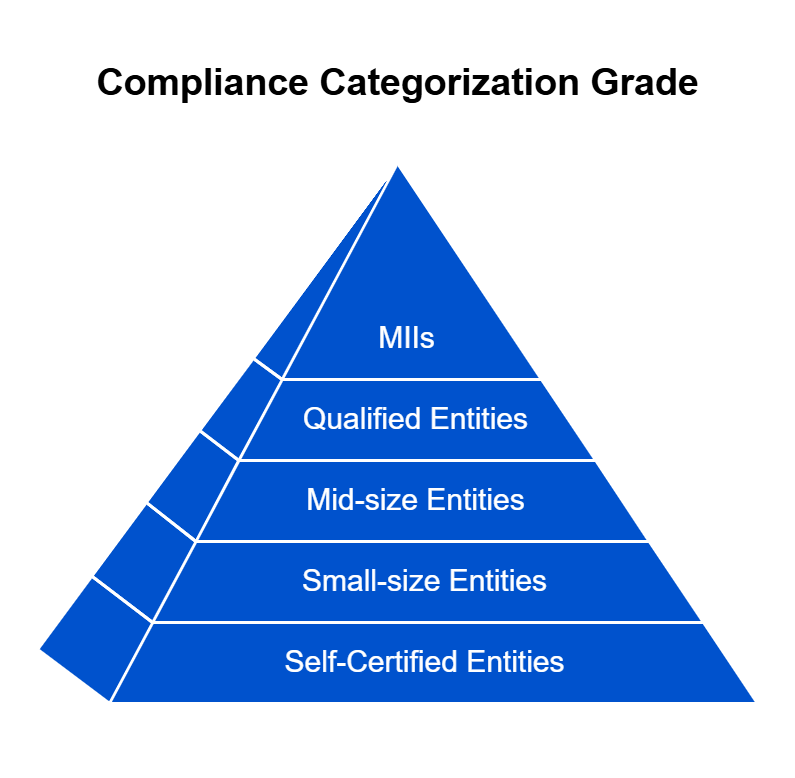
SEBI has introduced a graded approach to compliance, classifying entities into five categories based on their operational scale and cyber risk exposure:
Market Infrastructure Institutions (MIIs) – The most critical entities, requiring the highest level of cybersecurity.
Qualified Regulated Entities – Large entities with significant market impact.
Mid-size Regulated Entities – Entities with moderate operations and cybersecurity risks.
Self-Certified Regulated Entities – Entities with minimal impact, allowed a self-certification model.
Compliance Timeline
January 1, 2025 – Mandatory compliance for entities that were already subject to SEBI’s previous cybersecurity guidelines.
April 1, 2025 – New entities covered under CSCRF for the first time must comply by this date.
Why Compliance is Critical
Failure to comply with CSCRF could result in:
Regulatory penalties and enforcement actions by SEBI.
Increased vulnerability to cyber threats and financial fraud.
Operational disruptions and reputational damage.
All SEBI-regulated entities must urgently implement CSCRF to protect their business, clients, and the broader financial market.
Key Goals and Functions of SEBI CSCRF
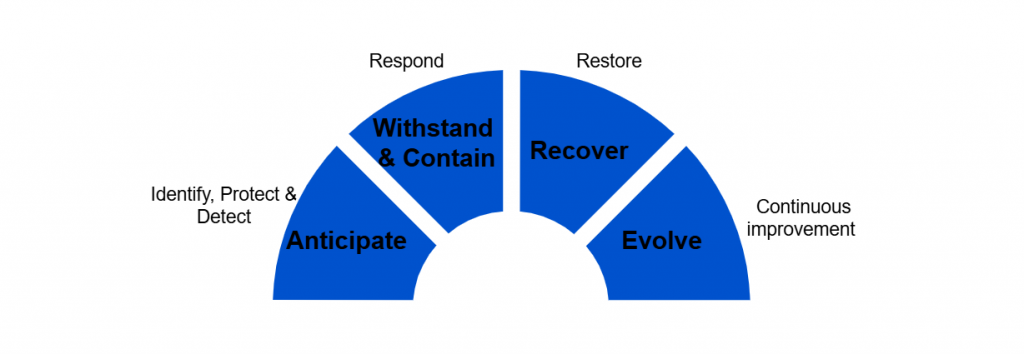
The Cybersecurity and Cyber Resilience Framework (CSCRF) is built on five cyber resilience goals that help SEBI-regulated entities (REs) proactively defend, withstand, contain, and recover from cyber threats. These goals are supported by specific cybersecurity functions, ensuring a structured approach to security management.
1. Anticipate: Proactive Risk Identification
Entities must identify cyber risks in advance and put preventive measures in place to reduce the likelihood of an attack. This goal is achieved through the following cybersecurity functions:
a. Governance: Establishing Strong Cyber Oversight
Board-approved cybersecurity policies and risk management frameworks must be in place.
Entities must define clear roles and responsibilities for cybersecurity teams.
Implementation of the Cyber Capability Index (CCI) to measure and improve security maturity.
b. Identify: Risk & Asset Management
Critical IT systems must be classified, and risk assessments must be conducted periodically.
Entities must maintain an inventory of digital assets and data flows to identify vulnerabilities.
Adoption of post-quantum risk assessment measures to prepare for future threats.
c. Protect: Preventing Cyber Threats
Multi-factor authentication (MFA) and access controls must be implemented to prevent unauthorized access.
Network segmentation, encryption, and endpoint security solutions must be deployed.
Periodic Vulnerability Assessment and Penetration Testing (VAPT) must be conducted to detect security gaps.
d. Detect: Early Identification of Cyber Threats
Security Operations Centers (SOCs) must be established for real-time monitoring of security events.
Threat intelligence systems must be implemented to detect anomalies and cyber threats.
Market SOCs, mandated for smaller REs, must ensure all entities have access to security monitoring.
2. Withstand & Contain: Responding to Cyber Incidents
Despite preventive measures, cyberattacks may still occur. CSCRF ensures entities can mitigate the impact and continue critical operations through the Respond function:
Respond: Incident Handling & Crisis Management
All cybersecurity incidents must be reported through SEBI’s incident reporting portal.
Entities must develop a Cyber Crisis Management Plan (CCMP) for rapid response.
Root Cause Analysis (RCA) and forensic investigations must be conducted after incidents.
Automated incident containment mechanisms should be in place to isolate affected systems.
3. Recover: Restoring Business Operations
After a cyber incident, organizations must restore normal operations quickly with minimal disruption. This is addressed through the Recover function:
Recover: Business Continuity & Disaster Recovery
Entities must have documented recovery plans to restore critical systems efficiently.
Backup strategies and failover mechanisms must be in place to protect against data loss.
Recovery activities must be coordinated with key stakeholders, ensuring transparent communication.
Lessons learned from incidents must be incorporated into future security strategies.
4. Evolve: Continuous Cybersecurity Improvement
Security is not static. Entities must continuously enhance cybersecurity strategies to stay ahead of evolving threats. CSCRF mandates:
Ongoing security audits and compliance reporting to SEBI.
Integration of new security technologies, such as quantum-resistant cryptography.
Regular training and awareness programs for employees, stakeholders, and IT teams.
Key Compliance Requirements of SEBI CSCRF
SEBI’s Cybersecurity and Cyber Resilience Framework (CSCRF) mandates a structured and rigorous approach to cybersecurity compliance for all SEBI-regulated entities (REs). The framework establishes minimum security standards that organizations must follow to protect against cyber threats, ensure business continuity, and enhance overall market stability.
All REs must set up Security Operations Centers (SOCs) for real-time monitoring of security incidents.
Market Infrastructure Institutions (MIIs) and large REs must have dedicated in-house or group SOCs, while smaller REs can use Market SOCs managed by NSE/BSE.
The effectiveness of the SOC must be evaluated periodically, with reports submitted to SEBI.
REs must conduct VAPT after every major software release or system upgrade.
Testing must be performed by CERT-In empaneled auditors, ensuring comprehensive vulnerability identification.
Critical vulnerabilities must be fixed within three months, with a follow-up validation test within five months.
3. Cyber Capability Index (CCI) Implementation
MIIs and Qualified REs must measure cybersecurity maturity using the Cyber Capability Index (CCI).
MIIs must undergo third-party CCI assessments every six months, while Qualified REs must conduct annual self-assessments.
The index helps SEBI track cybersecurity improvements across regulated entities.
4. Strengthening Access Controls & Data Protection
Implementation of multi-factor authentication (MFA) and least privilege access for all critical systems.
Network segmentation to restrict unauthorized access to sensitive data.
Encryption of data at rest and in transit, along with full-disk encryption for endpoint security.
5. Incident Response & Reporting to SEBI
REs must report cybersecurity incidents through SEBI’s incident reporting portal in a timely manner.
A Cyber Crisis Management Plan (CCMP) must be in place, detailing response strategies for various attack scenarios.
Root Cause Analysis (RCA) and forensic investigations must be conducted for major security breaches.
6. Ensuring Compliance with Global Security Standards
CSCRF aligns with internationally recognized security frameworks, including:
ISO 27001 certification (mandatory for MIIs and Qualified REs).
NIST 800-53 and CIS v8 guidelines for security best practices.
CERT-In advisories for real-time threat mitigation.
7. Mandatory Audits & Compliance Reporting
REs must conduct periodic cybersecurity audits to assess compliance with CSCRF.
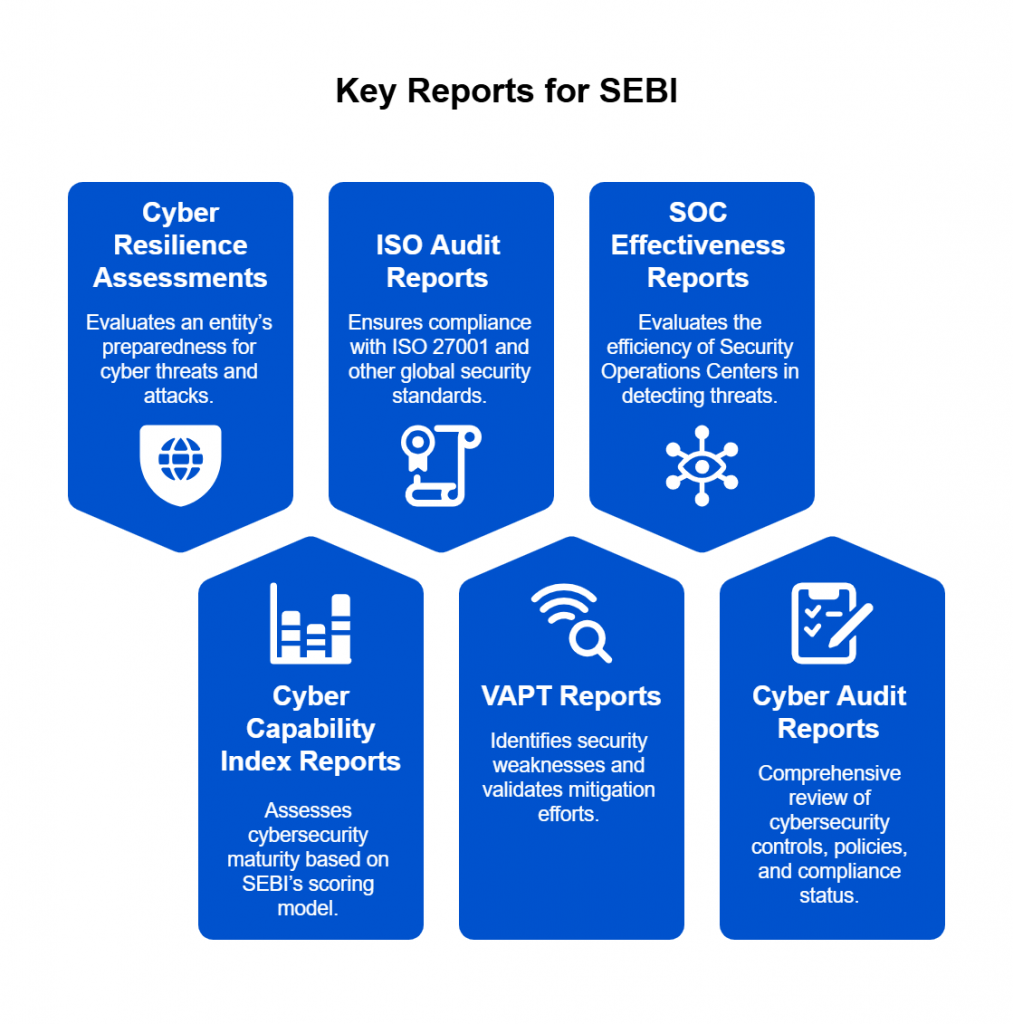
Reports required for SEBI submission include:
Cyber Resilience Assessments
ISO Audit Reports
VAPT Reports
SOC Effectiveness Reports
Cyber Capability Index (CCI) Reports
Failure to comply may result in regulatory action, penalties, or restrictions on market operations.
Key Reports to be Submitted to SEBI
CSCRF mandates regulated entities to submit the following reports within specified timelines:
Report Type
Purpose
Who Must Submit?
Submission Frequency
Cyber Resilience Assessments
Evaluates an entity’s preparedness for cyber threats and attacks.
All REs
Annual
Cyber Capability Index (CCI) Reports
Assesses cybersecurity maturity based on SEBI’s scoring model.
MIIs and Qualified REs
Half-yearly for MIIs, annually for Qualified REs
ISO Audit Reports
Ensures compliance with ISO 27001 and other global security standards.
MIIs and Qualified REs
Annual
Vulnerability Assessment and Penetration Testing (VAPT) Reports
Identifies security weaknesses and validates mitigation efforts.
All REs
After every major software update & at least once a year
SOC Effectiveness Reports
Evaluates the efficiency of Security Operations Centers (SOCs) in detecting threats.
All REs
Annual
Cyber Audit Reports
Comprehensive review of cybersecurity controls, policies, and compliance status.
All REs
Annual
How to Accelerate CSCRF Implementation
SEBI’s Cybersecurity and Cyber Resilience Framework (CSCRF) introduces a complex set of requirements that demand continuous monitoring, real-time reporting, and structured cybersecurity governance.
For many organizations, achieving compliance isn’t just about ticking boxes—it’s about embedding security into daily operations without overwhelming teams with manual processes.
This is where automation changes the game.
Instead of chasing compliance as a periodic exercise, organizations can integrate it into their existing security infrastructure, allowing technology to handle repetitive tasks, surface insights, and ensure ongoing adherence to SEBI’s mandates.
Moving Beyond Manual Compliance
Most SEBI-regulated entities already have security measures in place—firewalls, endpoint protection, SIEM systems. But compliance demands more than just security controls.
It requires structured evidence collection, audit trails, and real-time visibility into security risks. Doing this manually is not just inefficient; it increases the risk of errors, delays, and regulatory penalties.
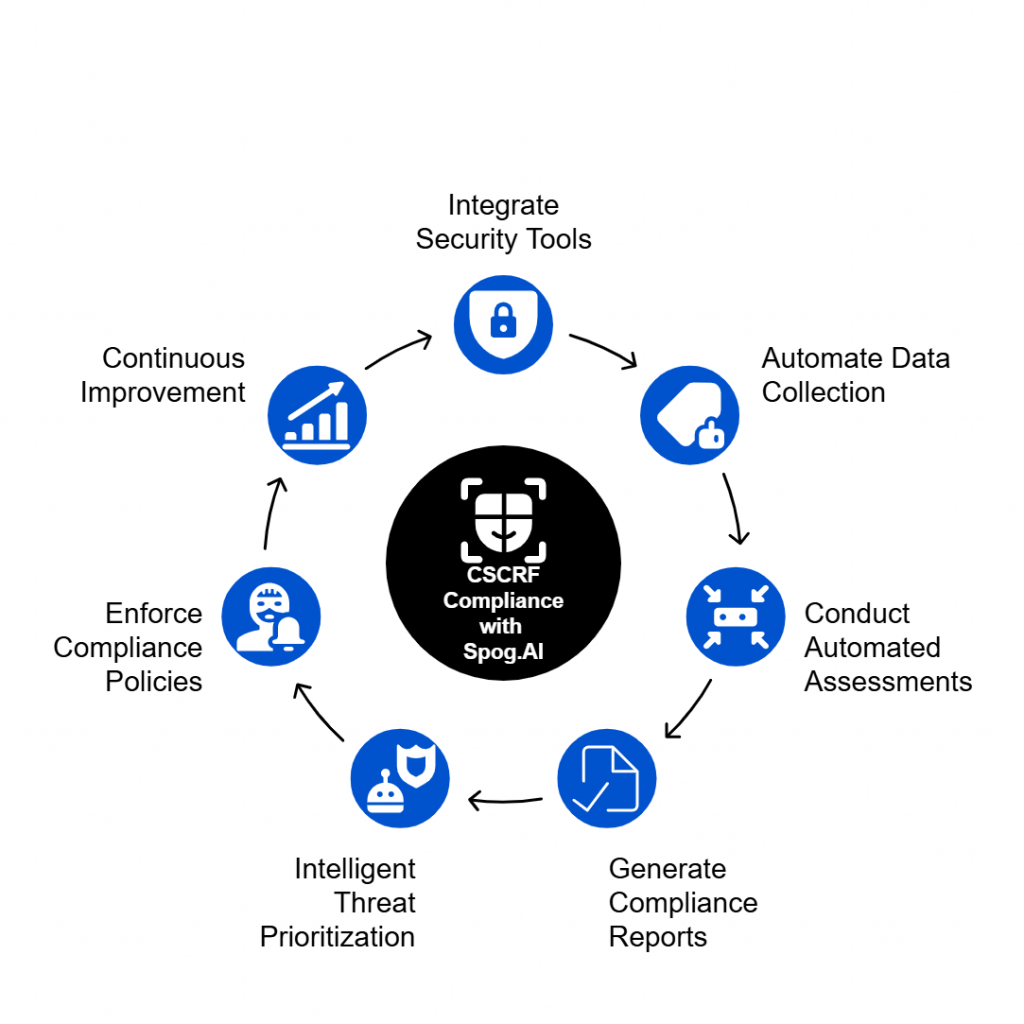
Automation removes this burden by:
Integrating with existing security tools to pull compliance data in real time.
Mapping security controls to CSCRF requirements, so organizations always know where they stand.
Reducing audit fatigue by generating reports that meet SEBI’s documentation standards without last-minute scrambling.
Security Operations Centers (SOC) That Work Smarter
SEBI requires entities to maintain a Security Operations Center (SOC) for real-time threat detection. Large institutions might have the resources for an in-house SOC, but smaller firms often rely on Market SOCs managed by stock exchanges like NSE and BSE.
Regardless of the setup, automation helps by:
Prioritizing threats intelligently—not all security alerts are critical, and automation ensures teams focus on what truly matters.
Enforcing compliance policies automatically—ensuring that security controls remain active and aligned with CSCRF guidelines.
Coordinating incident response—when an attack happens, automated workflows ensure a structured and immediate reaction.
Turning Compliance Into a Continuous Process
One of CSCRF’s most challenging aspects is that compliance is not static. SEBI expects organizations to regularly conduct Vulnerability Assessments and Penetration Testing (VAPT), Cyber Capability Index (CCI) evaluations, and resilience audits. Manually keeping up with these assessments leads to delays and inefficiencies.
By leveraging automation, organizations can:
Schedule and execute VAPT tests without human intervention, ensuring vulnerabilities are identified and patched proactively.
Automate Cyber Capability Index (CCI) reporting, providing clear insights into security maturity levels.
Maintain an always-updated compliance dashboard, so teams aren’t reacting at the last minute when reports are due.
Bridging the Gap Between Security and Compliance
A major challenge in regulatory compliance is the disconnect between security teams managing risks and compliance teams handling regulatory reporting. Automation bridges this gap by:
Providing a unified view of security and compliance posture, eliminating silos.
Reducing reliance on manual evidence collection, ensuring auditors have instant access to required documentation.
Aligning incident response efforts with compliance mandates, so organizations don’t just react to threats but also ensure regulatory adherence.
The Path Forward
For SEBI-regulated entities, CSCRF compliance isn’t just about avoiding penalties—it’s about strengthening cybersecurity posture in an increasingly volatile threat landscape. Automation isn’t a luxury; it’s an enabler. It ensures compliance isn’t a periodic headache but an integrated, ongoing process that evolves with the organization’s security needs.
Organizations that embrace automation will not only meet SEBI’s requirements faster but also build a more resilient security framework—one that is proactive, adaptive, and ready for the future.
SPOG.AI is built to automate, streamline, and simplify compliance by integrating seamlessly with your existing security and risk management systems. Instead of manually tracking compliance across fragmented frameworks, SPOG.AI does the heavy lifting by:
Continuously monitoring your compliance status across SEBI’s mandated security controls.
Automating evidence collection by pulling data directly from on-premises and cloud security tools.
Generating audit-ready reports in SEBI-compliant formats, ensuring submissions are accurate and on time.
Integrating with Security Operations Centers (SOCs) to provide real-time insights into security threats and compliance risks.
Mapping security controls to multiple compliance frameworks, reducing redundancy and effort across overlapping regulations.
With SPOG.AI, organizations can transform CSCRF compliance from a reactive, manual process into an automated, proactive strategy. By leveraging AI-driven insights, real-time monitoring, and automated reporting, SEBI-regulated entities can not only achieve compliance faster but also strengthen their cybersecurity defenses—ensuring they are resilient against evolving threats.
With SPOG.AI, you move beyond reactive checklists to a proactive, automated, and intelligent approach that keeps you secure, audit-ready, and always ahead of the curve. The future of compliance isn’t waiting—why should you?