Continuous Control Monitoring
Security Questionnaires: Respond with Accurate, Verifiable Answers
Security questionnaires help buyers understand how a supplier protects the data, systems and services involved in a proposed...
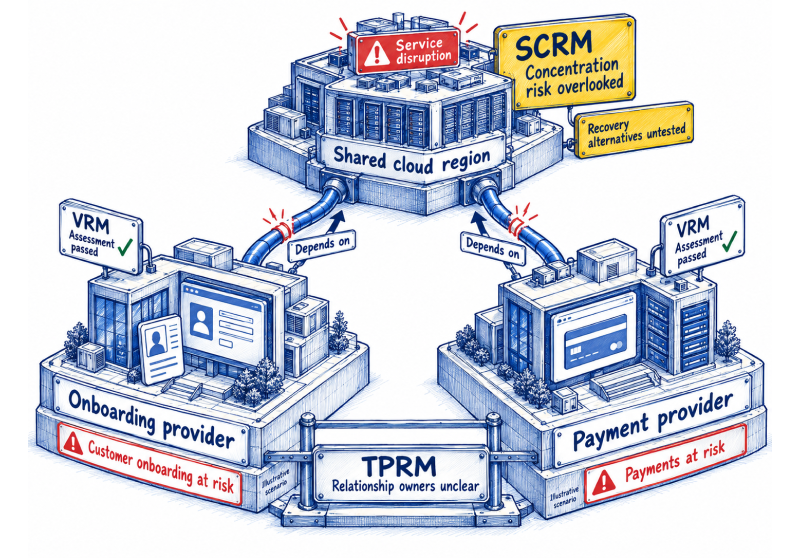
A security incident at a critical technology provider disrupts a bank’s digital services, despite the provider passing its security assessment. Was the vendor adequately evaluated, the relationship properly governed, and the wider technology dependency understood?
Vendor Risk Management (VRM), Third-Party Risk Management (TPRM), and Supply Chain Risk Management (SCRM) examine these questions from different perspectives. Their responsibilities overlap, but distinguishing them helps enterprises identify risks that conventional vendor assessments may miss.
VRM evaluates risks associated with individual vendors providing goods or services. It examines whether suppliers meet business, security, contractual, and performance expectations throughout the relationship.
Vendors range from SaaS platforms and consultants to hardware suppliers and outsourced service providers. Depending on the engagement, risks include data exposure, security weaknesses, financial instability, and service failures. VRM activities typically include vendor classification, due diligence, contractual safeguards, periodic reviews, and offboarding.
Assessment depth should match business impact. A payroll processor handling sensitive employee records warrants closer scrutiny than a furniture supplier with no access to enterprise systems.
TPRM addresses risks arising from external relationships, including vendors, contractors, service providers, and business partners. Its focus extends to entities that access information, connect to systems, or support essential business processes, even outside conventional procurement arrangements.
TPRM includes relationship inventories, inherent-risk classification, due diligence, contractual controls, ongoing monitoring, incident coordination, exceptions, and exit planning. For example, an API-connected partner may access customer information without being classified internally as a traditional vendor; the relationship still requires proportionate oversight.
VRM and TPRM often overlap. Some organizations treat VRM as part of TPRM; others use the terms interchangeably. There is no universal organizational hierarchy. What matters is whether every material external relationship has an accountable owner, suitable controls, and appropriate monitoring.
SCRM manages risks across the network of suppliers, technology components, processes, and dependencies supporting business operations. It extends beyond direct contracts to upstream providers, subcontractors, development tools, infrastructure, and logistics networks.
SCRM addresses supplier concentration, geopolitical disruption, financial instability, continuity, and product integrity. Cybersecurity supply chain risks include compromised software updates, vulnerable third-party libraries, tampered components, and malicious code introduced through development or delivery processes.
A software vendor may pass due diligence while relying on a vulnerable component or a single upstream hosting provider. SCRM assesses how such dependencies could compromise service integrity or continuity, whether alternative suppliers exist, and how disruption would propagate. It is not simply a subset of TPRM because it also addresses product integrity and non-cyber supply disruptions.
| Dimension | VRM | TPRM | SCRM |
|---|---|---|---|
| Focus | Individual vendors | External relationships | Extended delivery chain |
| Key risk | Vendor security or performance | Enterprise exposure through third parties | Upstream integrity, concentration, disruption |
| Activities | Due diligence, contracts, reviews | Tiering, ownership, monitoring | Dependency mapping, resilience, contingency |
| Example | Payroll provider assessment | API partner oversight | Shared cloud or software dependency |
These views are complementary. A vendor may meet contractual security requirements while a shared upstream dependency exposes multiple critical services. VRM evaluates the provider, TPRM governs the relationship, and SCRM reveals the wider failure path.
A fourth party is generally an entity used by a direct third party to deliver services. A contracted SaaS provider, for example, may rely on another company for hosting or identity verification. The enterprise might have no direct contract with that subcontractor but could still experience a data breach or service outage if it fails.
TPRM can establish subcontractor notification and oversight requirements; SCRM evaluates dependency concentration and disruption pathways. The priority is identifying fourth parties that materially affect sensitive information or critical services.
Consider a bank using an outsourced digital onboarding platform that processes identity documents and connects to banking systems. The platform uses cloud infrastructure and another provider for identity verification.
Passing an onboarding questionnaire is not proof of continuing resilience. Decision-makers must know which business services depend on external entities, how incidents could spread, and who can authorize a response.
A coordinated approach reduces duplicated assessments while improving accountability:
When exposure exceeds approved tolerance, the authorized risk owner or governance body should evaluate treatment and any temporary exception. Record the rationale, compensating safeguards, accountability, and review date. Risk acceptance does not eliminate exposure or automatically return it within tolerance. Regulated organizations should also apply the relevant outsourcing, privacy, cybersecurity, and resilience obligations in their jurisdictions.
Fragmented supplier inventories, outdated assessments, limited visibility into subcontractors, and unclear ownership make external risk difficult to assess consistently. A vendor can change infrastructure, increase data access, or suffer a control failure after approval. Periodic questionnaires alone may not detect those changes.
Another common blind spot is shared dependencies: two apparently independent providers may rely on the same cloud region or software component. An incident there can affect multiple business services simultaneously. Linking suppliers to critical services, reviewing material changes, and testing controls makes oversight more meaningful than relying on vendor counts or assessment completion rates.
SPOG.AI connects security and IT signals with asset information, business context, and control evidence through its Unified Risk and Exposure Management approach. External relationships can introduce exposure through connected applications, privileged access, misconfigurations, and dependencies in the organization’s technology environment.
SPOG.AI helps teams contextualize technical findings, monitor supported controls, and prioritize material exposures affecting assets and services. Where relevant evidence is available, those insights can inform TPRM and SCRM reviews and flag changed risk conditions. They complement rather than replace supplier due diligence, contractual oversight, or comprehensive upstream dependency mapping.
Strengthen risk visibility and control assurance. Book a Demo.
VRM evaluates individual providers, TPRM governs broader external relationships, and SCRM examines interconnected delivery dependencies. Their scopes overlap, but together they reveal risks that any single assessment may miss. Connecting ownership, dependency visibility, reliable control evidence, and event-driven monitoring helps organizations make more defensible decisions and strengthen operational resilience.


Security questionnaires help buyers understand how a supplier protects the data, systems and services involved in a proposed...

A vendor cybersecurity inquiry should establish what the supplier will do, which data and systems it can access,...

A vendor management policy sets the rules for approving suppliers, accepting exceptions and responding when relationships change. This...