How to Roll Out Enterprise GRC: Prove the Model Before You Scale
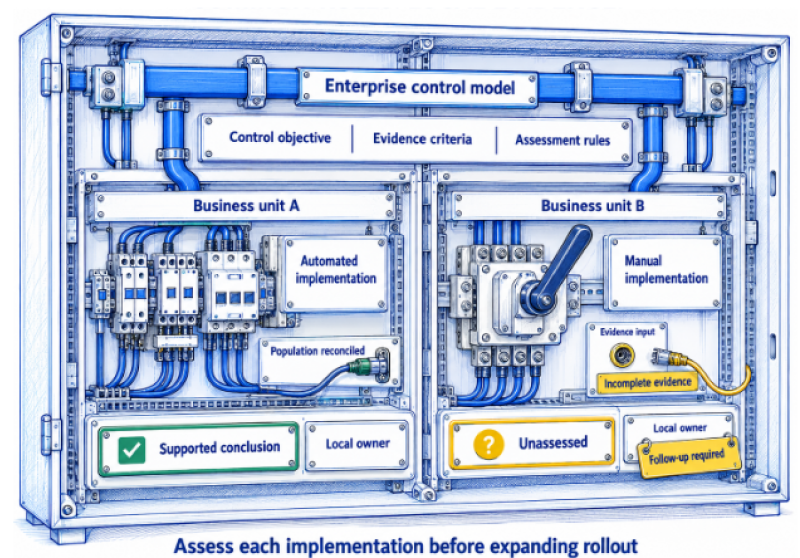
Enterprise GRC needs consistent assessments across business units while preserving local responsibilities and obligations. Establish clear ownership, reliable evidence and a complete pilot control cycle before expanding, so each rollout wave supports traceable decisions and verified action.
This is the central challenge of enterprise GRC implementation. Teams need a common way to evaluate controls while retaining the differences that affect their conclusions: systems in scope, local obligations, evidence quality, control ownership, and unresolved exposure.
A successful rollout establishes those connections before expanding them. Its measure of progress is whether leaders can trace a material gap to the affected service, the evidence supporting the assessment, the accountable owner, and the decision required.
Agree on decision rights before configuring workflows
Enterprise governance, risk, and compliance needs an executive sponsor with authority to resolve cross-functional disputes and secure operating capacity. A platform administrator cannot settle disagreements about risk ownership, funding, or regulatory interpretation.
Define who sets enterprise standards, who operates controls, who challenges assessments, and who can authorize risk decisions.
Responsibility
Enterprise role
Business unit or service role
Control model
Maintain definitions, assessment rules, and reporting conventions
Identify implementation and document variations
Scope
Set inclusion and inventory rules
Confirm services, assets, accounts, and dependencies
Operation
Define expected outcomes and minimum requirements
Operate controls and address failures
Evidence
Define acceptance criteria and safeguards
Supply evidence and explain limitations
Risk decisions
Set authority and escalation rules
Assess impact and refer to authorized risk owners
Assurance
Coordinate oversight and independent review
Support assessment and retain decision history
Assign named owners. A department name is insufficient when an overdue decision requires escalation. Keep control operation, oversight, and independent assurance clear. Management owns and manages risk; specialist roles support, monitor, and challenge; internal audit provides independent assurance without assuming management responsibility. The arrangement should reflect the enterprise’s circumstances.
The rollout charter should identify who can pause expansion when evidence quality or operating capacity is inadequate.
Standardize the control model and preserve local implementation
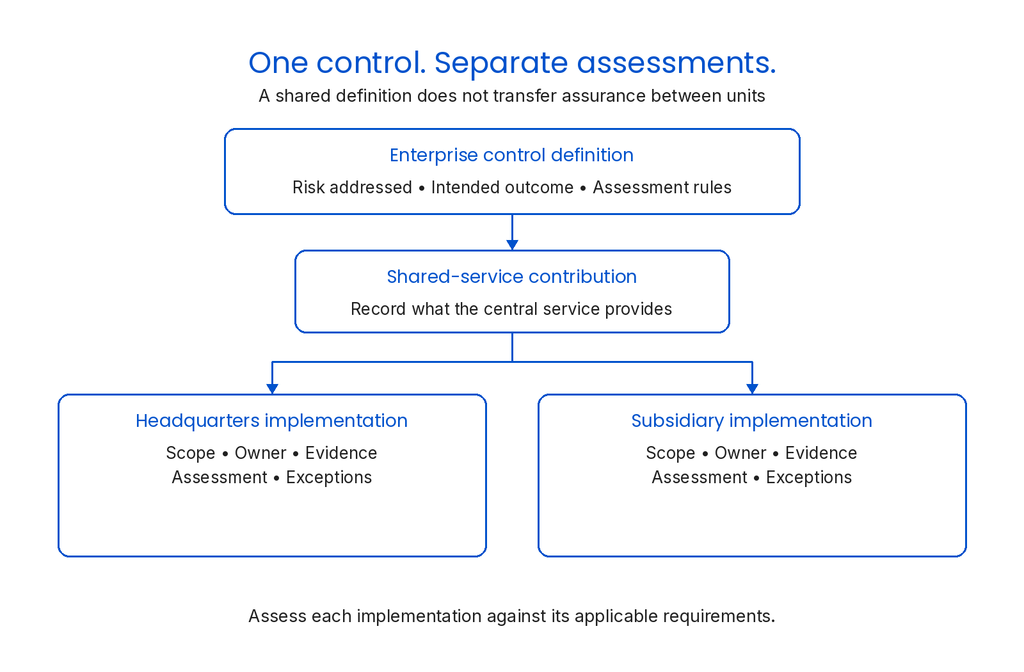
A common control library makes reporting consistent. It does not establish that every business unit implements a control in the same way. For each control, maintain an enterprise definition and separate implementation records.
Enterprise definition: risk addressed, intended outcome, applicable requirements and mapping rationale, minimum implementation and assessment expectations, evidence rules, and escalation.
Implementation record: service, population, operating owner, evidence sources, assessment result, local variations, and exceptions.
An enterprise access-review control may apply to headquarters and an acquired subsidiary. Headquarters uses an identity-governance system; the subsidiary uses a documented manual review. Both can pursue the same objective. Each needs appropriate evidence and neither should inherit the other’s assessment result automatically.
Also distinguish shared-service controls from local execution. A centrally managed identity service may enforce an access policy while application owners remain responsible for reviewing business access. Show both contributions and uncovered responsibilities.
A shared control may support several obligations, but differences in scope, timing, retention, or approval can require additional evidence. A mapping is an assessment aid, not a finding of compliance.
Establish scope before interpreting control status
Begin with services and business consequences. Identify the legal entities, business units, regions, systems, and third parties included in the rollout. Reconcile that scope against the populations used to assess controls.
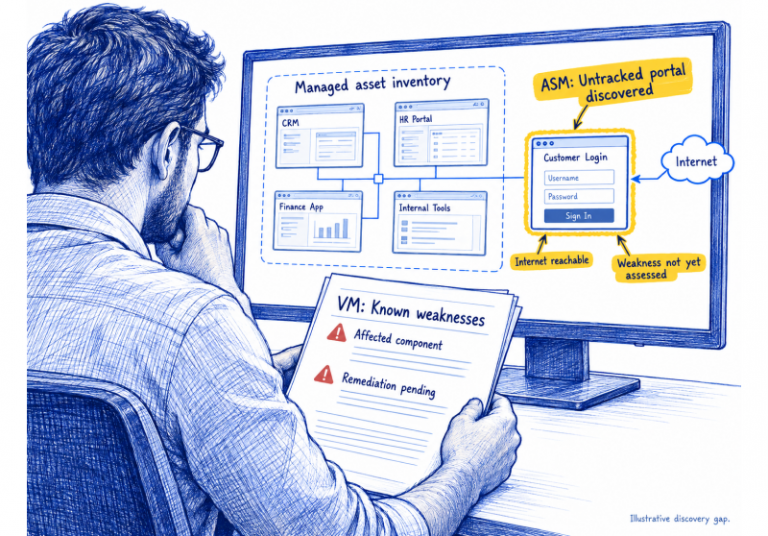
For access reviews, an application list is only a starting point. The assessment may also need privileged accounts, service accounts, local identities, and accounts outside the central directory. An evidence source cannot establish coverage over assets it cannot see.
Gap
Example
Response
Coverage
An application has no access-review process
Extend the control or record uncovered scope and treatment
Effectiveness
Inappropriate access remains active after review
Investigate and correct the failure
Evidence
Review records do not reconcile with account population
Obtain sufficient evidence; retain unassessed status
Governance
A material issue has no owner or authorized decision
Assign ownership and escalate
Record exclusions with rationale and approval. Unresolved inventory discrepancies remain limitations on assurance. For cybersecurity scope, NIST CSF 2.0 Organizational Profiles can help compare current and target outcomes and prioritize improvements. They complement the rollout register.
Define what acceptable evidence must demonstrate
Specify the assessment question before collecting evidence. An access-review completion record may not establish population coverage, identification of inappropriate access, or effective removal.
Scope: services, assets, accounts, or transactions covered.
Period: when the control operated and evidence was collected.
Source: originating system, provider, and collection method.
Method: what will be examined or tested.
Acceptance criteria: conditions needed to support the conclusion.
Limitations: missing records, sampling boundaries, errors, or reconciliation differences.
Set freshness requirements according to the control and decision. No universal refresh interval suits every control. Some controls require operational testing as well as records. NIST SP 800-53A provides a tailorable methodology for assessment and analysis.
Monitor automated collection itself. A failed feed should expose an evidence limitation. Retain the last successful assessment as dated history rather than silently presenting it as current assurance.
Pilot a complete control cycle
Choose a pilot with meaningful exposure, engaged owners, and manageable scope. Include variation such as a shared service and locally managed application. Define acceptance criteria before beginning.
Pilot gate
Evidence needed
Scope established
Populations reconciled; exclusions and limitations recorded
Ownership established
Operators, reviewers, risk owners, and escalation confirmed
Assessment reproducible
Another reviewer can understand the method and supported conclusion
Failure handled
Gap reaches appropriate owner and decision authority
Action verified
Corrective action checked against original objective
Reporting usable
Affected service, exposure, and next decision visible
Use a real finding where available. Otherwise run a clearly identified scenario exercise. An exercise tests routing and decisions; it does not prove production remediation succeeded.
Worked example of access review across two business units
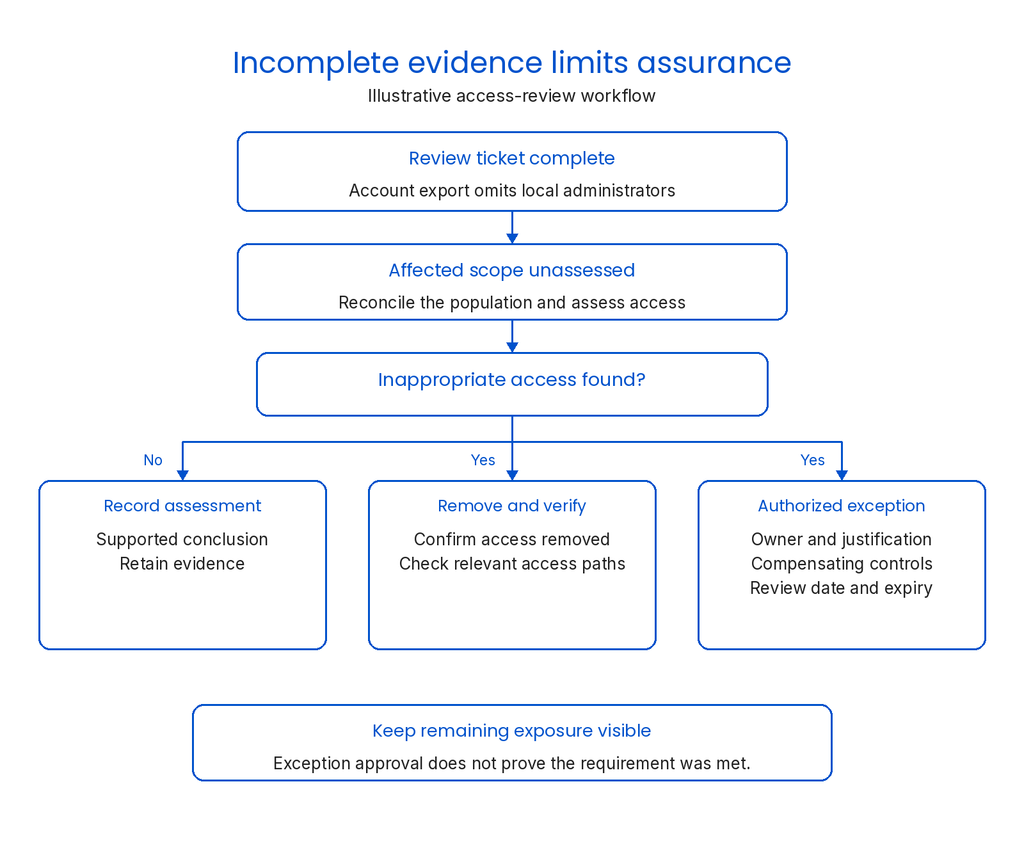
Illustrative scenario, not a SPOG.AI customer result. One unit provides review records reconciled with its account population. Another provides a completed ticket, but its export omits local administrator accounts.
Record the affected population as unassessed while investigating. Do not infer that all local accounts are inappropriate or report full effectiveness. If inappropriate access is identified, assign removal and verify the result in the target application. Where applicable, check active sessions, tokens, or alternative access paths.
If access must temporarily remain, record affected scope, justification, compensating controls, authorized decision, review date, expiry, and treatment plan. An accepted exception stays visible and does not prove the original requirement was met.
Expand after the pilot demonstrates these decisions and handoffs. A populated dashboard alone is insufficient.
Expand through waves with explicit acceptance gates
Group units by risk, dependencies, readiness, and shared implementation value. Each wave must fit the capacity of owners and reviewers. Expanding faster than remediation capacity creates a larger backlog.
Maintain a register of scope, obligations, implementations, evidence sources and limitations, owners, authority, findings, exceptions, dependencies, readiness conditions, and remaining work.
A unit may enter governed operation with known gaps if authorized treatment and follow-through are visible. Onboarding completion does not imply compliance or effectiveness.
Pause expansion when scope is unreliable, material findings lack decision owners, or evidence cannot support assessment.
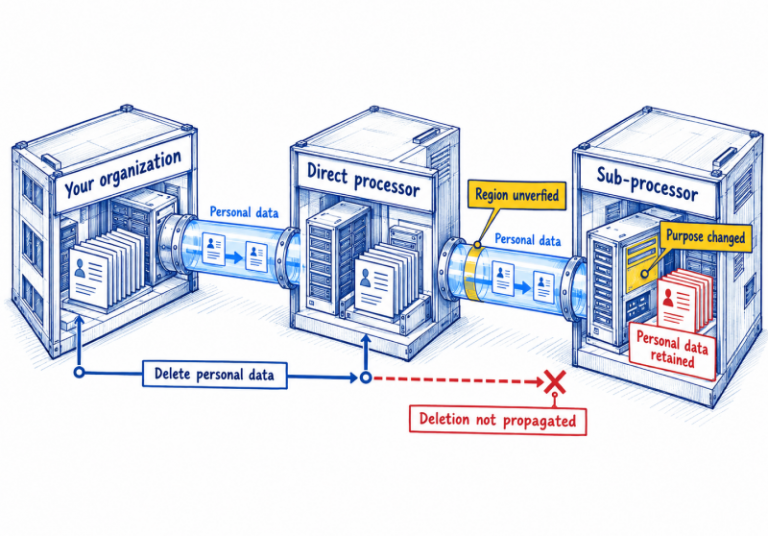
For multinational deployments, involve legal, privacy, and compliance specialists where obligations affect collection, transfer, retention, or authority. Internal risk acceptance cannot waive an applicable legal requirement. Record the compliance position separately.
Measure assurance coverage and operating outcomes
Counts of onboarded teams and uploaded policies track activity. Use measures with explicit denominators and reporting boundaries to assess outcomes.
Measure
Definition and safeguard
Ownership coverage
Owned priority implementations ÷ all in-scope priority implementations. Identify capacity and handoff issues.
Assessment coverage
Implementations with sufficient current evidence ÷ all in-scope priority implementations. Show unassessed and excluded scope.
Action backlog
Overdue material actions by service, severity, age, dependency, and escalation.
Verified remediation
Actions passing validation ÷ all actions due for validation. Retain failed and pending cases in denominator.
Exception exposure
Material exceptions by service, expiry, and risk decision. Keep expired and undecided cases visible.
Set targets according to risk appetite, obligations, and capacity. Avoid arbitrary universal benchmarks. Report critical-service weaknesses alongside aggregate measures. Repeated evidence requests, handoff delays, and local spreadsheets are adoption signals worth investigating.
Select technology against the operating model
Test a platform with a scoped implementation and realistic changes. Ask it to demonstrate a new application, different local implementations, incomplete evidence, delegated decisions, exception expiry, failed validation, access restrictions, and exportable decision history. These are evaluation requirements, not assumed capabilities.
SPOG.AI’s published GRC positioning describes connections between requirements, controls, operational evidence, accountability, and exceptions. Its continuous control monitoring page describes evidence-based assessment of coverage and effectiveness. Deployment-specific coverage, permissions, refresh behavior, and workflows should be demonstrated against buyer requirements.
Bring one critical service and one control to a SPOG.AI demo. Ask the team to demonstrate scoped evidence, assessment, decision, action, and verification.
Keep the enterprise model governed after launch
Assign an ongoing owner to the model and assessment rules. Retain version history so earlier conclusions remain interpretable. Trigger reassessment when acquisitions, new applications, outsourcing, incidents, or regulatory changes affect scope or implementation.
When a shared control changes, identify dependent local implementations and update their assessment expectations. Enterprise rollout succeeds when leaders can establish where exposure exists, what supports the assessment, who owns the decision, and how the response will be verified. Use that test before the next wave.
A coordinated model for risk and compliance across business units, legal entities, and environments. It connects requirements, controls, scope, evidence, ownership, and decisions.
Control definitions, assessment rules, evidence criteria, reporting conventions, and escalation authority. Preserve implementation details and local obligations.
An executive sponsor provides authority and resources. A program owner coordinates implementation; business and service owners retain responsibility for controls and risk. Specialist functions provide oversight.
Choose meaningful exposure, engaged owners, and manageable scope. Include variation to test evidence quality, local implementation, and decision routing.
When scope and ownership are established, assessments are supported, material gaps have treatment decisions, and verification works. Known gaps must remain visible.
Sometimes, if its scope, period, purpose, and quality meet each requirement. Similar wording or mappings do not establish sufficiency.
Record a limitation or unassessed status. Missing evidence does not prove failure, but cannot establish that a control worked.
No. It records a decision about a gap; it does not prove the requirement was met or waive legal obligations.
Ownership and assessment coverage, overdue actions, verified remediation, and exception exposure, with clear denominators and service-level results.
No. It can support evidence, traceability, and oversight. Independent assurance requires authority, objective assessment, and judgment.
Technology writer and content strategist with 5+ years of experience, including work for a US-based B2B SaaS client and a cybersecurity solution. I create cybersecurity and GRC content, product documentation, and user guides that help technical teams and business leaders understand security capabilities and workflows. Currently working on Confluence documentations on vulnerability management, ITSM, incident management, and continuous control monitoring, alongside SEO and AEO content, and technology partner database development.