How Lean GRC Teams Can Scale Compliance Without Adding Headcount
Help lean GRC teams support growing compliance demands with clear ownership, reliable evidence and selective automation. Reduce repeated follow-up, keep exceptions visible and verify remediation while measuring whether the team has capacity to scale.
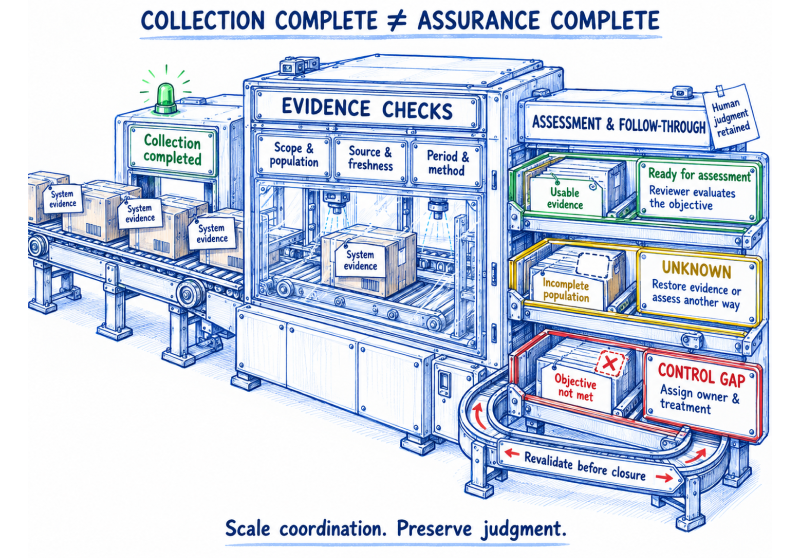
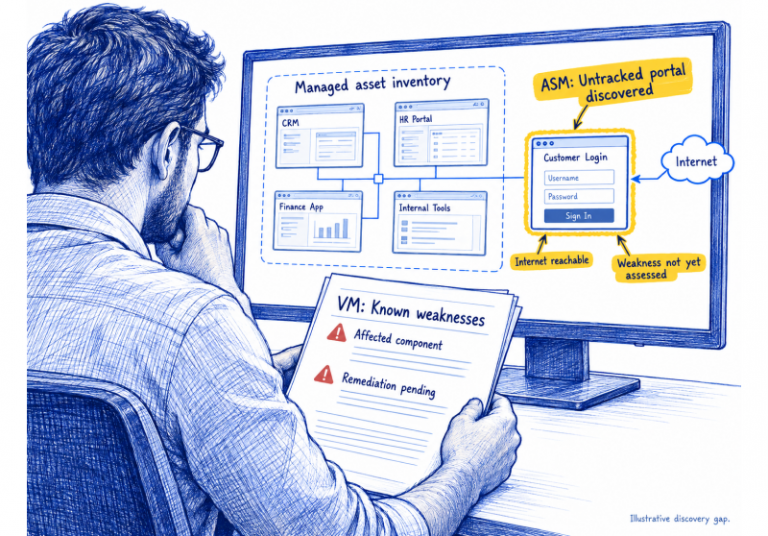
The GRC team has collected evidence and met a deadline, but the record cannot establish coverage across the intended population. Another reminder would not fix that problem. The team needs a reliable account inventory, a clear review boundary, and someone accountable for resolving the omission.
Lean governance, risk, and compliance teams scale by reducing repeated coordination while preserving the quality of control decisions. That requires defined ownership, evidence that answers a specific question, and a workflow that keeps gaps open until they are resolved or formally accepted.
This can help a small team support more systems and obligations. Whether it can do so without additional headcount depends on the remaining review workload, the complexity of the obligations, and the capacity of the people operating the controls.
Give GRC authority to coordinate and challenge
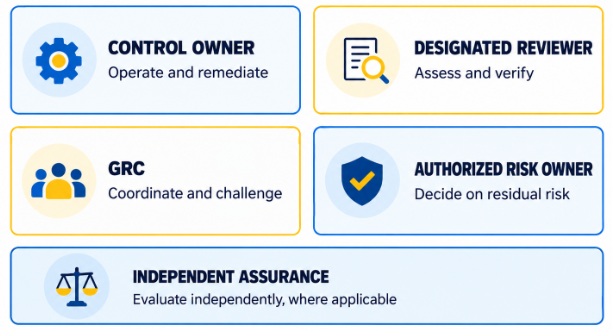
A compliance program becomes fragile when the GRC team owns every request, chases every response, and decides what every gap means. Distribute responsibilities according to the organization’s governance model and delegated authority.
Responsibility
Accountable role
Required outcome
Operate the control
Control owner
Maintain control and provide evidence of performance.
Assess the result
Designated assessor or reviewer
Evaluate scope, evidence quality, and whether the objective was met.
Coordinate oversight
GRC
Maintain requirement mappings, challenge gaps, and escalate unresolved decisions.
Accept residual risk
Authorized risk owner
Record the decision, rationale, conditions, and review or expiry date.
Provide independent assurance
Internal audit or another independent assurance function, where applicable
Evaluate the program with appropriate independence.
In a small organization, one person may perform several roles. Record those overlaps and establish an appropriate challenge or approval path for material decisions. The person implementing a correction should not be the only person confirming a high-impact finding is closed.
Give each handoff enough context to act: the affected service and scope, control objective, observed gap, supporting evidence, action owner, due date, and escalation path. A named owner without the authority or capacity to act does not solve the bottleneck.
Define what evidence must prove before collecting it
Start with the control objective. For an access review, the question is whether access across the defined population remains justified and whether unwanted access was removed. A completed spreadsheet answers only part of that question.
For each recurring control test, document:
Scope: the services, systems, identities, and exclusions being assessed.
Population: the authoritative inventory used to establish what should be covered, including how completeness is checked.
Source and period: where evidence originates, when it was collected, and which activity period it covers.
Method: the check, sample, interview, or test used to evaluate the objective, with its limitations.
Decision rule: what counts as satisfactory, failed, or unknown, and when evidence becomes stale.
Follow-through: who reviews the result, who acts, and what verifies closure.
Set collection and review frequencies according to risk, the rate of change, and applicable obligations. A daily collection schedule does not make a monthly review continuous, and a configuration snapshot cannot establish performance throughout an audit period.
Protect the evidence itself. Apply appropriate access restrictions, retain source identifiers and timestamps, preserve the assessment method and relevant changes, and use a documented retention schedule. Avoid collecting sensitive information that the assessment does not need.
Separate a failed control from an unknown result
Automation can make an incomplete record look conclusive. An integration may run successfully while omitting an application, account type, or newly created asset.
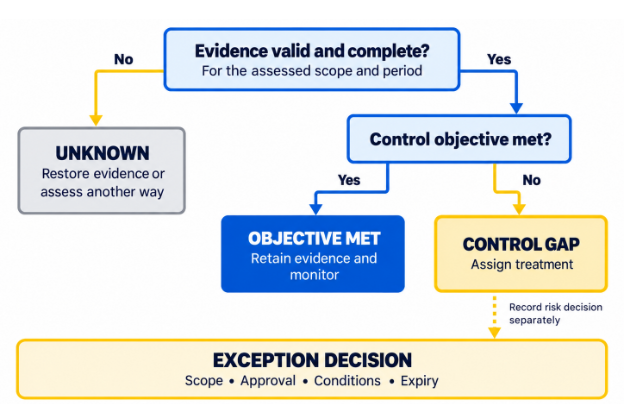
Evaluate collection health and population coverage before interpreting the control result. If the source is unavailable or the evidence is incomplete, show an unknown state and assign an investigation. Missing evidence limits assurance; it does not, by itself, establish that the operational control failed. A separate obligation to retain evidence may still have been breached.
Observed state
Meaning
Next action
Objective met
Evidence supports the defined test for the assessed scope and period.
Retain the result and continue the planned monitoring.
Objective not met
Valid evidence shows a control gap.
Prioritize and assign treatment.
Unknown
Evidence is stale, incomplete, unavailable, or inconclusive.
Restore visibility or perform an alternative assessment.
Approved exception
An authorized decision accepts a defined deviation under stated conditions.
Track exposure, conditions, and expiry separately from control performance.
An exception is a decision about a deviation, not a technical test outcome. If an account remains outside the required access control, approval should not convert that account into protected coverage. Keep the control result and the risk decision visible together.
Automate the recurring workflow and retain judgment
Choose work with stable inputs and explicit outcomes. Evidence retrieval, expiry checks, owner notifications, and duplicate-request detection are useful candidates. Validate the workflow on a bounded scope before extending it.
Continue the access-review example. Reconcile the identity-provider inventory with application accounts. Identify omissions and confirm whether they are in scope. Route the complete population to the appropriate reviewer. Record decisions and track revocations. Then verify the resulting access state, including relevant local accounts or other access paths covered by the objective.
Distinguish requests arising from one underlying failure from separate failures that happen to look similar. Group genuinely related findings around the same cause and owner while preserving the links to affected requirements. This can reduce repeated follow-up without hiding the impact across services.
Use automation to prepare decisions. A reviewer still needs to assess conflicting evidence, compensating controls, and material changes in business impact. Policy approvals, risk acceptance, and independent assurance require the appropriate human authority.
Reuse evidence with a clear boundary
One access-control record may support an internal policy, a customer obligation, and a framework assessment. Store the evidence once and link it to each relevant requirement, with the reason the evidence is suitable.
Before reuse, check that the scope, assessment period, control objective, and evidence detail match the destination requirement. A configuration snapshot may support a deployment check while being insufficient to demonstrate sustained operation. A customer contract may also require a different population or testing frequency.
Keep requirement-specific conclusions separate. If evidence becomes stale or a control fails, revisit the linked assessments rather than allowing each to retain an outdated satisfactory status. Agree evidence expectations with the relevant assessor; reuse does not guarantee acceptance.
Prioritize exposure and verify the outcome
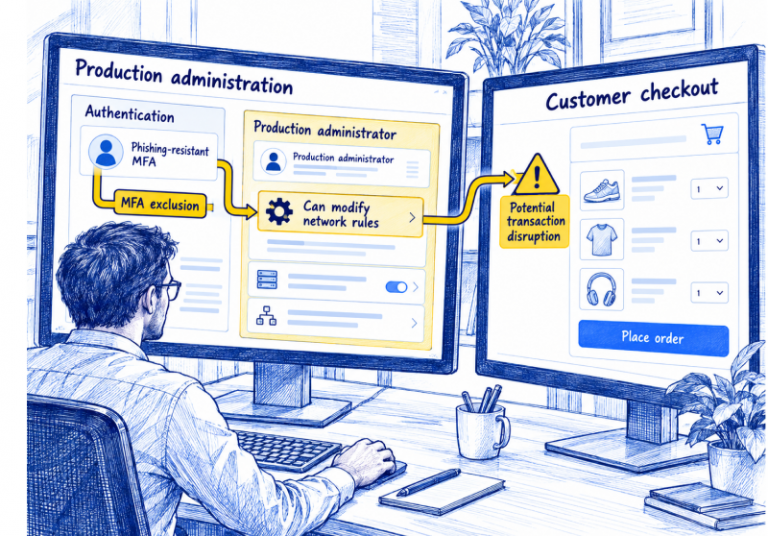
Review material gaps using service importance, affected data, privilege, exposure, available compensating controls, and binding deadlines. An unprotected production administrator may need faster action than an overdue review for a low-impact service. The overdue review still needs an owner and a decision.
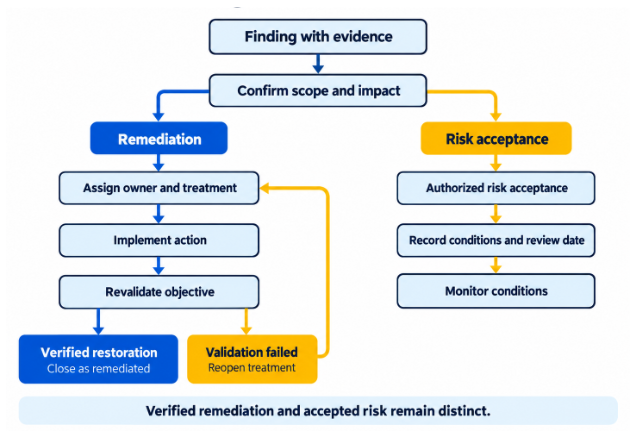
For each material gap, record the affected scope, evidence, risk rationale, treatment owner, due date, and escalation trigger. If an exception is proposed, identify the authorized approver, conditions, compensating controls and their evidence, review or expiry date, and what happens if conditions change. Internal approval cannot waive a binding legal or contractual obligation.
Define closure evidence when assigning the action. If the gap is excessive, verify removal against the relevant source. If the gap is an incomplete review population, reconcile the inventory and assess the omitted accounts. Preserve the original finding and the later result.
Record remediated, risk accepted, and no longer applicable as distinct outcomes. A closed ticket confirms workflow completion; the closure evidence supports the assurance conclusion. Reopen or reassess the issue if validation fails or material conditions change.
Measure whether the team has gained capacity
Run a bounded pilot on one recurring control, such as privileged access reviews. Record the existing workload and assurance gaps before changing the process. Then compare equivalent scope and periods after the workflow stabilizes.
Measure
What it reveals
GRC coordination time per review cycle
Whether repeated retrieval and follow-up work is falling.
Evidence meeting the agreed specification
Whether usable evidence is replacing incomplete records.
Age of material unresolved findings
Whether significant gaps are being addressed in time.
Remediations passing revalidation
Whether completed actions restore the required state.
Set thresholds from the organization’s baseline, risk appetite, and obligations. Review urgent findings when they arise; use a regular review for overdue decisions, evidence failures, and approaching exception expiries. Report capacity trends and remaining exposure to leadership.
Extend the model only when evidence quality and follow-through remain reliable. If specialist assessments, independent assurance, or unresolved decisions exceed available capacity, use the workload record to justify additional resources. Sustainable scaling includes recognizing that limit.
New AI uses can enter the same process. Register the use, owner, data, and connected services; route it for proportionate security, privacy, and legal review. Reassess when its purpose, access, or data changes. Registration alone does not establish acceptable risk.
How SPOG.AI supports this approach
SPOG.AI’s GRC capabilities connect requirements, controls, and operational evidence, with visibility into ownership and exceptions. Continuous control monitoring connects defined controls to operational evidence to assess coverage and effectiveness and support accountable remediation.
For a lean team evaluating the platform, use a real control in the demo. Ask to see how the assessed population is established, what happens when a source stops reporting, how exceptions remain visible, and what evidence supports closure. Confirm integration coverage and assessment frequency for the systems in your scope.
A lean GRC team can support growth when its time is available for assessment and challenge, and control owners can complete the operational work. Begin with one control, make the evidence and decisions traceable, and expand only after the process demonstrates reliable outcomes.
Book a SPOG.AI demo to explore connected evidence, control monitoring, and accountable remediation.
Reduce duplicate requests, define control ownership, reuse suitable evidence, and automate stable collection and follow-up tasks. Measure the remaining review workload and unresolved exposure. More headcount or specialist support may still be necessary as scope and obligations grow.
Start with recurring evidence retrieval, freshness checks, notifications, and genuinely duplicate requests. Choose a task with an agreed population, reliable source, clear decision rule, and owner. Pilot it before wider deployment.
Evidence should be traceable to its source, relevant to the requirement, complete for the agreed scope, and suitable for the assessment period and method. Preserve collection timestamps, review decisions, and limitations. Assessors may require additional evidence.
Not necessarily. Missing evidence creates an assurance gap and requires investigation or an alternative assessment. Valid evidence may later establish a control failure. Separately, a requirement to record or retain evidence may itself be unmet.
Yes, when it satisfies each requirement’s scope, period, and assessment expectations. Keep the mappings and conclusions separate. Shared evidence does not make different frameworks or obligations equivalent.
An authorized risk owner acting within delegated authority should approve the risk decision. Record scope, rationale, conditions, compensating controls, and review or expiry date. Approval does not establish control effectiveness or override a binding obligation.
No. Monitoring provides recurring operational evidence within its defined coverage. Audits may also assess governance, control design, historical performance, and evidence requiring interviews or other testing. Monitoring supports assurance but does not replace its independence or breadth.
Close it as remediated when verification supports the agreed control objective for the affected scope. Record risk acceptance or removal from scope as separate outcomes. Retain the finding, action history, reviewer, and closure evidence.
Compare coordination effort before and after implementation using equivalent scope and periods. Include the effort required from control owners and the cost of maintaining integrations and resolving collection failures. Check that evidence quality and risk outcomes have not deteriorated.
Register the use, responsible owner, processed data, and system access. Route higher-impact uses for appropriate security, privacy, and legal assessment. Review material changes and track treatment through the same ownership and evidence process used for other services.
Technology writer and content strategist with 5+ years of experience, including work for a US-based B2B SaaS client and a cybersecurity solution. I create cybersecurity and GRC content, product documentation, and user guides that help technical teams and business leaders understand security capabilities and workflows. Currently working on Confluence documentations on vulnerability management, ITSM, incident management, and continuous control monitoring, alongside SEO and AEO content, and technology partner database development.