Financial Services Compliance: Can Your Evidence Support the Decision?
Financial services compliance needs evidence that supports decisions about critical services. Learn how to define control scope, assess supplier evidence, expose uncertainty and verify remediation while keeping institutional accountability clear.
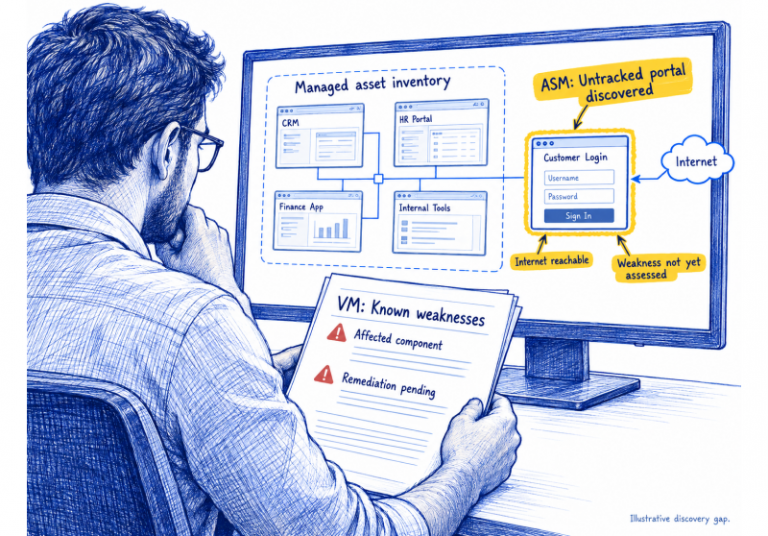
Financial services compliance becomes difficult when a reassuring control status cannot withstand a specific question: which regulated service does it cover, what was tested, and what remains unresolved? A dashboard may show successful access reviews while excluding a newly acquired subsidiary or a supplier’s administrative accounts.
The operational challenge is to connect each compliance conclusion to its applicable obligation, defined population, reliable evidence and accountable decision. For cybersecurity and GRC leaders, the most useful improvement is often stronger rules for deciding what evidence actually proves.
Define the boundary of financial services compliance
Financial services compliance includes obligations concerning licensing, anti-money laundering (AML), consumer protection, financial reporting, privacy, cybersecurity and operational resilience. Their applicability depends on the legal entity, regulated activity and jurisdiction. This article focuses on cybersecurity and operational assurance; specialist compliance functions retain responsibility for financial crime, conduct and prudential requirements.
Begin with an obligation register that records the entity, service, applicable instrument, accountable interpretation owner and relevant effective dates. Separate legal requirements, supervisory expectations, contractual duties and voluntary standards. A control shared across several frameworks still needs a defensible mapping to each requirement’s scope and wording.
Four current examples illustrate why a universal checklist is insufficient:
Whether the institution falls under FTC jurisdiction
The FTC’s June 2025 guidance reaffirmed the information-security-program obligation for covered non-banking financial institutions.
New York DFS, 23 NYCRR Part 500
Covered-entity status and applicable exemptions
October 2025 third-party guidance emphasizes oversight and clarifies that responsibility cannot be delegated to providers.
Digital Operational Resilience Act (DORA)
Whether the EU financial entity and arrangement fall within scope
Applicable since 17 January 2025; addresses ICT risk management, incident reporting, testing and third-party risk.
Payment Card Industry Data Security Standard (PCI DSS)
Relevant payment environment and validation route
Applicable future-dated v4.0.1 requirements became effective on 31 March 2025.
These are examples, not a complete jurisdictional inventory. Certification against ISO/IEC 27001 should not be treated as proof that every financial obligation has been satisfied. Map the actual requirement and obtain specialist interpretation where necessary.
Build an evidence test before collecting evidence
Start with the decision the evidence must support. “Access reviews completed” is ambiguous unless reviewers know which entitlements were assessed, whether inappropriate access was removed, and when the result was verified.
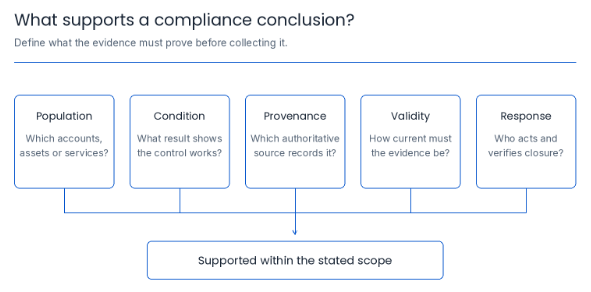
Use five questions to define an evidence test:
Population: Which accounts, assets, providers or services should be included?
Condition: What observable result demonstrates the control objective?
Provenance: Which authoritative source records the result?
Validity: How recent must evidence be, and what change invalidates it?
Response: Who investigates failure or uncertainty, and what permits closure?
This is a proposed operating method, not a regulator-prescribed template. It makes the conclusion challengeable: another reviewer should be able to reproduce the test and identify its limitations.
Use the matrix to reject evidence that proves only tool deployment. An endpoint dashboard can demonstrate agent coverage; it cannot, by itself, establish that detection, investigation and recovery work together across a critical service.
Separate control failure from missing evidence
A failed test and an unavailable test require different responses. When an identity feed stops updating, the team does not know whether access remains compliant. Carrying forward yesterday’s green result hides that limitation.
As an internal reporting convention, distinguish three states: supported, failed and unknown. Keep approved exceptions visible alongside the underlying result, rather than allowing approval to erase a failed test. Define collection-failure alerts and assign evidence-feed ownership separately from remediation ownership.
For each material result, retain the test version, timestamp, population reference, failed items and evidence location. Preserve historical results when the population changes. Otherwise, apparent improvement may reflect scope removal rather than better control performance.
Continuous control monitoring can support this routine, but its assurance is bounded by connected sources, test logic and collection frequency. Manual reviews remain necessary where judgement or unavailable data prevents automated testing.
Treat supplier evidence as a scoped input
Third-party risk management is more demanding than collecting a certificate. The New York DFS’s October 2025 guidance distinguishes due diligence, contracting, ongoing oversight and termination. It clarifies existing expectations rather than introducing a new regulation.
Apply that lifecycle to the service you consume. Identify which systems the provider accesses, which data it handles, relevant subcontractors and the institution’s retained responsibilities. Review assurance reports for their period, service boundary, exclusions, findings and controls the customer must operate.
A report covering a provider’s hosting service may leave the institution responsible for identity configuration and recovery testing. Record that allocation explicitly. Ask for remediation evidence when a finding affects your service, and define escalation if the provider cannot supply it.
Reassess this allocation when a supplier changes its support model, introduces a subcontractor or alters a material access path. Use the change record to identify which evidence tests and retained customer responsibilities need review.
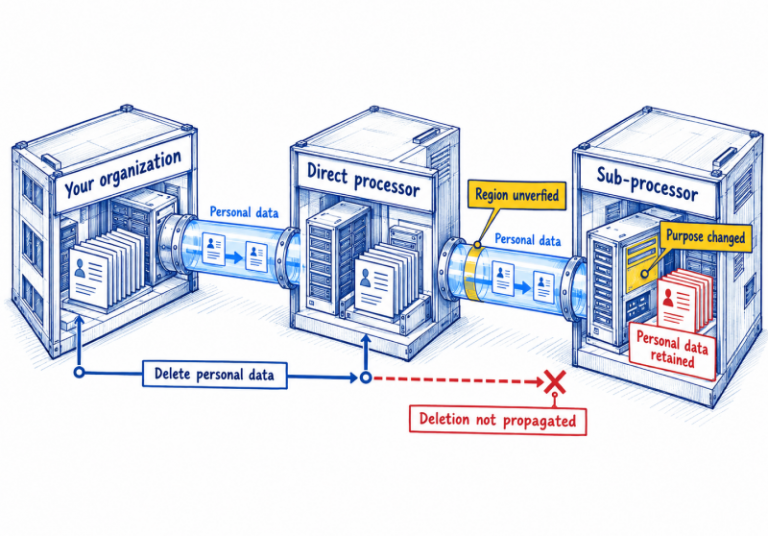
At termination, verify access revocation and the agreed data-return or deletion process. Contract language establishes an obligation; operational evidence establishes whether it was performed.
An illustrative case: a payment-service access gap
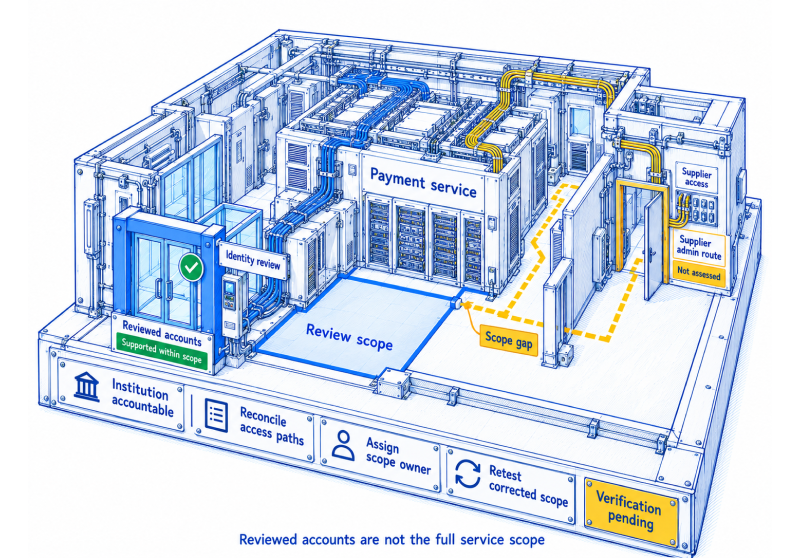
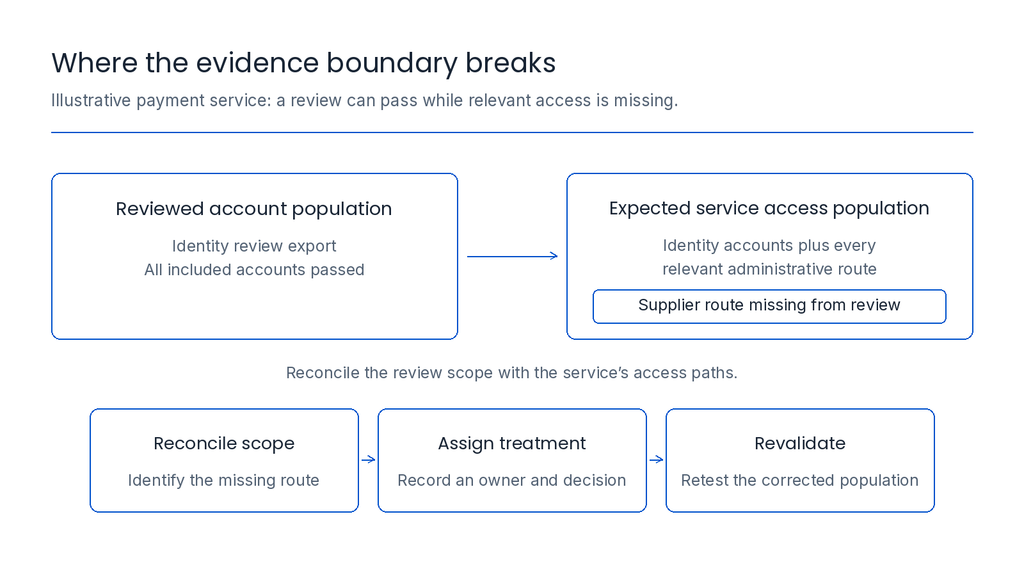
Consider a fictional payment service introducing a new external support provider. The identity team reports that every account in its review export passed. However, the supplier uses an administrative route maintained outside that export.
The access-review test may be valid for the exported population while insufficient for the payment service. The first decision is to reconcile the service’s expected access paths with identity, privileged access management (PAM) and supplier records. The missing route becomes an explicit scope gap with an owner.
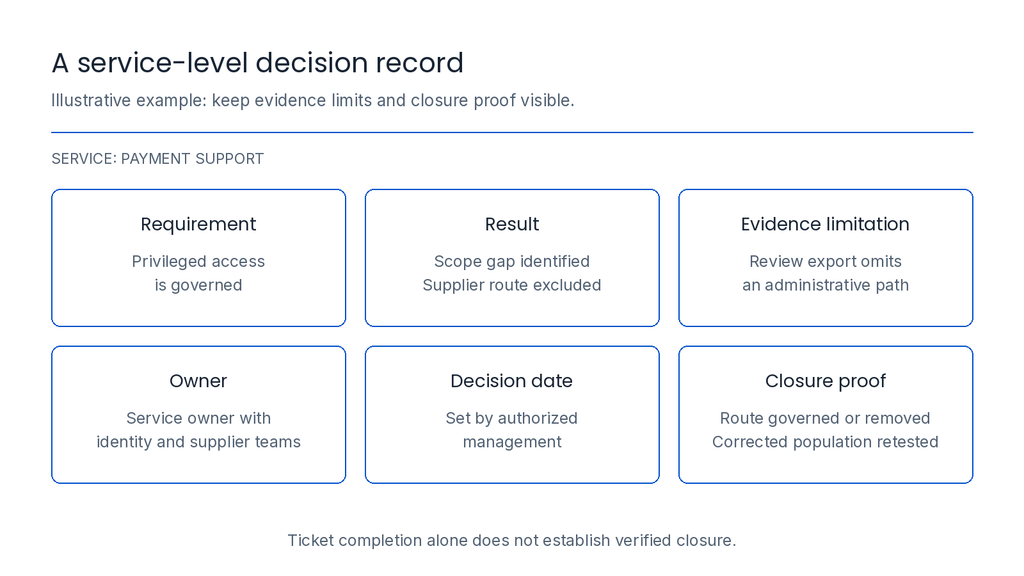
If immediate removal would disrupt support, authorized management assesses containment and temporary treatment. The record identifies the affected service, residual risk, approval authority, compensating measures, expiry and reassessment trigger. Acceptance does not remove a mandatory obligation or automatically authorize noncompliance.
Closure requires evidence that the route was governed or removed, followed by a repeat test against the corrected population. Completing the ticket alone cannot demonstrate restoration.
The lesson is that a technically accurate percentage can support the wrong conclusion when its denominator omits a relevant dependency.
Make financial services compliance reporting decision-specific
Leadership reporting should separate control performance, evidence limitations and unresolved decisions. Avoid averaging unlike obligations into a single score that implies regulatory compliance.
For a critical service, show its applicable requirements, failed or unknown tests, affected population, current exceptions, responsible owner and next decision date. Distinguish remediation progress from verified closure. Track recurring failures and expired evidence alongside overdue actions.
Incident reporting needs a separate decision path. Maintain jurisdiction-specific classification criteria, notification clocks, responsible approvers and required information. A technical alert is an input to that assessment; a generic ticket deadline cannot replace a regulatory reporting deadline.
Test compliance automation against a real decision
When evaluating compliance automation, ask the provider to demonstrate one failed control from source record through ownership, exception handling and retesting. Check how the system exposes missing inputs, preserves historical results and exports the evidence trail. Assess integration scope and permissions against your operating environment. A dashboard demonstration should establish what a reviewer can reproduce and challenge, rather than merely show how many frameworks the platform lists.
Start small and retain institutional accountability
Select one critical service and a small set of consequential controls. Establish applicability, reconcile scope, define evidence tests and run the resulting decisions through the institution’s governance process. A phased GRC implementation helps organize ownership and evidence without assuming every control can be completed on one schedule.
SPOG.AI connects cyber risk, control validation, compliance evidence and operational workflows. Its published financial-services positioning includes evidence collection and accountability for remediation and control restoration. The institution still determines applicability, operates controls and approves risk decisions; deployment does not establish compliance.
Start with one question leaders need answered. Make its evidence reproducible, its uncertainty visible and its response accountable. Expand after the institution can explain both the control result and the verified outcome.
Frequently asked questions
It is meeting applicable legal, regulatory, supervisory and contractual obligations across an institution’s activities, including cybersecurity and operational resilience.
No. AML, conduct, licensing, reporting and prudential obligations require additional specialist processes and owners.
No. Applicability depends on legal entity, regulated activity, location, service and any relevant exemptions.
PCI DSS is an industry security standard. Its applicability and validation route differ from statutory financial regulation.
Defined scope, an observable condition, an authoritative source, a validity rule and an accountable response.
It means the conclusion is unsupported. Investigate the evidence gap without assuming either compliance or failure.
No. Approval documents a decision; it does not demonstrate restoration or waive a mandatory obligation.
No. Assess the report’s scope, period, findings and customer responsibilities against the service you use.
After the defined condition is retested and supporting evidence demonstrates the agreed outcome.
The population, exclusions, failed or unknown tests, current exceptions, owner, decision date and verified closure evidence.
Technology writer and content strategist with 5+ years of experience, including work for a US-based B2B SaaS client and a cybersecurity solution. I create cybersecurity and GRC content, product documentation, and user guides that help technical teams and business leaders understand security capabilities and workflows. Currently working on Confluence documentations on vulnerability management, ITSM, incident management, and continuous control monitoring, alongside SEO and AEO content, and technology partner database development.