Cybersecurity Risk Management Strategy: Define Priorities, Authority and Limits
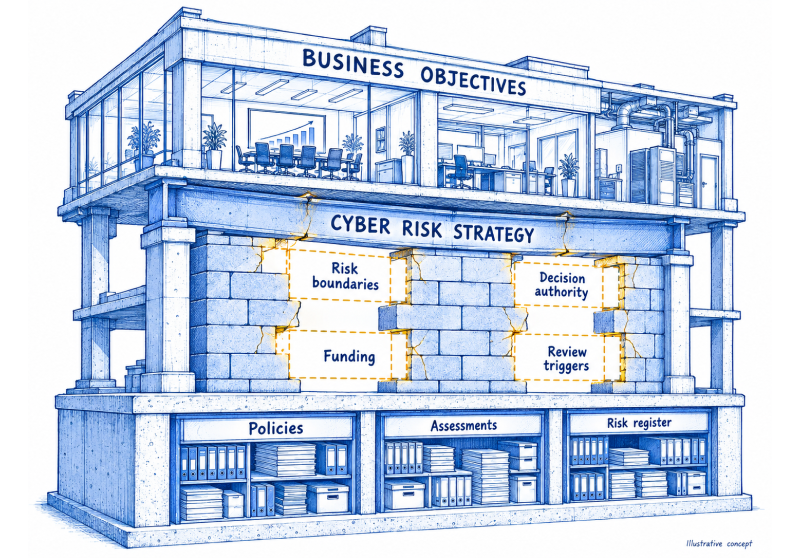
A cybersecurity risk management strategy should guide real choices about priorities, investment and acceptable exposure. This practical framework connects business objectives to decision authority, treatment and review.
A cybersecurity risk management strategy is tested when priorities compete: a launch needs speed, a safeguard needs investment, and a leader seeks an exception. A policy and register may leave decisions unclear.
A cybersecurity risk management strategy defines how decisions support business objectives. It links appetite, authority, priorities and funding. Current NIST guidance calls for cybersecurity risk information to inform enterprise risk management (ERM) and leadership decisions in light of business objectives [1].
The challenge is to make decisions consistent, funded and responsive to change. This article offers a strategy-level framework.
What a cybersecurity risk management strategy does
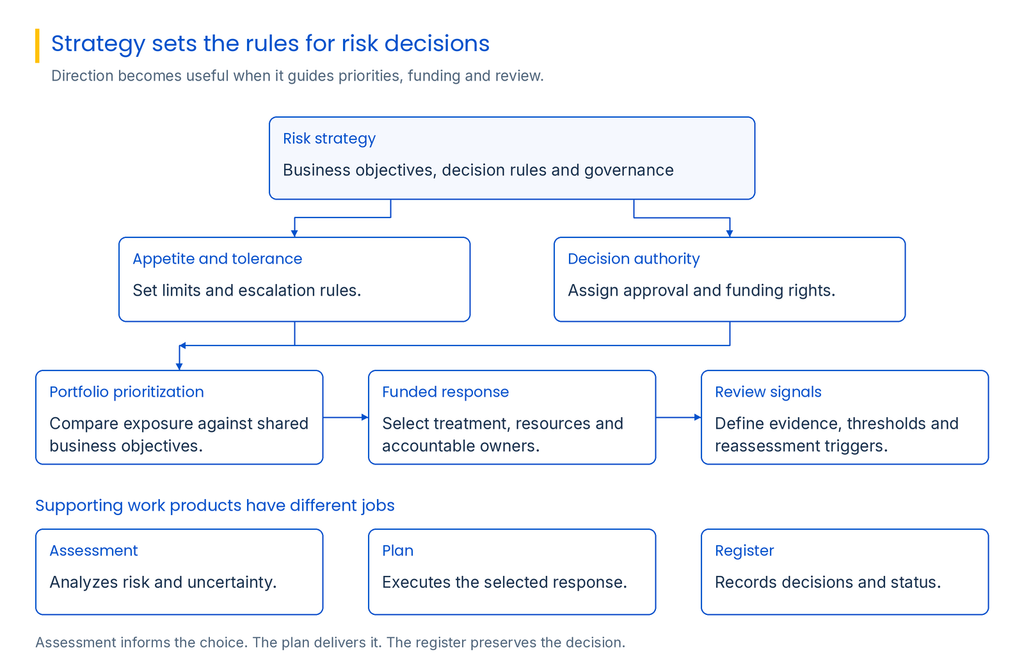
A strategy sets decision rules: which objectives matter, what exposure leaders will tolerate, who can approve decisions, and what signals require escalation. It differs from the records and work products that help apply it.
Element
Main purpose
Typical output
Risk strategy
Set direction, appetite, decision rights and review triggers
Risk principles and decision rules
Risk plan
Turn a chosen response into funded work with owners and timing
Treatment actions, budget and milestones
Risk register
Record material scenarios, assumptions, decisions and status
Current risk profile and decision history
Risk assessment
Analyze a defined exposure to support a decision
Evidence, estimates and uncertainty
The strategy governs how the other three are used. An assessment informs a choice; the plan executes it; the register records the rationale. None replaces leadership direction.
Five decisions in a cybersecurity risk management strategy
1. Tie risk to business objectives
Begin with the outcome the organization must protect or enable: customer trust, reliable operations, product delivery or a strategic investment. A threat list without this context cannot show whether exposure is tolerable or worth funding.
Describe the event and objective at risk, then state assumptions about critical dependencies, recovery and data. NIST IR 8286A Rev. 1 recommends documenting scenarios, likelihood and impact in the context of enterprise assets and risk appetite [2].
Appetite expresses the types and levels of risk leadership is willing to pursue. Tolerance turns that direction into practical boundaries or escalation conditions, such as availability thresholds, dependency limits or restrictions on sensitive data.
2. Make decision authority explicit
Set decision rights across governance, management and operations. Governing bodies oversee material exposure; executives set direction and allocate resources; risk owners decide how objectives will be protected; control owners implement safeguards; specialists advise and test.
Keep task ownership separate from risk acceptance. An engineer may implement a safeguard while a business executive owns whether the remaining exposure is acceptable. Security advises and challenges; it does not accept business risk on another leader’s behalf.
Name escalation triggers, such as a tolerance breach, a change to a critical dependency, an incident that invalidates assumptions, or a request for material new funding. Without them, decisions drift until a deadline forces action.
3. Build an enterprise view without flattening the detail
Executives need to see which exposures threaten shared objectives, not every technical finding at equal weight. Aggregate related risks by consequence or dependency while retaining their drivers. A single score can hide that one unit faces likely disruption while another faces a less likely but severe data event.
The revised NIST IR 8286 series describes integrating cyber risk into enterprise processes, prioritizing against objectives and staging information for governance oversight [1, 3, 4]. Translate technical exposure into comparable business consequences, preserve uncertainty and avoid adding scores built on incompatible assumptions.
An enterprise view should show concentrations, common dependencies, material changes and decisions awaiting authority or funding. NIST IR 8286D-upd1 explains how business impact analysis can inform prioritization and response by showing consequences for enterprise objectives [5].
4. Choose treatment and funding together
Choose among avoidance, reduction, transfer or sharing, and acceptance in light of the objective, appetite and response cost. These choices may alter exposure or financial allocation; they do not automatically remove obligations or consequences.
For each material response, state what changes, who delivers it, what resources it needs, what risk remains and what evidence will demonstrate the result. NIST IR 8286B-upd1 connects prioritized responses and projected costs with the enterprise risk view [3]. Prioritization without a path to funding rarely changes exposure.
Compare options against the same objective. Redesigning an activity, limiting access, adding recovery capacity or accepting a bounded exposure may have different costs over time. A control is not justified only because it is technically possible.
5. Define signals that can change the decision
Specify what is monitored and what action follows a change. Decision-linked signals might include concentration in a critical dependency, control failures affecting a key objective, overdue treatment or exceptions nearing an approval boundary. Each needs an owner, source, threshold and response.
Activity measures are not risk outcomes. Training completion or open-ticket counts show work, not necessarily reduced exposure. Pair leading signals, such as a deteriorating safeguard, with outcomes such as disruption duration or recovery performance.
Reopen decisions when assumptions fail: objectives shift, a critical technology or supplier changes, an incident reveals a gap, or tolerance is repeatedly breached. NIST IR 8286C Rev. 1 describes using aggregated risk information for oversight and strategy adjustment. A scheduled review helps, but does not replace event-driven reassessment.
Worked example: setting strategy for an AI support pilot
Illustrative scenario: a customer platform plans to use an AI assistant to summarize support conversations and draft replies. Its objective is to increase response capacity without losing control of sensitive information or customer trust. Strategy should set decision boundaries before the pilot becomes operationally important.
Leadership defines which information may be processed, required provider conditions and when human review is mandatory. It names a business risk owner, assigns assurance roles, and sets triggers for provider changes, control failures or unsafe output. The pilot starts with limited data and workflow scope, verified access and retention settings, review before sending, and a fallback process.
The owner weighs benefit and cost against remaining exposure. Measures test whether safeguards persist and the workflow meets its purpose. If assumptions change, the strategy specifies who can pause, modify or expand the pilot.
[VISUAL PLACEHOLDER 2: Apply the strategy to the illustrative AI support pilot]
Turn strategy into a decision chain
Trace one material risk from objective to review. The table below shows the decision chain leaders should be able to follow.
Decision link
Question to answer
Evidence or output
Who acts
Objective
What business result must be protected or enabled?
Critical outcome and dependency
Executive sponsor
Boundary
What exposure is acceptable, and what crosses tolerance?
Appetite, threshold and assumptions
Governing body / executive
Response
Which action changes the exposure enough to justify its cost?
Options, residual risk and funding
Risk owner
Assurance
How will we know the response is operating?
Current evidence and indicators
Control owner
Review
What change requires a new decision?
Trigger, escalation and review date
Named decision authority
If one link is missing, leaders may see risk but lack the authority, evidence or resources to change it. The chain also makes the required business decision visible.
Where GRC and control monitoring fit
A governance, risk and compliance (GRC) solution can connect risk records, controls, requirements, owners and treatment decisions. A continuous control monitoring solution can add current evidence about whether selected safeguards remain in place. These capabilities support the strategy’s information flow; leadership still sets appetite and accepts risk.
A cybersecurity risk management strategy is useful when it helps leaders make consistent choices under uncertainty. It connects objectives to boundaries, authority, funding and evidence, and shows when a decision must be revisited.
Begin with material objectives, define decision rights and escalation, and connect responses to resources and measures. Review when the business or its assumptions change. A strategy earns its place when it guides decisions leaders can explain, fund and revisit.
Frequently asked questions
The decision rules an organization uses to manage cyber risk in support of its objectives, including appetite, authority, response, funding and review.
A framework structures the process; strategy sets direction and boundaries; a plan turns a chosen response into work, owners, resources and timelines.
Strategy guides decisions; the register records scenarios, assumptions, owners, treatments and status.
Objectives, appetite and tolerance, decision rights, escalation, treatment funding, indicators and review triggers.
The governing body or senior leadership should approve it under the organization’s governance model; risk teams advise.
Appetite sets the risk direction. Tolerance defines boundaries or conditions that trigger action.
Set a regular review and reassess after material changes to objectives, dependencies, controls, incidents or assumptions.
Express cyber scenarios in terms of enterprise objectives, retain their drivers and uncertainty, and provide decision-ready information.
It can organize risks, controls, evidence and actions. Leadership still sets appetite and makes business trade-offs.
Trace material risks from objective to decision, funded response, evidence and review trigger. Missing links call for adjustment.
Technology writer and content strategist with 5+ years of experience, including work for a US-based B2B SaaS client and a cybersecurity solution. I create cybersecurity and GRC content, product documentation, and user guides that help technical teams and business leaders understand security capabilities and workflows. Currently working on Confluence documentations on vulnerability management, ITSM, incident management, and continuous control monitoring, alongside SEO and AEO content, and technology partner database development.