Cyber Risk Management Goals for a Zero-Trust World
As cyber threats grow in sophistication and scale, traditional security models that once protected corporate networks are no longer sufficient. Businesses today face ransomware attacks, insider threats, supply chain compromises, and cloud vulnerabilities that often bypass perimeter-based defenses. In this volatile landscape, cyber risk management can no longer be reactive — it must be strategic, goal-driven, and deeply integrated into every layer of the organization.
Enter the Zero Trust Security Model, a paradigm shift in cybersecurity that operates on a clear premise: “Never trust, always verify.” Instead of assuming internal traffic is safe, Zero Trust enforces strict identity verification and access controls, making it a powerful foundation for proactive risk reduction.
This guide explores how organizations can:
Define and prioritize cyber risk management goals
Align them with the Zero Trust security architecture
Overcome implementation challenges
Embed risk thinking into daily operations
Whether you’re a CISO, IT leader, compliance officer, or a business strategist, this post will help you develop actionable risk goals that strengthen resilience in a Zero Trust world.
What Is Zero Trust Security and Why It’s Crucial for Risk Management
The Zero Trust Security Model is not just a cybersecurity trend — it’s a response to a fundamental shift in how and where people work, how data flows, and how threats evolve. As businesses adopt cloud platforms, support remote and hybrid teams, and rely more heavily on third-party services, the traditional concept of a secure network perimeter has become outdated.
What Is Zero Trust?
Zero Trust is a security framework that assumes no user, device, or network — internal or external — should be inherently trusted. Instead, access is granted based on:
User identity and behavior
Device health and posture
Real-time risk assessments
Strict least-privilege principles
Under Zero Trust, authentication and authorization are continuous, context-aware, and enforced at every access point.
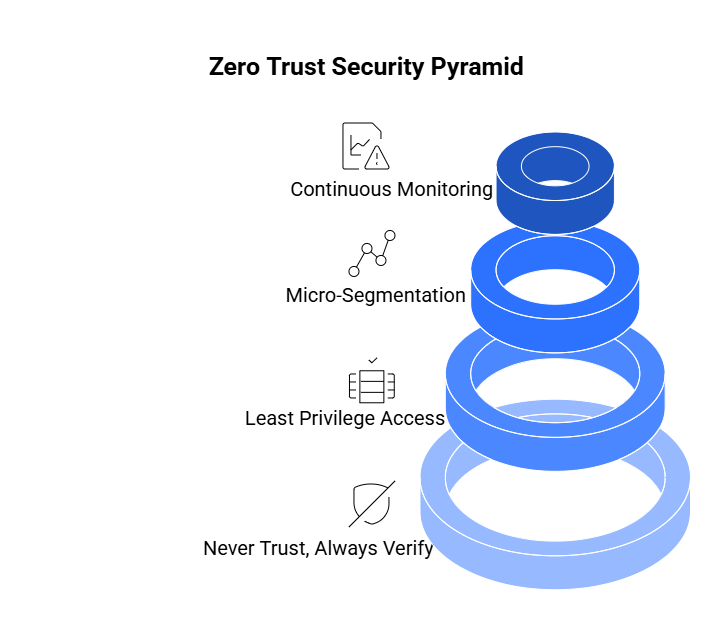
Core Principles of Zero Trust:
Never Trust, Always Verify: Trust is not automatically given based on location or credentials.
Least Privilege Access: Users and systems are granted the minimum access required for their tasks.
Micro-Segmentation: Networks are divided into smaller, isolated segments to limit lateral movement.
Continuous Monitoring: Activities are logged and analyzed for anomalies and risk indicators.
Why It Matters for Risk Management
Traditional risk management strategies often rely on assumptions about trusted zones or static controls. In contrast, Zero Trust enforces real-time, dynamic control, making it better suited to address modern threats like:
Insider breaches
Credential theft
Third-party compromise
Cloud misconfigurations
By integrating Zero Trust principles, organizations can redefine their cyber risk management strategy around granular access controls, visibility, and adaptability. This approach not only reduces exposure but supports regulatory compliance and data governance in sectors like finance, healthcare, and critical infrastructure.
Traditional vs. Zero Trust Risk Management Strategies
Risk management has long been a pillar of cybersecurity, but the strategies employed are evolving rapidly. Organizations that continue to rely on legacy, perimeter-based approaches may find themselves unprepared for the dynamic, decentralized nature of today’s threat landscape.
Traditional Risk Management Approach
Historically, risk management in IT environments centered around the assumption that:
The network perimeter is secure
Once inside, users and systems can be trusted
Threats originate mostly from the outside
This led to controls like firewalls, VPNs, and role-based access systems focused on external defense and compliance checklists, rather than continuous validation.
Limitations of the Traditional Approach
Assumes internal trust: Malicious insiders or compromised credentials can move freely within the network.
Lacks granular visibility: Once attackers breach the perimeter, lateral movement often goes undetected.
Static security posture: Risk assessments and policies are often reviewed infrequently.
Poor adaptability: Difficult to apply in cloud-native, multi-device, remote-first environments.
Zero Trust Risk Management Strategy
A Zero Trust-aligned strategy, by contrast, treats all access attempts as untrusted — no matter where they originate. This model:
Eliminates implicit trust between users, devices, and workloads.
Implements dynamic access controls that consider identity, context, behavior, and risk level.
Integrates automation to detect, contain, and remediate threats quickly.
Provides full visibility across cloud, on-prem, and hybrid environments.
Key Strategic Shifts
Traditional Risk Management
Zero Trust Risk Management
Trusts internal users by default
Requires verification for every request
Perimeter-focused defenses
Identity and context-driven protection
Periodic reviews of risk
Continuous monitoring and risk scoring
Manual access management
Policy-based automated enforcement
By transitioning from a static, perimeter-based model to a dynamic, risk-aware Zero Trust strategy, businesses can dramatically improve their cyber resilience and incident response capabilities.
Setting Cyber Risk Management Goals in a Zero Trust Framework
Establishing effective cyber risk management goals is essential to successfully implementing a Zero Trust strategy. Without clearly defined objectives, organizations may invest in tools and technologies without a cohesive framework to guide action or measure progress.
A Zero Trust environment demands that risk management goals go beyond compliance — they must be intentional, adaptive, and integrated across IT and business operations.
A. Strategic Risk Management Goals
Strategic goals focus on long-term vision and alignment with business objectives. Within a Zero Trust framework, these include:
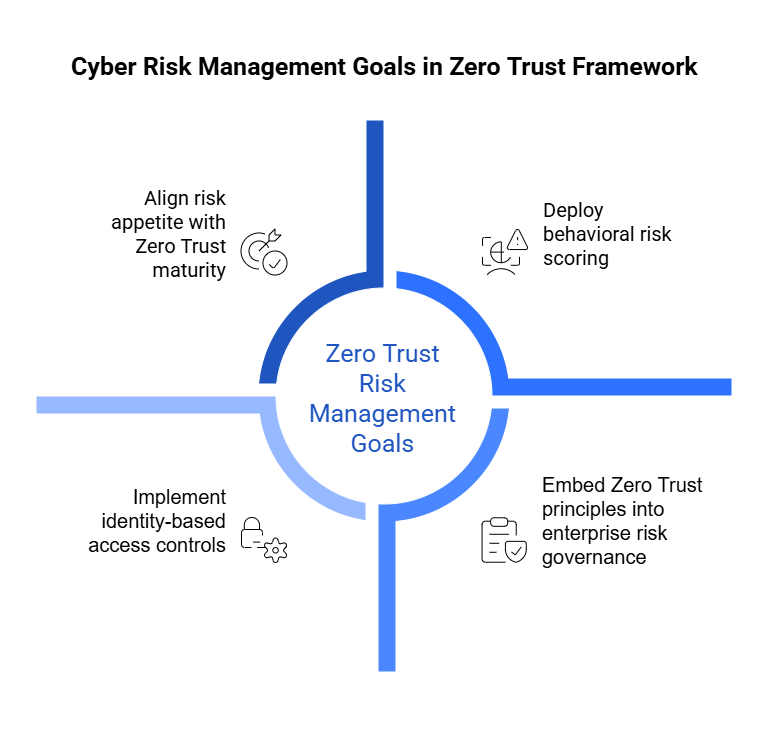
Aligning risk appetite with Zero Trust maturity: Define how much cyber risk the organization is willing to accept and adjust policies accordingly.
Embedding Zero Trust principles into enterprise risk governance: Make Zero Trust part of board-level discussions and enterprise-wide risk assessments.
Developing a unified cyber risk management roadmap: Coordinate across departments, aligning IT, security, compliance, and operations on shared risk priorities.
Example Goal: “Achieve full Zero Trust policy enforcement for all privileged users within 12 months.”
B. Operational Risk Management Goals
Operational goals are about making Zero Trust principles a reality in day-to-day functions. These focus on execution, tools, and workflow.
Implement identity-based access controls for all systems and data: Replace static permissions with role- and context-aware policies.
Enforce continuous authentication and device validation: Ensure that user identity, location, and device health are verified during every session.
Micro-segment critical assets: Limit access to sensitive data and services through segmented policies.
Example Goal: “Reduce unauthorized access attempts by 40% in the next two quarters through continuous authentication.”
C. Tactical Risk Management Goals
Tactical goals focus on technical enhancements and immediate risk reductions. They often support broader strategic and operational efforts.
Automate risk detection and response workflows: Use machine learning to identify threats based on behavior anomalies.
Establish real-time risk scoring: Dynamically evaluate users, devices, and sessions for potential risk and adjust permissions accordingly.
Conduct regular Zero Trust penetration testing: Validate the strength of Zero Trust controls and identify policy gaps.
Example Goal: “Deploy behavioral risk scoring in identity management systems by end of Q3.”
Overcoming Common Challenges in Zero Trust Risk Management
While the benefits of aligning cyber risk management goals with a Zero Trust model are substantial, the path to implementation is rarely straightforward. Many organizations encounter resistance, complexity, and capability gaps as they transition from legacy systems to Zero Trust architectures.
Understanding these challenges — and preparing to overcome them — is critical for success.
1. Budget Constraints and Resource Allocation
Implementing Zero Trust is not a one-time project but an ongoing transformation. It requires:
Investment in identity and access management tools
Upgrades to endpoint and network security
Skilled personnel to manage new systems
Solution: Start with a phased rollout based on risk prioritization. Focus first on protecting high-value assets and privileged identities, then expand gradually.
2. Talent Shortages and Skill Gaps
Zero Trust adoption demands advanced technical skills in areas like:
Identity governance
Threat detection and response
Policy automation and scripting
Solution: Provide upskilling programs for internal teams, partner with managed service providers (MSPs), or use low-code orchestration platforms that lower the barrier to entry.
3. Integration with Legacy Infrastructure
Legacy systems often lack APIs or modern security controls, making them incompatible with Zero Trust principles.
Solution: Use network segmentation and gateway solutions to isolate legacy environments. Gradually migrate critical workloads to modern platforms that support Zero Trust-native capabilities.
4. Organizational and Cultural Resistance
Shifting to a Zero Trust model requires changes in:
User behavior (e.g., MFA, session limits)
IT operations (e.g., least privilege enforcement)
Security ownership (moving beyond just the security team)
Solution: Establish strong executive sponsorship and communicate the “why” behind Zero Trust. Emphasize benefits like reduced breach risk, improved compliance, and faster incident response.
5. Complexity in Policy Design and Maintenance
Creating dynamic access policies for every user, device, application, and workload can feel overwhelming.
Solution: Leverage automation and behavioral analytics to reduce manual effort. Start with basic access rules and evolve toward adaptive, risk-based policies over time.
Best Practices to Align Risk Management Goals with Zero Trust Architecture
Successfully implementing a Zero Trust model requires more than just technology — it demands a thoughtful, strategic alignment of your risk management goals with security architecture, governance, and day-to-day operations. These best practices will help ensure that your Zero Trust initiative is not only technically sound but also sustainable and impactful.
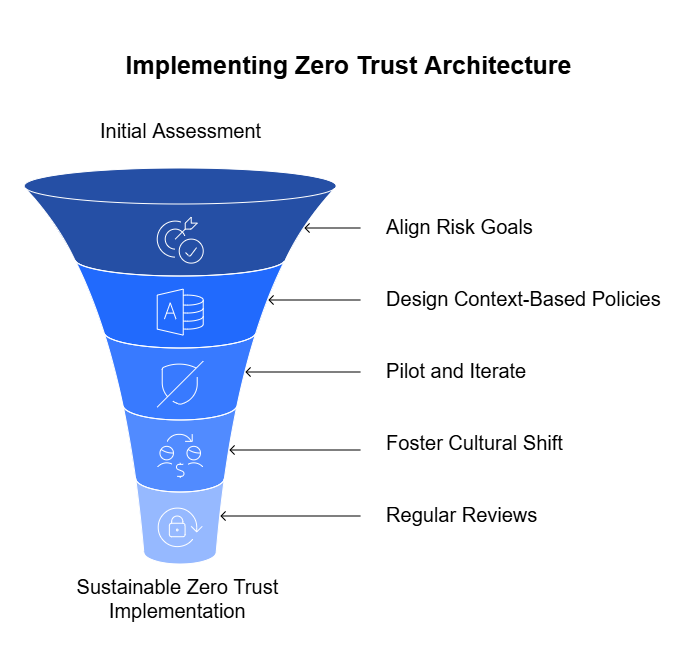
1. Start with a Zero Trust Readiness Assessment
Before setting goals or deploying tools, evaluate your current environment:
What data and systems are most critical?
Who has access, and how is it managed?
What legacy systems or gaps pose risks?
Action: Use a structured Zero Trust maturity model to benchmark your starting point and identify priority areas.
2. Align Risk Goals with Business Objectives
Cybersecurity should not exist in a silo. Your risk management goals must support broader business outcomes, such as uptime, customer trust, and compliance.
Example: If protecting customer data is a top business goal, create a risk objective to isolate and tightly control access to customer databases using Zero Trust policies.
3. Design Policies Based on Context, Not Roles Alone
Traditional access management often relies on static roles. Zero Trust introduces dynamic, context-based access control:
Where is the user connecting from?
What device are they using?
Is behavior consistent with past activity?
Best Practice: Implement adaptive access controls that adjust privileges based on risk signals — not just job titles.
4. Pilot, Iterate, and Scale
Trying to apply Zero Trust principles organization-wide from day one can be overwhelming. Instead:
Choose a limited-scope pilot (e.g., securing a sensitive application or department).
Measure results: breaches prevented, user friction, policy violations.
Use feedback to refine your approach before scaling further.
5. Make Zero Trust a Cultural Shift, Not Just a Tech Project
Achieving your risk goals under Zero Trust requires employee buy-in and organizational mindset change:
Provide training on new access procedures.
Reinforce the value of cyber hygiene.
Reward teams that meet security and compliance milestones.
6. Review and Update Goals Regularly
The cyber threat landscape evolves quickly, and so should your risk management objectives. Establish a quarterly review process to:
Analyze incidents and near misses
Reassess technology and control effectiveness
Reprioritize risk goals based on changing business needs
Final Thoughts on Adopting a Zero Trust Risk Management Strategy
The shift to a Zero Trust Security Model represents more than just a new security framework — it’s a necessary evolution in how organizations manage cyber risk. In a world where users, devices, and data are everywhere, relying on perimeter-based trust models leaves too many blind spots. Zero Trust encourages continuous verification, least-privilege access, and adaptive controls — all of which support stronger, more aligned risk management practices.
However, achieving these outcomes isn’t just about defining goals; it also depends on having the right tools to operationalize those goals across teams and systems.
Platforms like SPOG.ai can play a meaningful role in this process by helping teams:
Break down silos between security and operations
Integrate risk visibility into day-to-day decision-making
Automate and enforce access controls based on contextual risk
For organizations looking to put Zero Trust principles into practice, it’s important to not only design thoughtful strategies — but to ensure those strategies are actionable, measurable, and sustainable across the business.
Zero Trust is a long-term commitment, but with clear goals and the right infrastructure in place, it becomes a powerful enabler of resilience, agility, and trust