Continuous Control Monitoring
Security Questionnaires: Respond with Accurate, Verifiable Answers
Security questionnaires help buyers understand how a supplier protects the data, systems and services involved in a proposed...
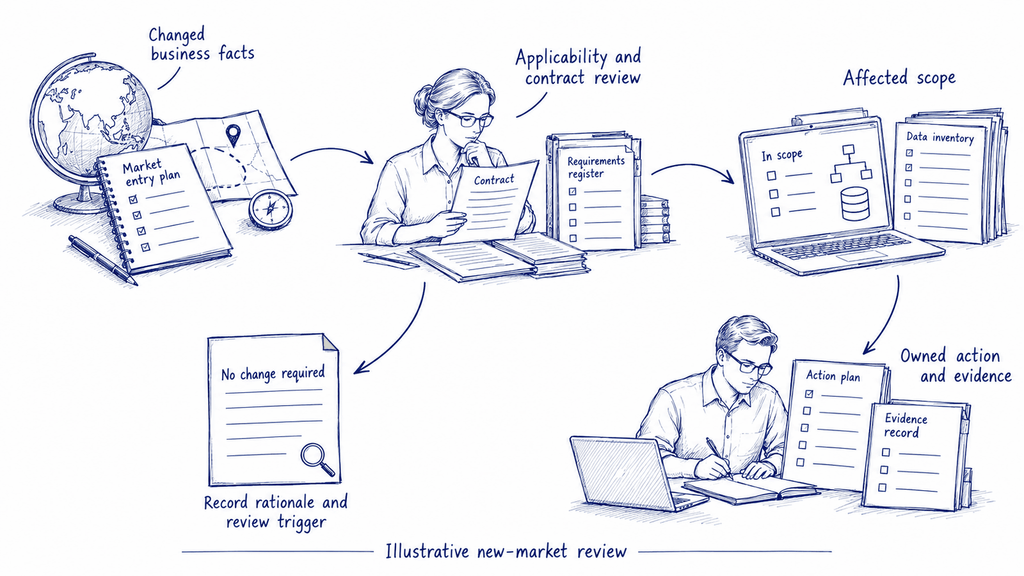
A company launches in another country, introduces a new use for customer data, or signs an enterprise contract with stricter security terms. Each decision can change what the organization must protect, demonstrate, or deliver. Yet the teams responsible for compliance may learn about it only after the launch or signature, leaving little time to assess requirements and close gaps.
The practical response is to make material business changes a trigger for review. Before proceeding, identify the changed facts, assess relevant legal and contractual requirements, and assign any necessary control updates to accountable owners. Record unresolved questions and the reasons behind decisions, including when no change is needed, so future reviews start from a clear basis.
Compliance challenges for fast-growing companies rarely arrive as one large regulatory event. They build in the seams: a product enters a new market, a new data use reaches production, or a supplier becomes critical. The organization may still rely on a compliance map built for the business it was six months ago.
Growth changes what the company does, where it operates, whose data it handles, and which partners deliver the product. Each shift can affect legal obligations, contract commitments, framework scope, control ownership, or assurance evidence. The compliance program has to notice before an annual review or customer questionnaire does.
Do not treat every milestone as a new framework project. A compliance scope review should connect business changes to an applicability decision: what changed, which obligation or promise may apply, what is affected, and who must decide or act. This keeps attention on the compliance perimeter growth moves.

A company’s compliance perimeter is the entities, products, locations, data, systems, suppliers, and commitments included in its obligations and assurance claims. It is rarely defined by headcount alone. A 40-person company might cross a threshold by launching a payment flow or serving a regulated customer; a larger company may add little scope after routine hiring.
Different teams often maintain separate versions of reality: legal tracks jurisdictions, product tracks features, engineering tracks architecture, procurement tracks suppliers, and sales tracks commitments. Each list may be accurate while the overall compliance position is wrong. Start with the growth event and follow its operational consequences.
Use these changes as review triggers, not as a checklist that automatically declares a law applicable. Legal applicability depends on the facts, the entity, the activity, and the relevant jurisdiction. The point is to identify when the facts have changed enough to ask the question again.
A new country, state, or customer segment can change privacy, cybersecurity, financial-sector, or reporting obligations—and buyer assurance expectations. Record the target market, contracting entity, customer type, data subjects, and activity. Have counsel or the compliance owner confirm whether this creates a legal duty, contract commitment, or assurance request. A sales territory alone does not establish applicability.
Features can change information purpose, sensitivity, retention, or access. Analytics, automated decisions, model-assisted functions, or a new identity integration may change applicable controls and approvals. Ask product and engineering to identify affected systems and data flows, then compare them with current scope and commitments.
India’s Digital Personal Data Protection Rules, 2025 show why effective dates belong in the review. The MeitY Rules listing and Official Gazette notification set different commencement dates for different rule groups and include a later corrigendum. Recording only “DPDP” in a tracker can obscure which provisions apply now and which begin later. Check the current notification and obtain legal interpretation for the organization’s activities.
New cloud platforms, processors, and support tools can change data location, access, and control operation. Procurement approval alone does not settle those questions. Connect the supplier to the product, process, and data involved. Check whether the assessment and contract cover the use and whether disclosures or evidence must change.
An acquisition can bring a new entity, technology estate, customers, records, contracts, and obligations into scope. Before consolidating systems, establish which obligations continue for each entity, which controls are shared, and which records remain distinct. Treat acquired controls as unverified until their design, coverage, and operating evidence meet your requirements.
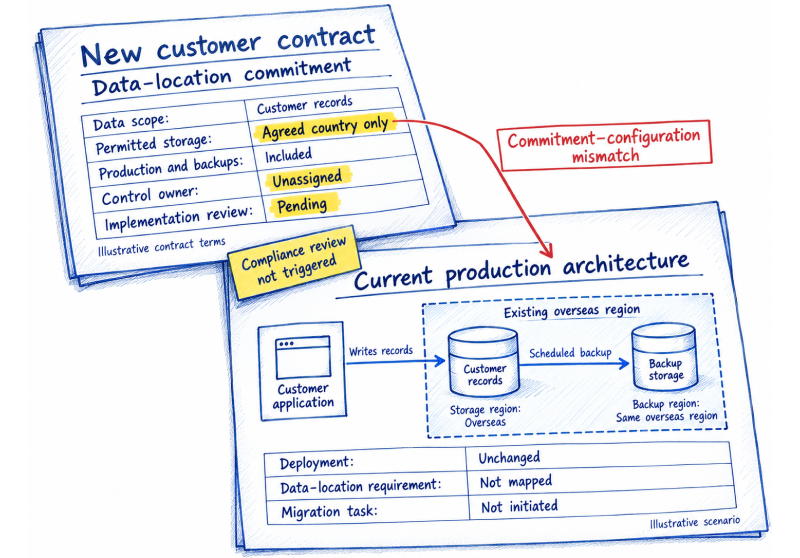
Enterprise contracts may set incident-notification windows, testing cadence, data-location promises, or subcontracting limits beyond formal certification scope. These are contractual, not automatically statutory, commitments. Route terms to control and process owners before signature; otherwise, the company may promise an outcome it cannot demonstrate.
A trigger review should fit into launch planning and prevent a vague “compliance checked” sign-off. Attach the decision record to product release, market entry, supplier onboarding, acquisition integration, or contract approval.
Capture the event and date; changed facts; obligations and commitments considered; affected entities, systems, data, and controls; and the decision, owner, and next review point. Preserve “not applicable” with its rationale. Keep unknowns open rather than converting them into a green status.
Overlapping frameworks may point to similar safeguards but differ in scope, population, frequency, or evidence. A shared control can support several obligations, but each requirement’s conditions still need to be met. Reusing control language does not prove equivalent coverage.
The person who spots a change may not be qualified to interpret its compliance effect. Sales may hear a customer requirement; product knows the feature; engineering understands the data path; legal or privacy determines applicability; a control owner changes the procedure. Make these handoffs explicit and time-bound.
Make the initiating team responsible for raising a trigger, and assign applicability decisions to the appropriate legal, privacy, risk, or compliance authority. Control owners confirm what must change and when. This keeps legal interpretation with qualified decision-makers and discovery distributed across the business.
For critical infrastructure organizations, CISA’s Cross-Sector Cybersecurity Performance Goals 2.0, released in December 2025, treats governance, accountability, and risk management as explicit cybersecurity concerns. CISA presents the goals as foundational guidance for critical infrastructure owners and operators, not a universal legal mandate.
Illustrative scenario: A B2B software company plans to open a second-country tenant and add a model-assisted support summary. The launch review records the new market, customer entity, data sent to the model, retention setting, and access roles. The privacy lead confirms applicability; engineering names affected systems; the control owner identifies required changes. If a requirement does not apply, the rationale stays with the launch record for later reassessment.
After applicability is assessed, teams need to connect requirements to controls, evidence, and action. SPOG’s GRC solution provides a shared view of requirements, controls, evidence, and exceptions. Its Continuous Control Monitoring solution connects controls with operational evidence to assess coverage and effectiveness. The Remediation solution supports accountable execution and validation when a gap is identified. Fit depends on connected systems, evidence sources, and workflows.
Put the review at product launch, market entry, supplier onboarding, acquisition integration, and contract approval. Revisit the record when a material fact changes. A quarterly check can identify new entities, locations, product uses, or promises that missed review.
Measure whether changes are caught early enough to act: time from trigger to decision, launches with unresolved scope questions, commitments without a control owner, and overdue procedure changes. These are operational signals, not a legal-compliance score; interpret them with decision quality and evidence.
Fast growth will keep changing compliance obligations and assurance boundaries. Make those changes visible while there is time to decide what they mean. Connect each material change to scope, requirements, accountable owners, and affected controls. Leaders gain a clearer basis for expansion, while teams have an action before an audit or customer review exposes a gap.


Security questionnaires help buyers understand how a supplier protects the data, systems and services involved in a proposed...

A vendor cybersecurity inquiry should establish what the supplier will do, which data and systems it can access,...

A vendor management policy sets the rules for approving suppliers, accepting exceptions and responding when relationships change. This...