Continuous Control Monitoring
Security Questionnaires: Respond with Accurate, Verifiable Answers
Security questionnaires help buyers understand how a supplier protects the data, systems and services involved in a proposed...
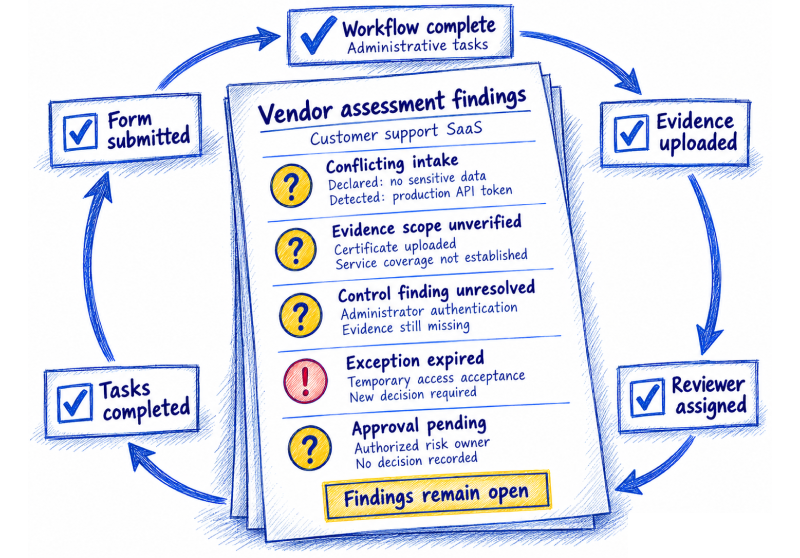
Vendor risk assessment automation can process more suppliers with fewer manual steps. But speed creates risk if incomplete intake earns a low tier, a certificate stands in for control evidence, or a workflow closes with gaps unresolved.
A better design automates repeatable handling but keeps judgment where context matters. NIST’s 2026 due-diligence guide frames supplier research as input to acquisition and existing-system decisions. Automate the review path while keeping evidence, exceptions and decision authority visible.
Manual processes often fail when requests arrive late, owners are unclear, evidence sits in email or business use starts before review closes. Automation can reduce handoffs; it cannot repair a weak risk model or decide whether a control fits a use.
Treat automation as workflow control. Define assessment triggers, required data, routing, approval authority and reopening conditions. Reviewers must be able to explain the rules that determine a tier or outcome.
A useful automated process moves through gates. Each checks readiness for the next step. Missing or conflicting information must stop or route the case for review, never become a favorable default.
Record the supplier offering, sponsor, purpose, systems, data, requested access and start date. If uses have different permissions or exposure, keep separate use records under one supplier identity, each with its own owner.
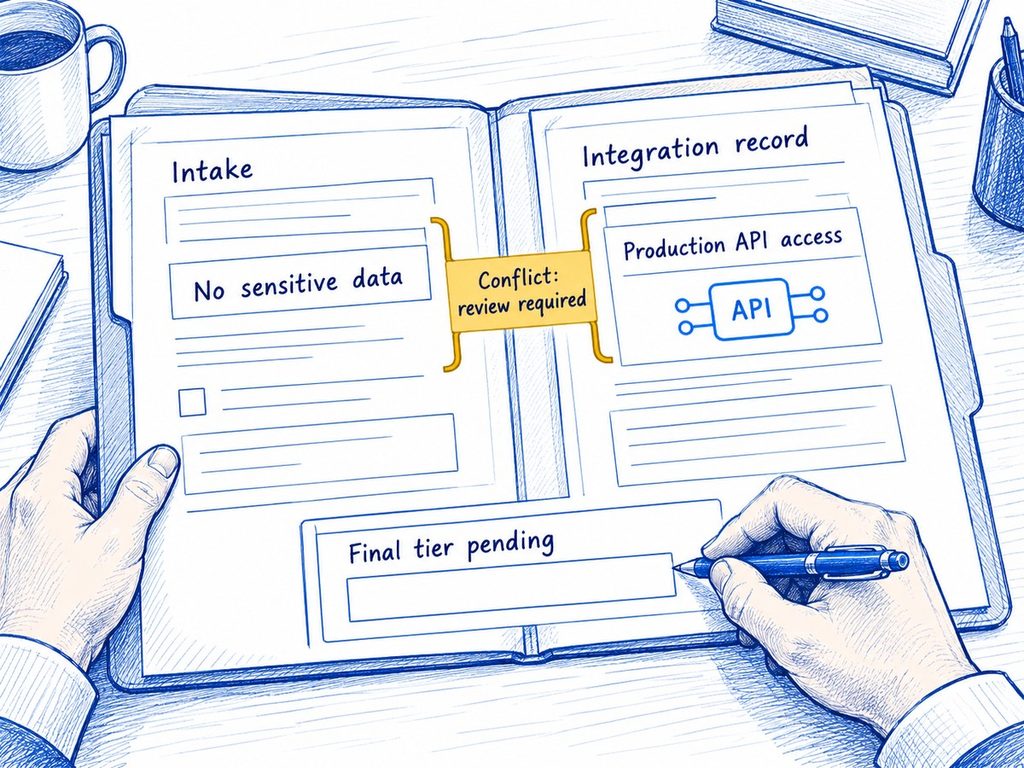
Validate required fields and duplicates before review. Flag conflicts, such as “no sensitive data” alongside production access, and send them to a named reviewer instead of assuming a lower tier.
Set a few review paths with explicit criteria. A low-impact purchase may need owner confirmation and baseline terms; confidential data may require targeted evidence; privileged access or a critical role may need security, technology and business approval. Align categories to policy and obligations.
Record the answers and rule version behind each route. Require a reason and approver for overrides. This exposes threshold changes and reduces inconsistent outcomes across units.
Treat rule changes like controlled policy changes. Record the effective date, approving owner and reason; preserve the old version on assessments already in progress. When a threshold changes, test a representative set of prior cases against the new rule. That comparison can reveal whether the change shifts too many relationships into a lighter path or creates a queue the team cannot review.
A completed field shows that someone answered. Capture evidence source, date, scope and review status. A current certificate, policy or test report may support a claim without proving that the relevant product, environment or control population is covered.
Track evidence as requested, received, under review, accepted for this use, rejected, expired or not applicable with rationale. Do not let “complete” hide scope questions. Link shared evidence once, then record its relevance to each use.
For connected sources, retain collection time and source identity. A successful integration call does not mean the underlying record is current. Show when data was last refreshed, distinguish unavailable from empty, and prevent failed syncs from overwriting a known value with a blank. These small states determine whether a routing decision can be trusted.
Turn incomplete responses or control gaps into findings with an owner, due date, action and closure evidence. Route the risk decision to the policy-defined authority. Reviewers may recommend an outcome; task completion must not silently approve the relationship.
For an accepted issue, record scope, rationale, safeguards, approver and expiry or review date. Escalate overdue conditions so expired exceptions do not remain invisible.
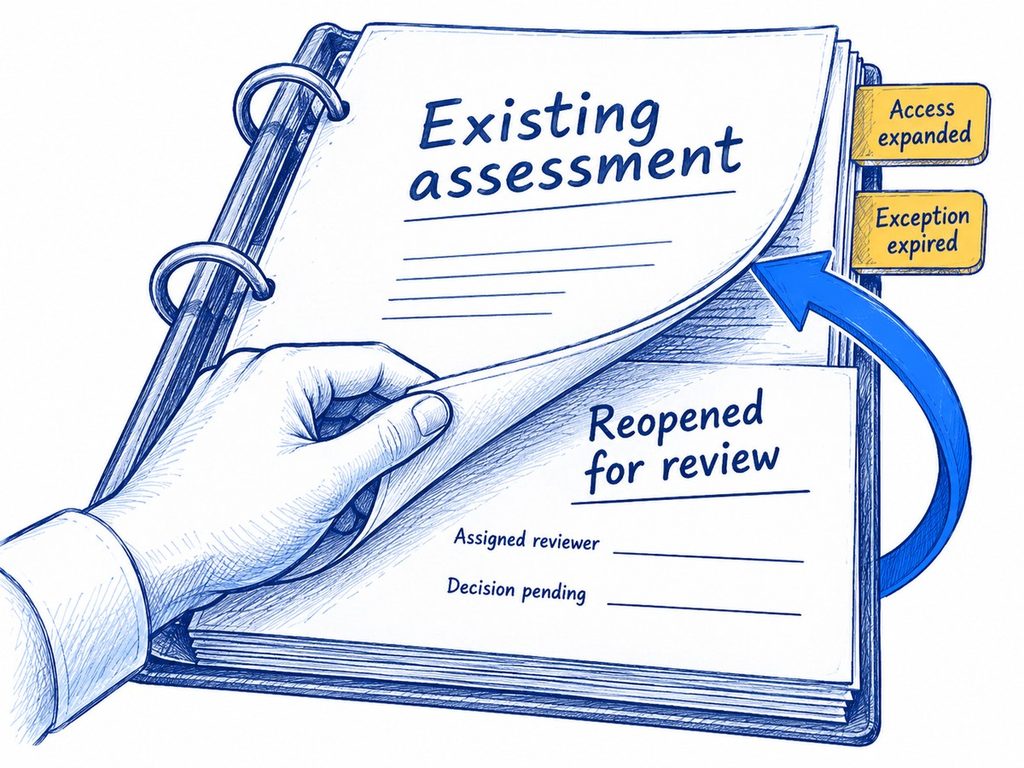
Assign each trigger an owner and action. Renewal, changed purpose, expanded access, new data use, expired evidence or a significant incident may reopen review. An alert without a reviewer is just another inbox item. Do not call a scheduled check real-time monitoring.
Automate repeatable coordination: intake validation, assignment, reminders, escalation, expiry notices, routing, record linking and status reporting. Test each rule against expected outcomes.
Keep people accountable for interpreting ambiguous evidence, judging safeguard fit, weighing business consequences, approving exceptions and accepting residual risk. A system can flag missing or conflicting data; it cannot infer risk tolerance or own the decision.
If AI assists with summaries or answers, require source references, visible uncertainty and reviewer correction. Generated text is not evidence just because it fills a field.
Pilot varied records before connecting every procurement request. Test missing data, contradictions, expired evidence, unusual access, multiple uses, unavailable reviewers and expiring exceptions. Confirm each case reaches the right person and leaves a traceable record.
Test failed integrations and stale data. Does the workflow mark the source unavailable, use a dated fallback or proceed as if current? It should fail visibly. Compare automated routes with human-reviewed cases and resolve disagreements before rollout.
Illustrative case: an intake form records that a provider stores no sensitive data, while the integration inventory shows a production API token. A well-designed workflow pauses the low-risk route, attaches both source records and assigns a reviewer to resolve the conflict. The reviewer confirms the actual use, updates the record and records the reason for the final tier. The system has reduced delay by surfacing the inconsistency early; it has not made the risk decision.
Define what the workflow may do while the conflict remains open. For example, policy may allow assessment work to continue but block production access or contract approval. That distinction prevents a process status such as “assessment in progress” from being mistaken for authorization to use the supplier.
Assessment volume alone does not show process quality. Track measures that expose delays and routing errors:
Keep the denominator and scope visible. A low average may hide critical suppliers awaiting approval. Sample low-risk and closed cases to detect false confidence.
Vendor risk automation depends on more than the assessment form: teams need accountable owners, connected control evidence, risk context and follow-through on gaps. SPOG.AI’s GRC solution describes governance across requirements, controls, evidence, ownership, exceptions and remediation. Its Continuous Control Monitoring solution focuses on control coverage and effectiveness using operational evidence, while IT & Operations connects governance decisions with operational workflows.
These pages describe related SPOG capabilities, not a dedicated vendor-risk automation module. Confirm each platform’s intake, integration, routing, evidence, approval and export functions before selection.
Automated vendor risk assessments work when routes have reasons, claims have traceable support, and open issues have owners. Pilot narrowly, test missing or conflicting data, and measure decision quality and timeliness.
Scale only when reviewers can explain each route, evidence basis and approval. Automation should clarify that chain, not replace it with a faster green check.


Security questionnaires help buyers understand how a supplier protects the data, systems and services involved in a proposed...

A vendor cybersecurity inquiry should establish what the supplier will do, which data and systems it can access,...

A vendor management policy sets the rules for approving suppliers, accepting exceptions and responding when relationships change. This...