Attack Surface Management in 2026: Find Unknown Assets and Reduce Their Exposure
Attack surface management helps security teams discover assets and access paths their existing inventories miss. Learn how external and internal discovery, contextual prioritization and targeted remediation reduce exposure across changing environments.
Attack surface management (ASM) is the continuous practice of discovering, classifying, monitoring and reducing the assets and pathways an attacker could use. In 2026, that includes public domains and APIs, cloud workloads, identities, endpoints, SaaS integrations, remote access services and supplier connections. The practical question is not “How many assets do we have?” It is “Which exposures can change our business risk today, and who can reduce them?”
What attack surface management should tell a security leader
A useful ASM view answers four questions. What is exposed? Which service, data set or identity does it support? What control is supposed to reduce the exposure? What action has been completed and rechecked? A scanner can identify a port or a vulnerability. ASM adds context and a decision path.
This distinction matters because an unknown internet-facing host and a known, segmented test host do not deserve the same response. Nor does a critical vulnerability automatically become the highest priority if the affected asset is isolated, compensating controls are operating and the evidence is current. ASM should make those distinctions visible without hiding the underlying facts.
External and internal attack surface management
External attack surface management
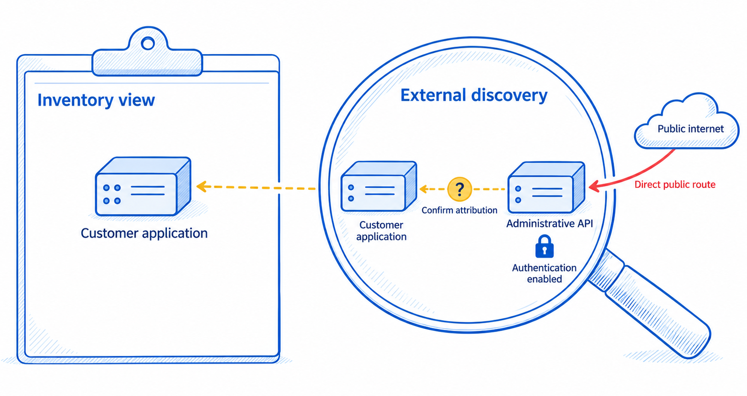
External ASM examines what an attacker can find from outside the organization. Typical scope includes domains, certificates, public cloud services, web applications, APIs, remote access gateways, exposed management interfaces and third-party portals. It relies on discovery, DNS and certificate relationships, safe probing, vulnerability data and threat intelligence. Its blind spots are often forgotten domains, newly published services and assets owned by a supplier but trusted by the business. Domain and certificate associations are clues, not proof of ownership. Confirm attribution with cloud accounts, contracts or authorized administrators before intrusive testing. Agree probing boundaries for supplier infrastructure.
Internal attack surface management
Internal ASM focuses on assets and pathways available after an attacker gains a foothold or an insider misuses access. It includes endpoints, servers, identity groups, privileged accounts, internal applications, network paths, data stores and unmanaged software. The priority is to reduce lateral movement and privilege escalation, not merely to count devices.
Where CAASM supports attack surface management
Cyber Asset Attack Surface Management, or CAASM, usually brings together inventories and signals from endpoint, cloud, identity, vulnerability, IT service and security tools. It is useful when separate tools disagree about ownership, status or scope. CAASM does not remove the need for external discovery. It improves reconciliation across the environment. External and internal describe the scope being examined. CAASM describes an approach to combining asset information; these are complementary concepts, not three mutually exclusive categories.
A five-step attack surface management process
1. Define scope by service, not by tool
Start with business services and trust boundaries. Record the environments, identities, suppliers and data flows that support them. This prevents the programme from becoming a collection of disconnected scans and gives owners a reason to keep records current.
2. Discover and reconcile assets
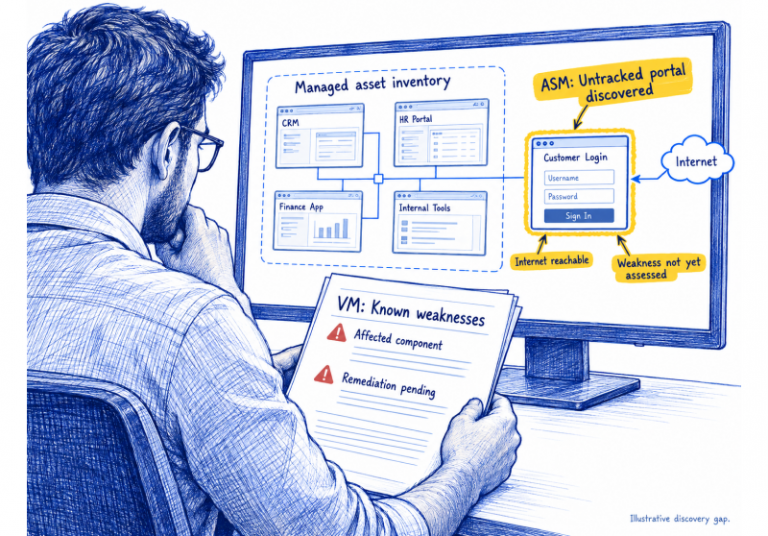
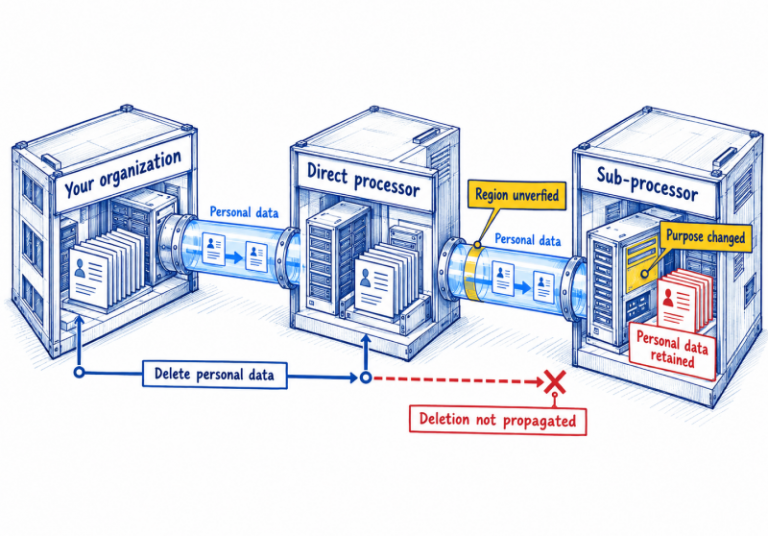
Use more than one source. Combine cloud inventories, endpoint management, DNS, certificate transparency, vulnerability platforms, identity systems and IT service records. Classify records as managed, unknown, duplicate, retired or disputed. Do not silently merge conflicting records. A data-quality problem can be a security finding when it hides an exposed asset. Preserve stable identifiers, source timestamps and the reason for each match. A reused IP address can belong to a different workload; an old certificate can outlive the service. Keep unresolved candidates visible rather than assigning ownership solely from a name match.
3. Enrich exposure with context
Add reachability, asset criticality, data sensitivity, privilege, exploit evidence, control coverage and owner confidence. Record observation time. A risk statement should explain why the asset matters, not just that it has a weakness.
4. Prioritize a small number of decisions
Use action bands that map to treatment: contain now, fix within a defined window, investigate ownership or accept with an expiry. Avoid false precision. A score is useful only when its drivers can be challenged and the assigned action is clear.
5. Remediate, validate and learn
Close the loop with a fresh observation. Confirm that the exposure is gone, the intended control is operating and the asset has not reappeared elsewhere. Track recurrence, ageing and exception expiry. If the same exposure returns, the issue may be a process or architecture weakness rather than a single missed patch.
Best practices for 2026
Treat internet exposure as a changing condition. New cloud resources, vendor changes, certificate renewals and application releases can alter risk between assessments. Set detection and review frequencies according to service criticality, not convenience.
Separate exposure from vulnerability. An unpatched flaw on a reachable payment service is different from the same flaw on an isolated, monitored system. Keep both facts visible so teams can adjust the decision when reachability or controls change.
Assign the team authorized to change the exposure. Reconfirm responsibility when the service or account moves.
Measure outcomes, not scan volume. Useful measures include discovered assets still awaiting attribution, exposed management interfaces, material findings past target and recurrence after closure. Define the population, observation period and exclusions. An increasing asset count may mean discovery improved; it does not by itself mean security deteriorated.
Use threat-informed prioritization carefully. Threat intelligence can raise urgency, but it should not erase asset context, compensating controls or uncertainty. Preserve the evidence behind the decision.
A worked example of an overlooked administrative API
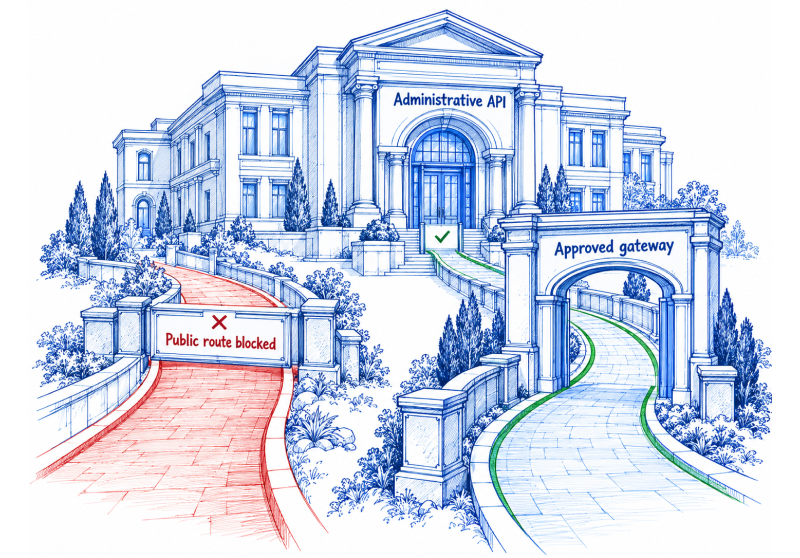
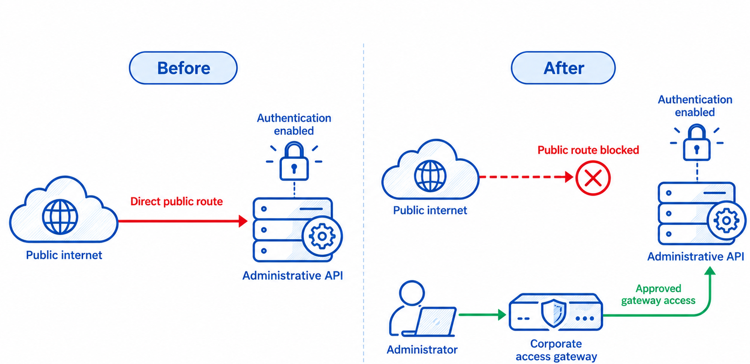
Illustrative scenario: external discovery finds an administrative API on a subdomain absent from the managed inventory. Authentication is enabled, but the service is reachable from the internet and its recorded owner has left. No known software vulnerability has yet been established. The finding is an unexplained administrative access path, not proof of compromise.
The team confirms attribution using DNS history, the cloud resource identifier and deployment records. The application owner establishes that administrators need the API only through the corporate access gateway. Engineers check dependent integrations before restricting ingress, while the security team reviews available access logs for suspicious activity. If those records are incomplete, that limitation remains open for investigation.
The approved treatment removes direct public access and permits administration through the gateway. Patching would not have corrected the unnecessary access route. A repeat check from an authorized external vantage point confirms direct requests are blocked; an internal test confirms legitimate administration still works. Engineers also check alternate hostnames, public addresses and deployment templates so a later release does not recreate the route.
Closure requires a current inventory record, the implemented access restriction and the two test results. The organization has reduced this specific exposure. It has not established that every administrative interface is protected or that the service has no other weaknesses.
How ASM supports compliance review
ASM records can support inventory, vulnerability management and monitoring controls. Retain the defined scope, discovery sources, attribution decisions, treatment records and repeat observations. Reviewers need to know which environments were checked and which remain outside coverage. A clean external scan says little about internal identities or unobserved supplier systems.
For a temporarily accepted public interface, record the business need, approving authority, compensating safeguards, expiry and reassessment trigger. An exception does not eliminate exposure. Assess these records against the applicable requirement and control objective; asset counts or closed tickets alone cannot demonstrate compliance.
Where SPOG.AI fits
SPOG.AI’s exposure management capabilities connect exposure findings with business context, prioritization and remediation workflows. Its continuous control monitoring connects defined controls with operational evidence to assess coverage and effectiveness. For the API example, relevant connected evidence can support oversight of the intended access restriction and any remaining gaps. Available coverage depends on the connected systems and evidence sources. External discovery and authorized technical testing remain necessary to establish the exposed condition and verify the treatment.
Make overlooked exposure harder to recreate
Attack surface management should leave fewer unexplained assets and fewer unnecessary routes into important services. Start with one critical service, compare its managed inventory with authorized external observations and investigate mismatches. Resolve the exposure, then fix the deployment or retirement process that allowed it to escape the inventory. That final step prevents discovery from becoming a repeated cleanup exercise.
FAQs
ASM continuously discovers, assesses and reduces assets and pathways that attackers could exploit.
It is the collection of reachable assets, identities, applications, interfaces and data paths that could be used to affect an organization.
It monitors internet-facing assets and exposures visible from outside the organization.
It examines internal assets and pathways that could enable lateral movement, privilege misuse or data access.
CAASM reconciles cyber-asset information across security, IT, cloud and identity tools.
Discovery and monitoring frequency should reflect exposure volatility and service criticality. High-change public services need more frequent observation.
Vulnerability management focuses on weaknesses. ASM also covers unknown assets, reachability, ownership, identity and exposure context.
Technology writer and content strategist with 5+ years of experience, including work for a US-based B2B SaaS client and a cybersecurity solution. I create cybersecurity and GRC content, product documentation, and user guides that help technical teams and business leaders understand security capabilities and workflows. Currently working on Confluence documentations on vulnerability management, ITSM, incident management, and continuous control monitoring, alongside SEO and AEO content, and technology partner database development.