Introduction: Why “Boardroom-Ready” Matters More Than Ever
Cyber threats have moved from the server room to the boardroom. Breaches now impact share prices, brand trust, and regulatory standing. And with every high-profile incident, boards are asking sharper, more strategic questions:
“How secure are we?”
“What are our top risks?”
“Are we investing in the right protections?”
In this new reality, being a technically brilliant CISO isn’t enough. You must be able to quantify cyber risk, assess security maturity, and—most critically—communicate both in language decision-makers understand. That’s what it means to be boardroom-ready.
This guide is your playbook for that shift—from reactive defender to proactive business leader. We’ll walk through why risk quantification and maturity assessment matter, and how you can translate cybersecurity into real boardroom impact.
Let’s get started.
The New Boardroom Expectations
Cybersecurity is no longer an operational afterthought — it’s a core component of enterprise risk and strategic planning. For CISOs, this means one thing: the board expects more.
Today’s boardroom doesn’t want technical deep-dives into patch cycles or firewall logs. Instead, they’re asking focused, outcome-driven questions:
- “What are our biggest cyber risks?”
- “Are we improving over time?”
- “How does our security posture compare to peers?”
- “What’s the business impact if something fails?”
In short, boards are looking for clarity, confidence, and context. They want to know if the organization is resilient — not just compliant. And they expect CISOs to deliver that message in a language that aligns with business priorities like revenue protection, operational continuity, and regulatory standing.
It’s no longer enough to say, “We have tools in place.” You need to back that with real metrics: how risk is trending, where maturity gaps lie, and where investments will have the greatest impact.
This shift is not just a challenge — it’s an opportunity. It gives CISOs a seat at the strategic table. But only if they’re prepared to speak in terms the board trusts and understands.
Major External Drivers for Financial Risk-Based Cyber Decisions
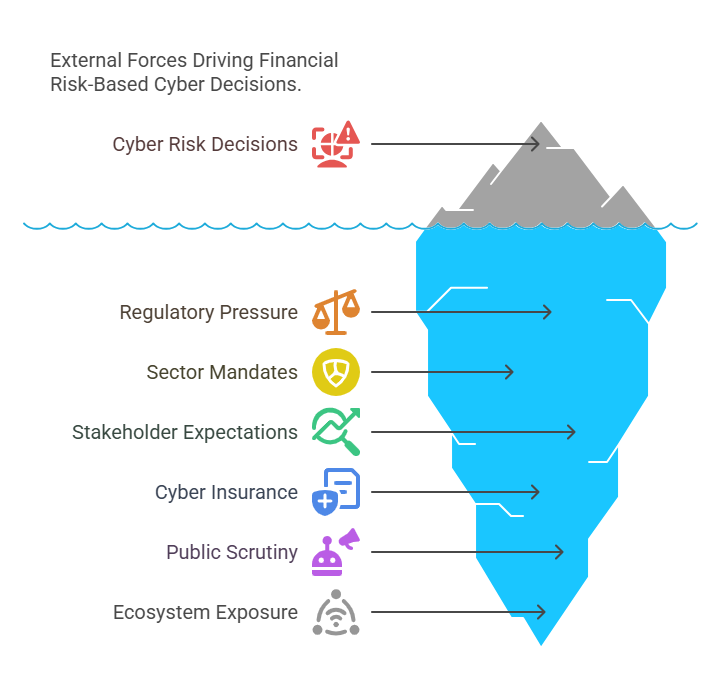
The shift toward financial risk-based cybersecurity decisions isn’t happening in a vacuum. It’s being driven by external forces—from regulatory mandates and market expectations to media scrutiny and ecosystem interdependence. These pressures are reshaping how CISOs and boards think about cyber risk, especially in fast-growing digital economies.
Here are the top external drivers shaping this evolution:
1. Stricter Data Protection Laws and Regulatory Pressure
Across jurisdictions, data protection laws are introducing hefty financial penalties for breaches, non-compliance, and failure to adopt “reasonable security practices.”
Regulators are:
- Requiring timely breach notifications (often within 6–72 hours)
- Holding organizations accountable for not just their data, but also how they handle third-party risk
- Demanding evidence of risk assessments and maturity baselines
Result: Boards expect to see clearly articulated cyber risk exposure—measured not in technical terms, but in potential financial impact.
2. Sector-Specific Cybersecurity Mandates
Financial services, telecom, insurance, healthcare, and digital platforms are under increasing scrutiny from sectoral regulators.
Common expectations include:
- Implementation of risk-based cybersecurity frameworks
- Regular maturity assessments and independent audits
- Incident reporting tied to business impact
Result: CISOs are expected to present quantified maturity metrics and prioritize cybersecurity investments based on business-critical risk.
3. Investor and Stakeholder Expectations
The capital markets are paying attention:
- Security breaches increasingly impact valuations, especially around funding, IPOs, or M&A
- Institutional investors and boards want visibility into how digital risk is being governed
- Governance scorecards now include cyber maturity and risk exposure as performance indicators
Result: Cyber risk must be expressed in terms investors understand—projected loss exposure, breach cost modeling, and maturity growth over time.
4. Rising Bar for Cyber Insurance
Insurers are becoming more selective:
- Underwriting now depends on demonstrated security maturity and quantified risk
- Organizations are asked to provide financial models of likely loss events
- Premiums and coverage terms are increasingly linked to internal assessments and posture clarity
Result: Without financial quantification and structured assessments, organizations risk either higher premiums or reduced coverage altogether.
5. Media, Consumer, and Public Scrutiny
Public trust is fragile. High-profile breaches routinely lead to:
- Reputational damage that erodes customer confidence
- Regulatory investigations and reputational fines
- Media narratives that scrutinize leadership decisions and response preparedness
Result: Executive teams are demanding board-ready metrics that demonstrate proactive risk governance—not just compliance artifacts.
6. Third-Party and Ecosystem Exposure
As digital businesses grow, they become more interconnected—and interdependent:
- A breach in one partner can ripple across supply chains and customer networks
- Organizations are held accountable for vendors and downstream risks
- Ecosystem-wide cyber resilience is becoming part of due diligence, especially in finance, healthcare, and tech
Result: Risk assessments now must factor in external exposure, vendor maturity, and probable financial impact from cascading failures.
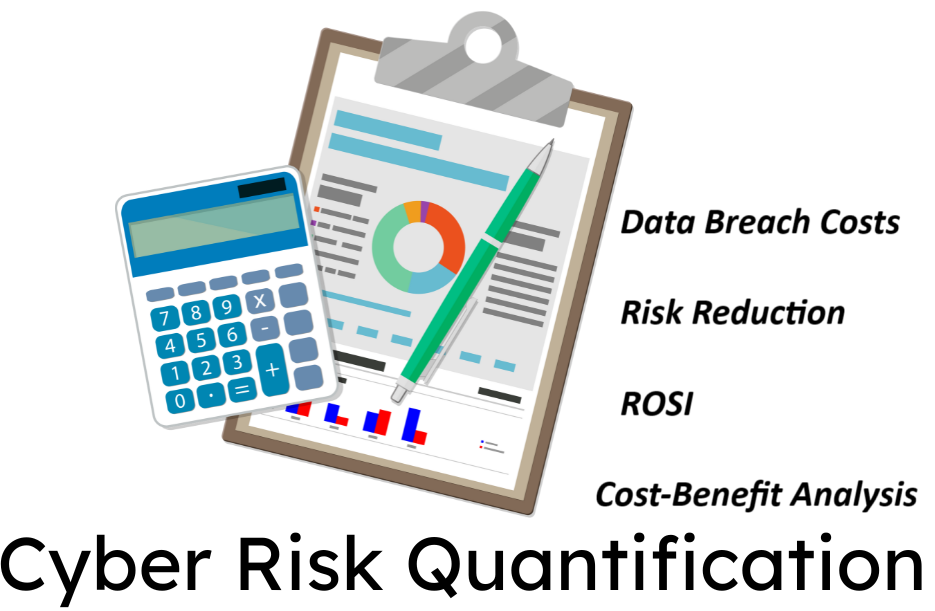
What is Cyber Risk Quantification — and Why It Matters
Cyber risk quantification is the process of turning complex, often technical, cybersecurity threats into clear, measurable business impacts — often expressed in financial terms. It’s about answering the board’s real concern:
“What’s at stake if this risk isn’t addressed?”
Rather than presenting a list of vulnerabilities or vague scores, quantification allows you to say:
- “A successful phishing attack could cost us ₹2 crore in downtime and recovery.”
- “Our current security gaps expose us to a potential data breach worth ₹5 crore in reputational and regulatory damage.”
- “By investing ₹20 lakh in X control, we reduce that risk by 70%.”
This isn’t fear-mongering — it’s translating technical risk into strategic insight.
When risk is quantified:
- Executives can prioritize with confidence
- Security investments become justifiable, not negotiable
- Risk management aligns with enterprise KPIs like revenue protection, compliance readiness, and operational resilience
Boards aren’t asking for firewalls or encryption updates. They’re asking:
“Where do we stand? What’s improving? What still needs attention?”
Cyber risk quantification gives you the numbers to answer that — without the guesswork.
Security Maturity Assessments: The Missing Link
While cyber risk quantification tells you what’s at stake, security maturity assessments tell you how well prepared you are. Together, they offer a full picture of both exposure and readiness—two things every board wants to understand.
A Security Maturity Assessment evaluates the strength and sophistication of your security program across key domains:
- Identity & access management
- Incident response
- Data protection
- Governance & compliance
- User awareness and training
- Technology controls and infrastructure
Rather than just checking if a control exists, maturity assessments look at how consistently and effectively those controls are implemented and measured over time.
Why Does This Matter to the Board?
Because it turns “We’re secure” into something tangible and trackable:
✅ Are we improving year over year?
✅ Where are we strongest, and where are we exposed?
✅ How do we compare to industry peers?
✅ What level of maturity should we target based on our risk profile?
Frameworks like NIST CSF, SEBI CSCRF, CMMI, and DPDPA offer standard ways to evaluate and benchmark maturity. When structured well, these assessments help CISOs:
- Show progress, not just posture
- Prioritize investments based on capability gaps
- Align cybersecurity goals with business strategy
- Earn trust and buy-in from non-technical stakeholders
The beauty of a maturity model? It shifts the board conversation from “Are we safe?” to “Where should we go next—and why?”
Becoming Boardroom-Ready: How to Tell the Right Story
Being boardroom-ready isn’t just about having the right data — it’s about delivering the right story. One that speaks in clarity, confidence, and business relevance.
Here’s how CISOs can shift from technical explainers to strategic storytellers:
- Start with Outcomes, Not Overwhelm
Instead of leading with vulnerabilities or acronyms, begin with the big picture:
- “Here’s how our current risk posture impacts operational resilience.”
- “This is where we’ve improved, and here’s where investment will deliver the greatest return.”
- Visuals Matter — Use Simplicity with Power
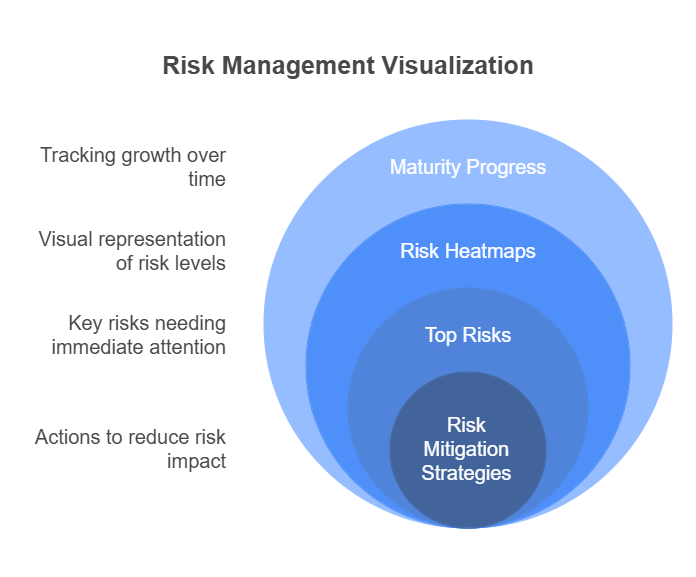
Boards don’t need pages of dashboards — they need smart summaries:
- Risk heatmaps (High/Medium/Low) tied to business functions
- Maturity progress over time (line graphs, radar charts)
- Top 3 risks + top 3 mitigations, side-by-side
Make it scannable. Make it sticky.
- Speak Their Language
Translate cybersecurity concepts into business outcomes:
- Instead of “DLP policy,” say “Controls to reduce data leak risk by 40%”
- Instead of “Zero Trust framework,” say “Approach to minimize lateral movement during breaches”
Your job is to bridge the language gap — not widen it.
- Show Trend, Not Just Snapshot
Boards care about trajectory, not just today:
- Are we getting better?
- Are investments reducing risk exposure?
- How do we compare to where we were 6–12 months ago?
- Make It Collaborative
Invite feedback. Align security priorities with business goals. Frame cybersecurity not as an IT cost, but as a business enabler.
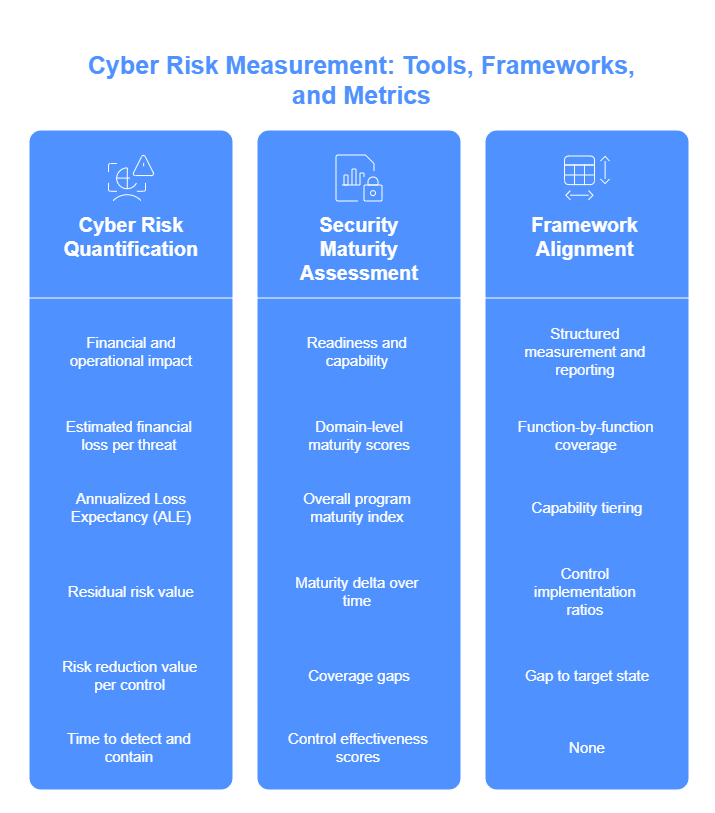
Tools, Frameworks, and Metrics That Make Cyber Risk Measurable
Boards don’t respond to vague threat levels or arbitrary color codes — they need numbers that mean something. To meet this need, CISOs must rely on tools and frameworks that not only structure assessments but also generate clear, quantifiable metrics.
Below is a breakdown of what that looks like in practice:
- Cyber Risk Quantification — What to Measure
Quantifying cyber risk involves assigning financial and operational impact to your threat landscape. The focus is on answering:
“If this risk materializes, what’s the potential cost?”
Key metrics to track and report:
- Estimated financial loss per threat (e.g., ₹2.5 Cr from a ransomware event)
- Annualized Loss Expectancy (ALE) – expected yearly cost of a given risk
- Residual risk value – risk remaining after controls are applied
- Risk reduction value per control (e.g., “Implementing X reduces risk exposure by ₹80 lakh”)
- Time to detect and contain – e.g., “average dwell time is 22 days”
These metrics shift conversations from “we’re at risk” to “this is the cost of doing nothing.”
2. Security Maturity Assessment — What to Measure
While quantification focuses on risk outcomes, maturity assessments focus on readiness and capability — how well your systems, teams, and processes are positioned to prevent or respond to those risks.
Key maturity metrics include:
- Domain-level maturity scores (e.g., Incident Response = 2.0 / 5.0)
- Overall program maturity index – an aggregate score across all domains
- Maturity delta over time (e.g., “+0.7 improvement in Identity & Access in 6 months”)
- Coverage gaps (e.g., only 65% of endpoints have MFA enforced)
- Control effectiveness scores (based on frequency, consistency, and audit results)
Boards want to see direction and progress — not just where you are, but how fast you’re improving.
3. Frameworks to Anchor Your Measurement
To give structure and credibility to these metrics, assessments should align with widely accepted frameworks. These allow CISOs to benchmark and report in consistent, board-trusted formats.
Framework-aligned metrics often include:
- Function-by-function coverage (e.g., Detect = 78%, Respond = 65%)
- Capability tiering (e.g., “Asset Management: Tier 3 – Repeatable”)
- Control implementation ratios (e.g., “14 of 18 essential controls fully operational”)
- Gap to target state (e.g., 3.2 current vs. 4.0 target maturity by Q4)
Using these structured models, you can present maturity as a journey — with a clear current state, target state, and roadmap.
Bringing It All Together: Boardroom-Ready Metrics
A high-impact security program should be able to deliver:
- Top 5 cyber risks by ₹ exposure
- Overall security maturity score and trendline
- Investment impact per ₹ spent (risk-reduction ROI)
- Business-unit-level performance comparisons
- Timeline for closing priority gaps
These aren’t vanity metrics — they’re decision-making tools. When presented clearly, they help boards understand risk in the same way they understand revenue, cost, or compliance.
Conclusion: From Cyber Defense to Strategic Influence
The role of the CISO has changed—permanently.
Today, you’re not just expected to defend systems; you’re expected to guide the business through uncertainty, quantify cyber risk in financial terms, and build confidence at the highest levels of leadership. In a world where trust, resilience, and accountability are paramount, your ability to speak the language of the boardroom has become as critical as your technical expertise.
Cyber risk quantification and security maturity assessments are not just tools—they’re enablers. They help translate complexity into clarity, posture into progress, and data into decisions.
When you can show:
- What your top risks are
- What they could cost
- How prepared you are to face them
- And where investment will make the biggest difference
—you earn more than budget. You earn influence. You earn trust.
In the modern enterprise, cybersecurity isn’t just a function. It’s a differentiator.
And boardroom-ready CISOs are the ones who will lead that shift.