Continuous Control Monitoring
Security Questionnaires: Respond with Accurate, Verifiable Answers
Security questionnaires help buyers understand how a supplier protects the data, systems and services involved in a proposed...
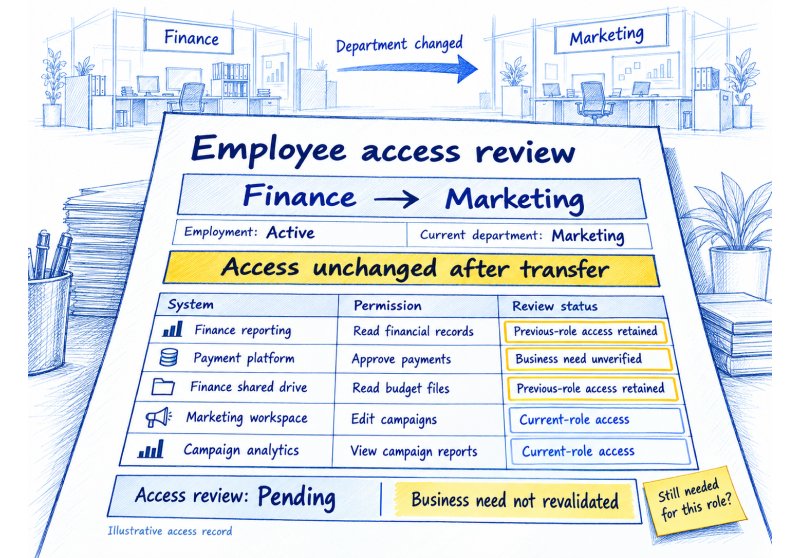
For security and GRC leaders, the test is not whether reviewers clicked approve or deny. It is whether the right access was in scope, the right people made informed decisions, and the resulting changes were verified.
Treat each review as an assurance chain: establish coverage, support judgment, record the decision, and confirm the state afterward.
An access review asks whether a person, workload, or external identity still needs permission to a resource. It should produce an accountable decision and, where needed, a verified change to effective access.
Identity data is distributed. A central provider may show a disabled employee account while a separate application account stays active. Access may also come through nested groups, cloud roles, shared mailboxes, or application assignments. A review of one layer can look complete while missing effective access elsewhere.
Ask what population was reviewed, who made each decision, what action followed, and what evidence shows the final access state. Those answers make the review useful to security, operations, and assurance teams.
Access reviews lose reliability when account lists miss access paths, reviewers lack context, or removal decisions are never implemented. These gaps can leave unnecessary permissions active even after a review is marked complete.
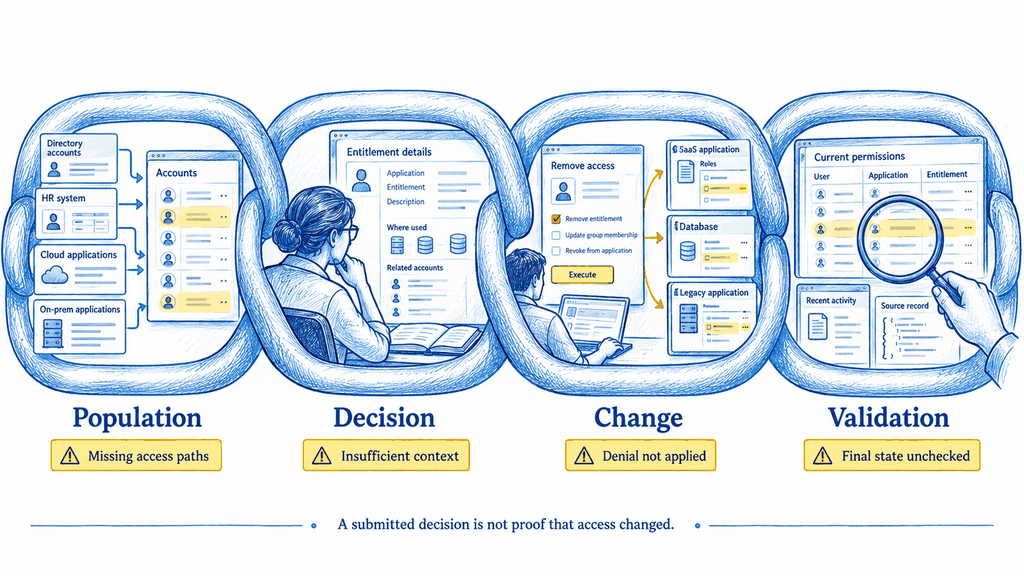
Review scope often follows the easiest inventory: directory groups, an identity-provider list, or a spreadsheet export. That may omit local application accounts, workload identities, delegated permissions, emergency access, external users, or nested groups. An export may also predate a role or application change.
For each application or data set, identify the authoritative access paths, including direct assignments and inherited roles. Document exclusions and known blind spots. The review owner should be able to explain what the list represents and what it misses.
Managers know role context but may not understand the capability behind a finance or cloud permission. Application owners know the resource but may not know whether a person still needs it for their job. Choose reviewers based on the decision required.
Show the person’s status and role, what the permission allows, resource sensitivity, business owner, and relevant changes or exceptions. Usage data can flag an entitlement, but inactivity alone does not prove access is unnecessary. A reviewer still needs to understand the work and operational dependency.
An approval or denial is a decision, not proof that access changed. Verify permissions at the source instead of inferring success from a completed workflow.
A defensible access review shows what was assessed, who made each decision, and why access was retained or removed. It also preserves evidence of the resulting changes and keeps unresolved gaps visible.
Define the resource, data, and business process. Map how people and workloads receive access through identity providers, applications, cloud roles, nested groups, local credentials, delegated rights, and emergency mechanisms. Name an owner for each source and state when the extract was taken.
Reconcile the list with independent records. Compare application accounts with workforce or contractor status and group membership with effective roles in the target system. Record blind spots. If a source lacks needed fields, use a controlled alternative and state its limits.
Use the person closest to the decision. Managers confirm role context, application or data owners assess business needs, and technical owners explain what a permission allows. High-impact access may require both business justification and security approval.
Do not ask reviewers to certify long lists of unexplained permissions. Group routine entitlements only when role mappings are clear; surface privileged rights, conflicts of duty, external access, role changes, and sensitive-data access individually. Record why access is retained when a risk signal exists.
Retain the in-scope population and source, observation time, reviewer and authority, permission details, decision, rationale when needed, and any exception. Preserve decision history; a later approval should not erase an earlier denial or open item.
The record should let another reviewer reconstruct what was considered. Keep identifiers that match decisions to accounts and permissions. Limit personal information and set record access and retention according to evidence and privacy requirements.
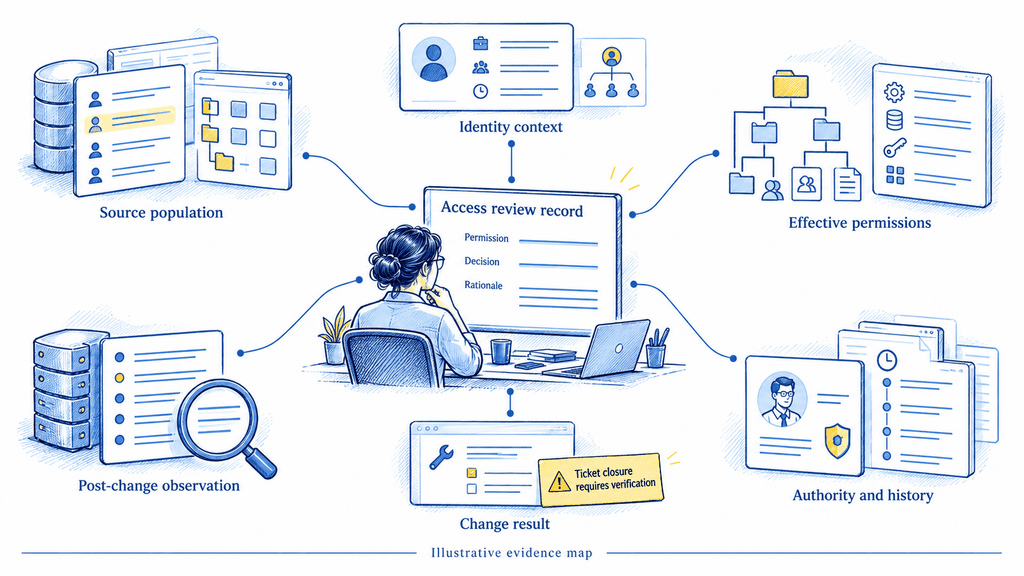
Route denied access to the team that controls the application or identity source. Distinguish “decision submitted,” “change requested,” “change completed,” and “validated.” Capture automated action results and errors. For manual changes, collect a fresh source observation or equivalent evidence.
If validation fails, keep the item open, identify the remaining path, and assign an owner. Disabling a central account may leave a local credential or inherited permission active. The decision stands, but the control outcome is incomplete until access is removed or an approved exception is recorded.
A data owner denies a contractor’s access to a reporting workspace after the engagement ends. The identity platform shows the main account disabled and the review marked complete. A check of the workspace finds an active local account that retains read access through a nested group.
The decision is clear, but the control is unfinished. The owner removes the local account and inherited membership, records both paths, then checks the workspace again. Close the item only when effective access is gone. If handover work needs temporary access, record an approved exception with an owner and end date.
This distinction also matters in incident response. CISA’s 2025 mailbox-permission countermeasure recommends auditing and restricting delegated permissions after suspected mailbox compromise. Account status alone may not reveal every route into a resource.
No single interval suits every access type. Set a baseline using resource sensitivity, privilege, change rate, and applicable obligations. Trigger additional reviews when a person changes role, a contract ends, ownership changes, permissions expand, or a control finding calls access into question.
Shorter cycles are not automatically better. Frequent, undifferentiated campaigns can increase completions while weakening decision quality. Prioritize high-impact entitlements and escalate missed reviews. A missed decision is not evidence that access is appropriate. If a platform applies a default decision at deadline, document and test that behavior.
Measure scope reconciled to source records, decisions with an accountable reviewer, denied access removed and validated on time, overdue exceptions, and repeated source failures. Completion rate is useful, but does not prove full coverage or successful revocation.
Access reviews work best when identity, application, IT, and control owners share the decision and outcome. SPOG’s GRC solution connects requirements, controls, evidence, and remediation context. Its Continuous Control Monitoring solution supports ongoing assessment where relevant evidence sources are connected; coverage depends on available systems and data. The remediation solution helps teams govern assigned gaps and follow-up.
These capabilities do not replace owner judgment or prove every permission source is visible. Before adopting a workflow, confirm which records it can access, how it represents inherited permissions, how it reports failed changes, and how reviewers inspect evidence.
An access review is complete when its scope is explainable, decisions are attributable, exceptions are time-bound, and consequential changes are verified at the system enforcing access. Keep gaps visible and assign the next action. That is how a review becomes a dependable control.


Security questionnaires help buyers understand how a supplier protects the data, systems and services involved in a proposed...

A vendor cybersecurity inquiry should establish what the supplier will do, which data and systems it can access,...

A vendor management policy sets the rules for approving suppliers, accepting exceptions and responding when relationships change. This...