Continuous Control Monitoring
Security Questionnaires: Respond with Accurate, Verifiable Answers
Security questionnaires help buyers understand how a supplier protects the data, systems and services involved in a proposed...
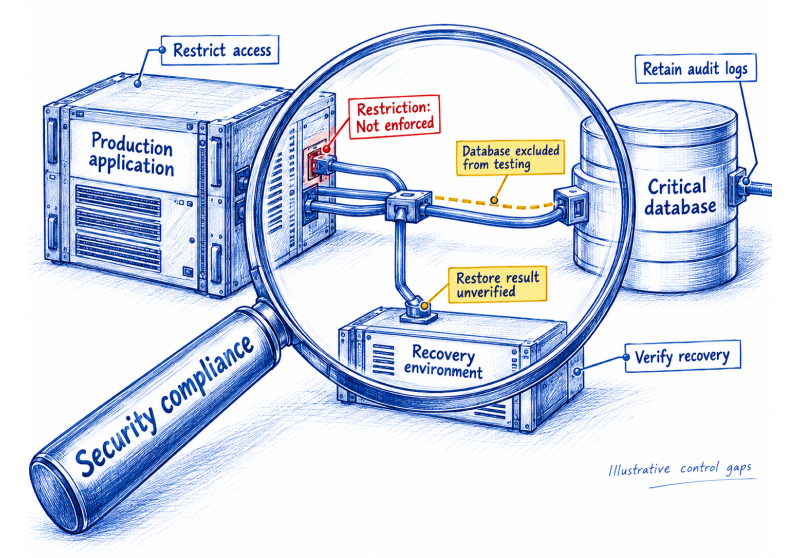
A company can maintain a complete compliance register while an application retains unnecessary access or a critical data store sits outside a control test. The problem is often a broken connection between the requirement, the systems it concerns, and the evidence used to declare it addressed. Audit conclusions and certificates have boundaries that leaders need to understand.
The practical task is to trace each material requirement into an operating control and a testable outcome. Teams need to know what must be protected, who performs the safeguard, and what evidence would expose a failure. When the environment changes, the mapping and test must change with it.
Security compliance means meeting and demonstrating the legal, regulatory, contractual, or adopted framework requirements that apply to the organization. Security is the broader work of protecting systems and information from harm. A newly exposed attack path may need urgent action even before it appears in an established compliance test.
Passing an assessment does not establish that every threat has been addressed; the assessment has a defined scope, criteria, and period. An effective safeguard may also fail a specific obligation if it misses required people, timing, approvals, or records. Connect the two views and make limitations visible.
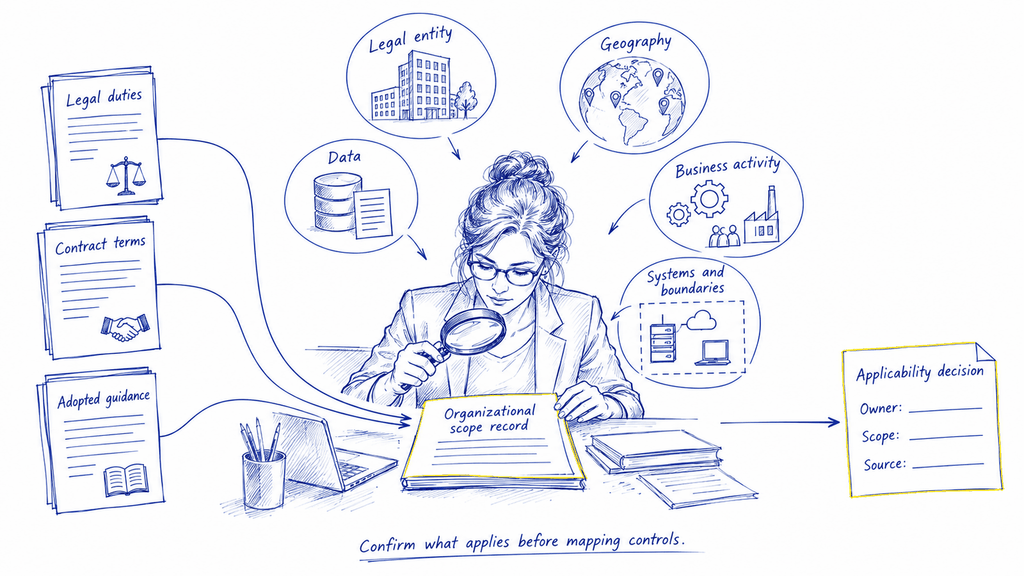
A company should not begin by collecting every familiar framework logo. First define the legal entities, locations, customer types, information handled, business activities, and technology boundaries involved. Applicability depends on those facts. Contract terms and customer assurance requests should be tracked alongside statutory requirements, but labeled accurately: a contractual promise is not automatically a law, and a voluntary framework is not automatically a regulator’s mandate.
A requirement is not yet an operational safeguard. Break it into the outcome the organization needs, the control or process intended to produce that outcome, and the evidence that can support a conclusion. Keep the original requirement linked so reviewers can trace why the control exists and whether its scope matches.
For example, an access-control requirement should prompt more than a policy reference. Identify the systems and accounts in scope, who approves access, how privileged access is limited, how changes are recorded, and how access is removed when it is no longer needed. Then test whether those steps work for the relevant population. A policy document can show intent; it cannot, on its own, prove that an account was disabled on time.
This is also where a control can serve more than one requirement. Shared safeguards may reduce duplicate work, but mapping must preserve each requirement’s conditions. If two requirements differ in coverage, review frequency, or retained records, a single control statement may need separate tests or evidence. Reuse the control where appropriate; do not assume that the proof is interchangeable.
Evidence should support a defined conclusion. A current configuration snapshot might show a setting at one point in time, while a population report may show whether the setting applies to all in-scope accounts. A ticket can show that work was assigned, but a later test is needed to establish that the intended state was restored. Ask what was observed, when, for which systems or people, and what the artifact cannot prove.
This is a practical safeguard against “green” reporting. A completed task, a signed policy, or a collected artifact is an activity or record. It is not automatically a tested control result. Keep gaps, exceptions, and limits visible so a dashboard does not imply stronger assurance than the underlying evidence supports.
A lean operating cycle can make the work manageable without turning every requirement into a separate project.
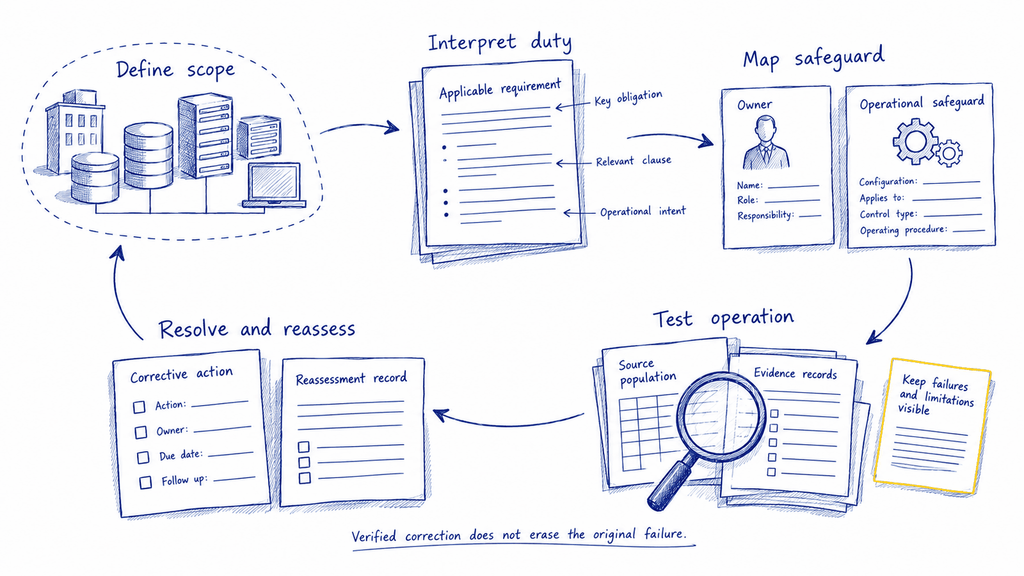
Assume a software company has a customer contract requiring departing contractors’ access to a production reporting service to be removed within 24 hours of the engagement ending. This is an illustrative contractual commitment, not a universal legal deadline. The control links the contractor register to identity and application owners, who revoke access and retain source records.
For a defined monthly period, the reviewer reconciles all contractor departures with accounts in the identity provider and reporting application. The test compares engagement end times with revocation timestamps and checks direct accounts and inherited group permissions. An incomplete departure list would make the result inconclusive, even if every listed account passed.
One contractor’s central account was disabled within the deadline, but a local reporting account remained active. The control failed for that departure. The application owner removes the local account, checks the service again for alternate permission paths, and retains the resulting access record. The review records the missed deadline separately from the later verified correction.
The process owner then adds local application accounts to the offboarding workflow and tests subsequent departures. A closed ticket alone would not establish that the gap was corrected. Leaders need the original failure, affected scope, corrective action, and validation result to understand both compliance performance and remaining exposure.
Compliance and security work crosses legal, privacy, product, engineering, IT, procurement, and business teams. Name who can interpret applicability, who operates each safeguard, who reviews evidence, and who accepts residual risk or an exception. A control owner should not be expected to make a legal determination without the right authority; a compliance lead should not be expected to validate a technical setting without its operational owner.
Review the program when obligations, products, data use, suppliers, systems, or controls change. Periodic reviews matter, but they cannot replace reassessment when material facts shift. Keep decision dates and sources so the next reviewer can tell whether a conclusion still fits.
Useful leadership questions include: Which obligations have changed? What business outcome does each important control protect? How do we know the control covers its intended population? What is currently unverified? Who owns the next decision? These questions make the compliance report useful for investment and risk decisions, not only audit preparation.
SPOG’s GRC solution connects mapped requirements with controls, operational evidence, and exceptions. Its Continuous Control Monitoring solution uses current evidence to assess control coverage and effectiveness between formal reviews. When a gap needs action, the Remediation solution supports accountable execution and validation. The value depends on connected systems, evidence sources, and the organization’s control design; product workflows do not replace legal interpretation or independent judgment.
Security compliance should leave an organization with more than a completed checklist. It should clarify which duties apply, what safeguards address them, whether those safeguards work in the real environment, and who must act when they do not. When leaders can answer those questions, compliance supports sounder security decisions and a more defensible account of the protection the organization actually provides.


Security questionnaires help buyers understand how a supplier protects the data, systems and services involved in a proposed...

A vendor cybersecurity inquiry should establish what the supplier will do, which data and systems it can access,...

A vendor management policy sets the rules for approving suppliers, accepting exceptions and responding when relationships change. This...