Continuous Control Monitoring
Security Questionnaires: Respond with Accurate, Verifiable Answers
Security questionnaires help buyers understand how a supplier protects the data, systems and services involved in a proposed...
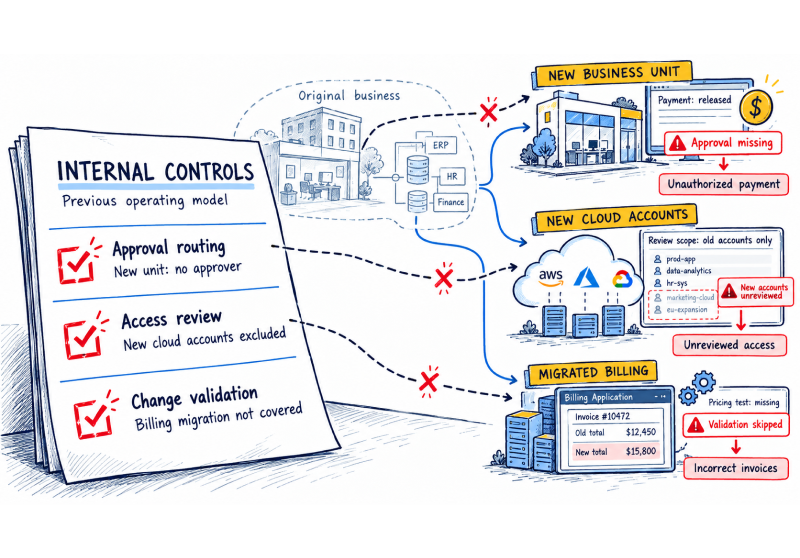
Growth changes who can make decisions, which systems hold critical information, and where responsibilities pass between teams. An approval process that worked for one business unit may leave gaps after an acquisition or platform migration. Without clear authority and checks at those handoffs, routine decisions can lead to unauthorized spending, inaccurate reporting, or access that outlasts a business need.
Effective controls start with the outcome a process must protect. Teams need to know who can authorize a change, what must be checked before it proceeds, and who responds when a check fails. When these responsibilities are built into the workflow and reviewed after material changes, controls support reliable execution and give leaders a clearer basis for decisions.
Internal controls matter because they make business work reliable: they clarify who can decide, protect information quality, and set a response when a process deviates. Their value shows up in everyday operations long before an auditor asks for evidence.
In practical terms, business internal controls are policies, approvals, technical safeguards, and operating checks that help an organization meet its objectives. They protect more than systems: transactions are authorized, information is trustworthy, responsibilities are clear, and deviations lead to a response.
That matters most when the organization changes. New applications, outsourced processes, acquisitions, AI-assisted workflows, or revised approval paths can alter authority and control coverage. The practical test is whether people can do critical work within defined limits, recognize when those limits are crossed, and correct the process before a small deviation becomes a business failure.
Internal controls support effective operations, reliable reporting, and compliance with applicable obligations. For U.S. federal agencies, the Government Accountability Office’s 2025 Green Book revision adds guidance on information security, significant change, risk documentation, preventive controls, and management responsibility across the organization.
The point applies beyond government: control responsibility cannot sit with a central team alone. Security may define access requirements, application owners approve access, managers confirm business need, and administrators implement changes. Vague handoffs create gaps even when each group believes another owns the control.
Internal controls make management information more credible. When reports inform funding, customer commitments, or regulatory responses, leaders need to know how the underlying data was created, changed, reviewed, and corrected. Data integrity depends on process design as much as technology.
A control does not guarantee that loss or error will never occur. It gives the organization a reasonable, repeatable way to prevent foreseeable failures, identify when assumptions no longer hold, and limit the consequences. This is why a certificate or policy document cannot substitute for operating controls.
Weak controls often show up as friction: approvals chased in email, access reviews that miss part of the population, exceptions without expiry, or unexplained changes. The deeper problem is that the business cannot show who decided, under what authority, and what happened next.
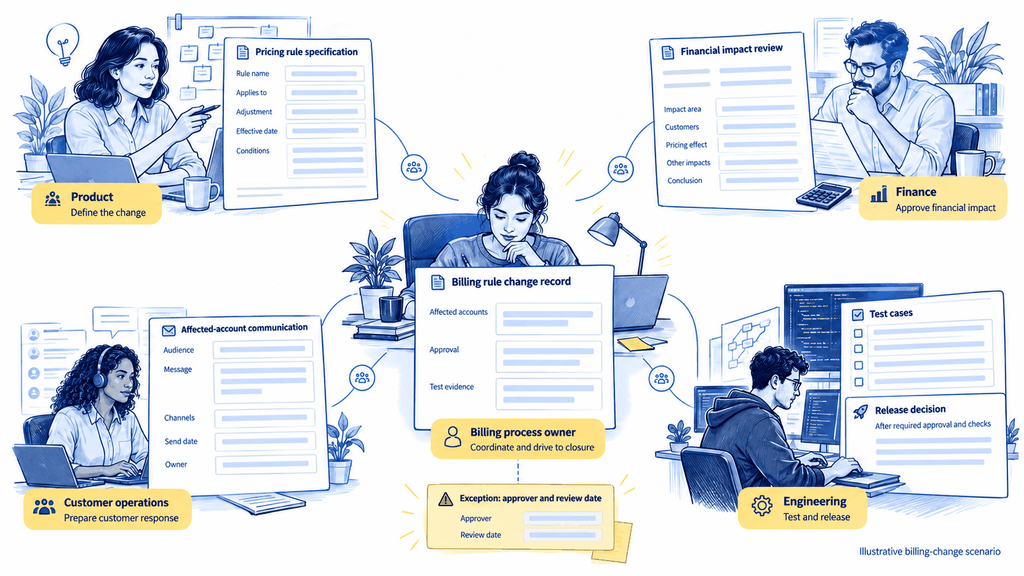
Consider an illustrative scenario: a company changes the pricing logic in its billing platform before a product launch. The deployment is technically successful, but the change bypasses a finance review, test results are not retained, and customer-facing teams are not told which accounts are affected. A single process gap can create inaccurate invoices, rework, customer disputes, and unreliable revenue reporting.
The useful control is not “more approvals” in the abstract. It is risk-based approval, a test against agreed cases, a retained result, and a route for a failed check. This protects the decision while letting routine changes move at an appropriate speed.
This distinction matters. Controls should reduce uncertainty in a process, not add ceremony to every task. Poorly designed controls can slow work, encourage workarounds, or concentrate too much authority in one person. Good design makes the safe path clear and the exception path usable.
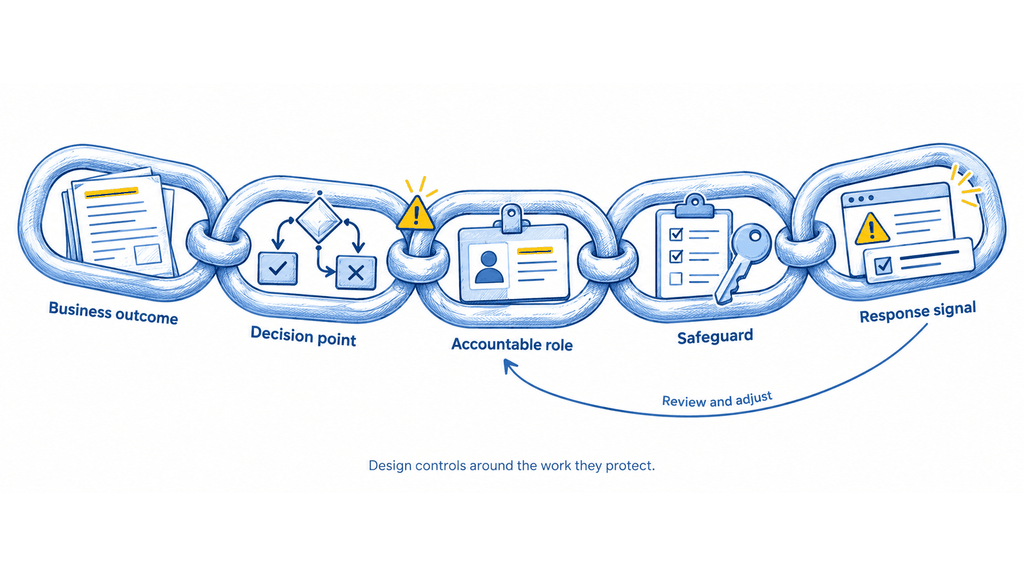
A practical design begins with the business objective and the point at which that objective could be undermined. Avoid starting with a list of technologies or a generic framework. Ask what must remain true for the process to work, where a decision or handoff can break that condition, and what action would prevent or expose the failure.
Cybersecurity internal controls are strongest when they reinforce the same workflows used by finance, product, and operations teams. At a high level, organizations use preventive, detective, and corrective measures. They may also assess the control environment, risk assessment, control activities, information and communication, and monitoring activities. These are useful design lenses, but they do not replace understanding the actual workflow.
For each material process, document five practical points in plain language: the outcome the process must protect; the decision or step that can change that outcome; the person accountable for the decision; the safeguard or review that applies; and the signal that triggers investigation or correction. Keep the record proportionate to the consequence and complexity of the process.
The owner should be close enough to the process to recognize when it changes. A central GRC team can define common requirements and provide oversight, but it should not become the invisible operator of controls owned by business, security, finance, or technology teams. Control owners need authority to make the process work and a route to escalate when the safeguard is impractical.
Internal controls cross roles. Executives set expectations; process owners define workflows; operators perform controls; security and GRC provide criteria and challenge; internal audit, where present, evaluates independently. Accountability should not disappear between them.
Exceptions deserve particular care. A temporary bypass may be necessary to restore a critical operation or meet a deadline. It should have a reason, defined scope, compensating measures where appropriate, an accountable approver, and a review or expiry date. Otherwise, a temporary decision can quietly become the default process.
Keep exception handling separate from evidence of normal operation. A control can be designed appropriately and still have an exception; recording the exception accurately helps leaders understand the actual condition. Hiding it to preserve a green status harms decision quality and weakens trust in reporting.
When controls fail, the response should address the cause as well as the immediate symptom. If a review was missed because the owner lacked access to the system data, repeating the review is not a durable fix. The process may need a changed data feed, clarified responsibility, or a different control point.
Evidence should answer a decision question: did the safeguard cover the intended process, did it operate at the right point, and what happened when it detected a deviation? A screenshot without scope may not establish this. Automated collection alone does not make a control effective.
Choose evidence that reflects the process: approvals linked to a change, access decisions tied to the user population, tests connected to release criteria, or exceptions showing authorization and follow-up. Define pass, fail, and unknown before review.
Internal control indicators should help managers intervene. Useful signals can include overdue high-impact decisions, recurring exceptions, repeated failures at the same handoff, or control activity that no longer matches the live process. Avoid treating the count of documented controls or evidence files as proof of effectiveness.
For teams that manage requirements across multiple frameworks, SPOG’s GRC solution describes connecting requirements, controls, and operational evidence. Its Continuous Control Monitoring solution describes assessing control coverage and effectiveness using connected operational evidence. These capabilities can support visibility; management still owns control design, interpretation, and decisions.
Review a control when its process changes materially, such as a platform migration, new data use, changed authority, acquisition, supplier dependency, or significant incident. Check whether the objective remains valid, the safeguard still covers the process, and the accountable person can act on the result.
Do not rewrite the control every time a tool changes. Preserve its required outcome, then update implementation and evidence when the operating environment changes. This avoids brittle procedures and vague requirements.
Where a control failure requires corrective work across security and IT teams, SPOG’s Remediation solution describes workflows for assigning owners, deadlines, exceptions, and validation through closure. A workflow can keep work visible; it cannot determine whether a proposed fix is appropriate without informed review.
Internal controls matter because they make the organization’s important processes more reliable and its decisions more defensible. Start with the work that could materially affect customers, finances, information, or continuity. Clarify who can decide, place a proportionate safeguard at the real point of failure, and make the response to exceptions explicit. Then revisit the design when the process changes. That is how controls support execution rather than merely describe it.


Security questionnaires help buyers understand how a supplier protects the data, systems and services involved in a proposed...

A vendor cybersecurity inquiry should establish what the supplier will do, which data and systems it can access,...

A vendor management policy sets the rules for approving suppliers, accepting exceptions and responding when relationships change. This...