Continuous Control Monitoring
Security Questionnaires: Respond with Accurate, Verifiable Answers
Security questionnaires help buyers understand how a supplier protects the data, systems and services involved in a proposed...
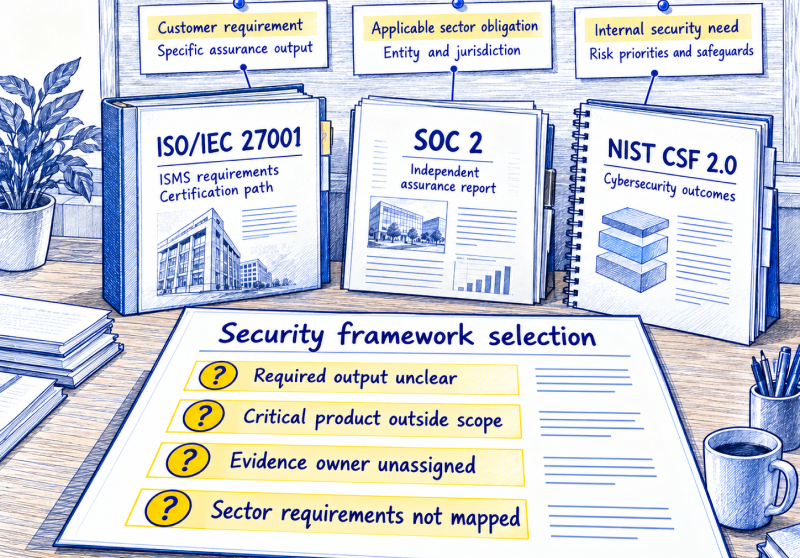
A customer asks for an ISO 27001 certificate, while a banking partner requests a SOC 2 report and alignment with its cybersecurity requirements. Leadership also needs a consistent way to prioritize security investment. These requests overlap, but each calls for a different output.
Start by separating mandatory requirements from customer assurance requests and internal improvement goals. Then assess which framework, standard or assurance approach fits each need, what it leaves uncovered, and whether teams can maintain it as products, systems and commitments change.
A security framework gives teams a structure for describing outcomes, organizing controls or governing a program. It creates shared scope and vocabulary; it does not, by itself, prove obligations are met or controls work.
Keep four terms distinct. A law or regulator’s direction creates obligations for in-scope organizations. A standard sets requirements or practices. A framework organizes outcomes or guides implementation. An assurance report communicates an independent examination. Adopting one instrument does not satisfy every contract or legal requirement.
For example, ISO/IEC 27001 is an information security management system standard with a certification path. SOC 2 is an independent examination and report based on applicable Trust Services Criteria, not a certificate. NIST Cybersecurity Framework (CSF) 2.0 organizes cybersecurity outcomes; sector requirements may add obligations a broad framework does not cover. The current ISO/IEC 27000:2026 overview explains the relationship between ISMS standards and confirms that ISO/IEC 27001 specifies ISMS requirements.
There is no universal taxonomy. Group options by why the organization needs them and what they must produce.
| Selection driver | Typical instrument | What it helps answer | What it does not prove by itself |
|---|---|---|---|
| Improve cybersecurity outcomes | NIST CSF 2.0 or a risk-oriented profile | Which outcomes should the program pursue, and how will progress be described? | That a certification or regulatory obligation has been met |
| Establish an auditable management system | ISO/IEC 27001 | How is the ISMS defined, governed, reviewed and improved? | That every customer or sector-specific requirement is covered |
| Provide independent customer assurance | SOC 2 report | What did an independent examination conclude about the scoped system and controls? | That the report covers every product, entity, location or period a buyer cares about |
| Apply a sector or regulator baseline | RBI cyber-risk KPIs and KRIs, SAMA, SEBI CSCRF, NCIIPC guidance or UAE IA requirements | Which expectations apply to this entity, activity, market and system? | That a broad international framework alone satisfies local applicability |
| Set prioritized technical safeguards | A control catalogue or baseline selected for the environment | Which safeguards should be implemented first and how will coverage be checked? | That its priorities automatically match the organization’s risk appetite |
This is a decision aid, not a claim that the options have the same legal status or scope. RBI KPIs and KRIs, SAMA, SEBI CSCRF, NCIIPC guidance and UAE IA requirements apply differently by entity, sector and jurisdiction. Confirm applicability before setting a baseline.
Recent NIST resources show how one framework can support distinct tasks: a March 2026 guide connects cybersecurity risk information with enterprise risk and workforce planning, while a June 2026 community profile applies CSF outcomes to ransomware risk.
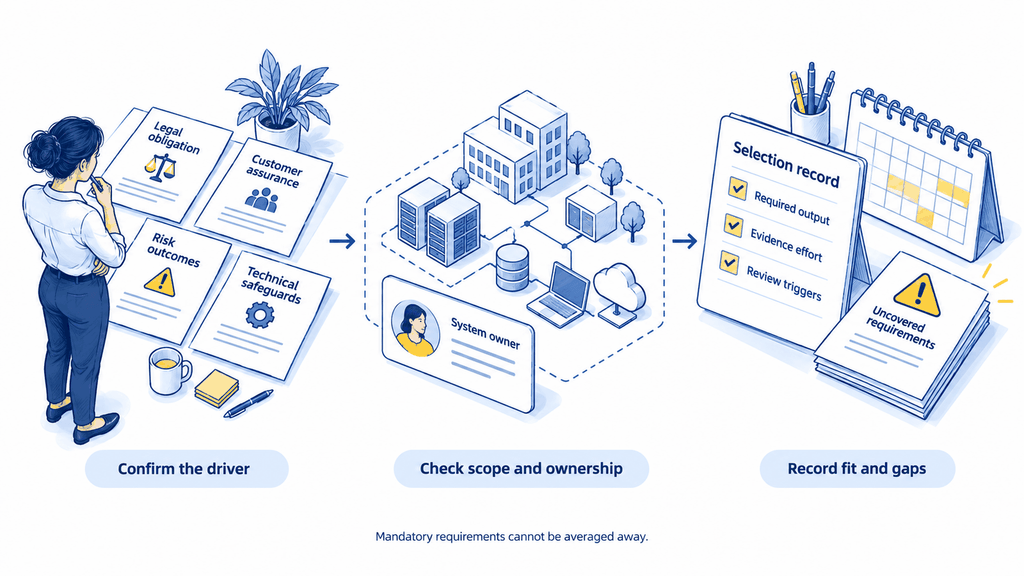
Start with the requirement that could block a launch, contract or regulated activity. A customer may need a specific assurance report, a regulator may set an obligation, or the board may need a repeatable cyber-risk model. Define the required output and decision owner before comparing framework names.
Test each candidate against five questions:
Shortlist with mandatory constraints first; do not average away a hard requirement. Compare remaining options for scope, risk relevance, assurance value, effort and update burden. Record why the selection fits and what it leaves uncovered.
Consider a software company selling to financial institutions in India and the Gulf. One buyer asks for an independent assurance report; another requests a mapping to sector requirements. Security leadership also needs a method to prioritize technical gaps.
The company confirms the scope and source of each request, then chooses an assurance path for the explicit buyer requirement, an outcome framework for internal priorities, and a map for applicable sector controls. The result can be one control environment with distinct boundaries. Reuse evidence only where scope, period and test method align; otherwise preserve the difference.
This example is illustrative. Applicability depends on the company’s role, customers, contracts and jurisdiction.
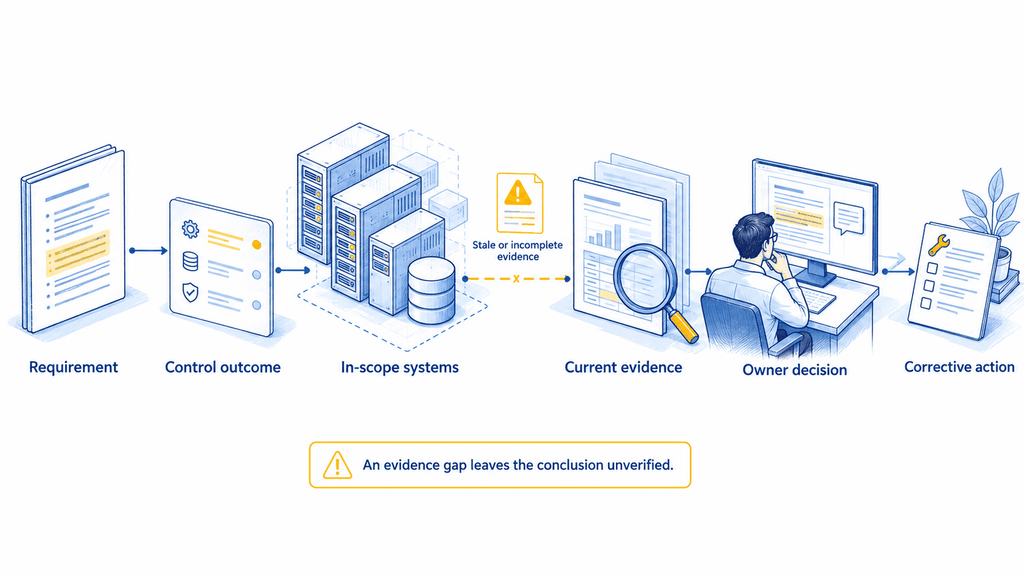
Selection is only the start. Maintain a concise operating map:
This map separates a missing document from an unimplemented control or an evidence gap. It also helps preserve scope and unresolved findings during a framework change.
Revisit the selection when business or regulatory context changes, not only when a publisher issues a new edition. A new market, product or buyer requirement can change scope. Keep versions and dates visible so teams distinguish current requirements from drafts or superseded references.
SPOG.AI is relevant once teams need to connect framework requirements with controls, evidence, ownership, exceptions and action across operational systems. Its GRC solution supports visibility across requirements, control accountability and framework alignment. The Continuous Control Monitoring solution can assess selected control states using operational evidence, subject to configured scope and connected sources. The Remediation solution supports governed follow-through on assigned corrective work.
These capabilities can support the operating model around a chosen framework; they do not decide legal applicability, issue a SOC 2 report, grant ISO certification or replace control owners’ judgment. That boundary keeps the selection useful instead of turning it into a software decision.
Choose a security framework for the obligation or decision it must support. Confirm scope, separate legal duties from assurance requests, and define how control outcomes will be evidenced and acted on. Add overlays only when they meet a real requirement.
Select an approach teams can explain and maintain as systems and obligations change. State what it covers, what it does not, and when to review it again.


Security questionnaires help buyers understand how a supplier protects the data, systems and services involved in a proposed...

A vendor cybersecurity inquiry should establish what the supplier will do, which data and systems it can access,...

A vendor management policy sets the rules for approving suppliers, accepting exceptions and responding when relationships change. This...