Continuous Control Monitoring
Security Questionnaires: Respond with Accurate, Verifiable Answers
Security questionnaires help buyers understand how a supplier protects the data, systems and services involved in a proposed...
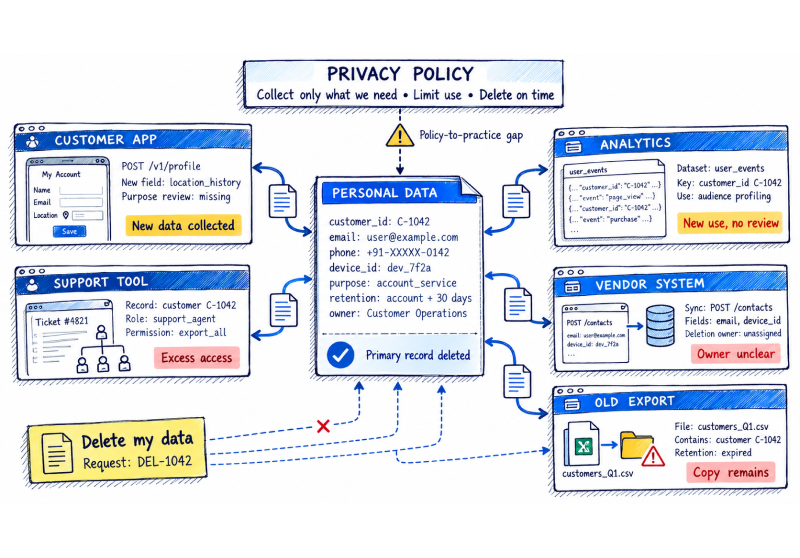
A product release adds a profile field. Analytics begins retaining an identifier that was not part of the original design. The privacy notice stays unchanged because the feature passed product testing, not privacy review.
The mismatch often appears at handoffs between product, engineering, security, legal and operations: who approved the new purpose, who limited access, and who can verify that copies are removed when they are no longer needed.
For each activity, identify its purpose, data elements, systems, recipients, retention rule and owner. Then verify that the live product still matches that decision. A change to a field, feature, analytics use or integration should have a named review path.
The legal layer matters. The GDPR remains in force, and recent European Data Protection Board guidance applies its purpose limitation and data minimisation principles to age assurance. Its 2026 report on erasure requests discusses retention periods and practical request handling. Saudi Arabia’s Personal Data Protection Law (PDPL) is also in force; SDAIA’s current guide explains its scope and controller and processor roles. India’s Digital Personal Data Protection (DPDP) Act and Rules use phased commencement. As of October 27, 2026, key operational provisions are scheduled for the 18-month phase in May 2027. MeitY’s official notices set the timetable. Prepare now without describing every provision as already effective.
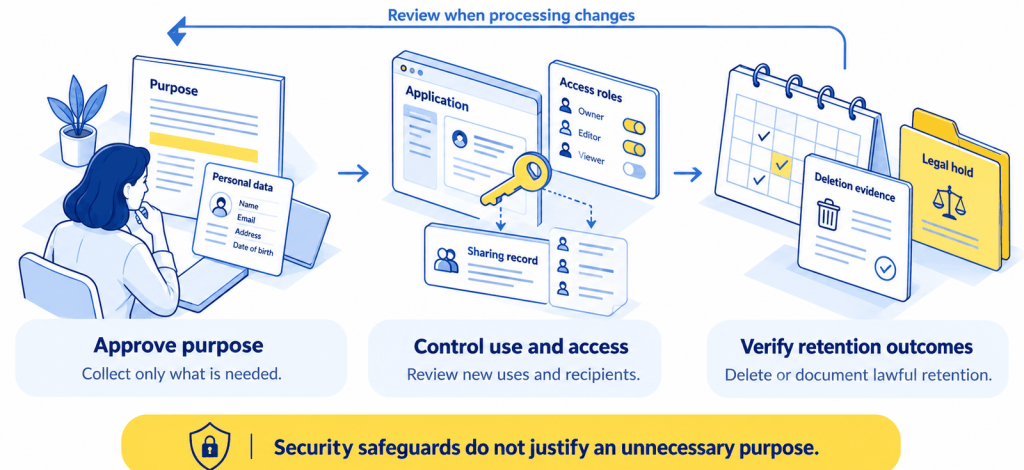
Common privacy compliance best practices become usable when controls identify the activity, accountable owner, evidence of operation and response to failure.
For each material activity, record purpose, data categories, affected people, systems, locations, recipients, legal authority and retention. Treat the record as a working map. Trigger review when a feature, field, use, geography or integration changes. Define who can approve a change and what risk level requires privacy counsel or senior review; otherwise teams may recognize a change without knowing whether they can proceed.
For each data element, ask whether the purpose can be met with less detail, a shorter period or a less identifying form. The workflow owner makes the case; privacy and legal review higher-risk processing.
Access should reflect the task. Support may need a narrow customer record, data science a masked dataset, and an administrator platform access without routine content access. Define roles and exceptions, then review actual access.
A new use should trigger an assessment of affected data, purpose compatibility, notice or consent, and required control changes. Bring legal, privacy and security into higher-impact decisions before deployment.
Security measures support privacy, but do not establish it by themselves. Encryption, monitoring and access reviews reduce exposure; they cannot justify an unnecessary purpose or an undisclosed use. A clear notice cannot compensate for overbroad access or untested deletion. Treat privacy and security as linked control sets with distinct questions and owners.
SPOG’s GRC solution can provide a shared view of mapped obligations, control owners, evidence, exceptions and remediation. This is useful where privacy depends on controls operated by security, IT or governance teams. Legal interpretation and processing decisions stay with accountable business, privacy and legal owners.
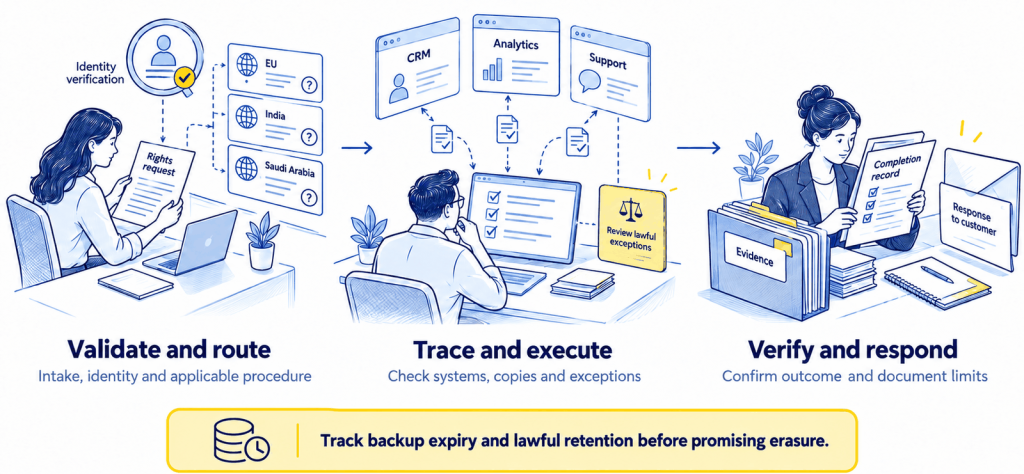
Rights requests reveal whether the processing map is accurate. A request may involve CRM, support tools, analytics and backups. Because rights and deadlines vary, use jurisdiction-specific procedures: controlled intake, proportionate identity checks, assigned system-owner tasks, documented exceptions and a completion check.
Deletion may leave exports, caches, backups or derived records. Define in-scope copies, backup expiry and exceptions for legal holds or other lawful retention. Verify the technical path before promising erasure.
Incident response must identify affected data, systems, people, processors and locations, then assess notice obligations. Align runbooks with privacy escalation and decision authority; criteria and deadlines depend on jurisdiction and circumstances.
“Keep it only as long as necessary” is not a schedule. Define record categories, triggers, periods, legal holds, deletion methods and owners. Reconcile privacy needs with tax, employment, financial and litigation duties.
Test deletion in the systems that hold data, including connected copies and backup expiry. If immediate deletion is constrained, set interim protection, restricted access and a final removal date.
Continuous evidence can show whether a control exists and whether it operates. SPOG’s Continuous Control Monitoring solution is relevant when privacy relies on mapped technical and governance controls that can be observed over time. It can help assess control coverage and follow findings to remediation; it does not replace a data inventory, legal analysis or rights-request workflow. SPOG’s remediation solution can help assign and track corrective work through closure.
A global policy can set a baseline without flattening local obligations. Maintain jurisdiction-specific scope, rights and notices, incident criteria, transfer conditions, retention rules and effective dates. Legal owners maintain interpretations; control owners implement them.
For DPDP, version the plan against official commencement notifications and prepare records, notices, requests, retention and safeguards ahead of applicable dates. For GDPR and PDPL, check current law and regulator guidance; consent, transfer and breach procedures do not automatically carry across borders.
The goal is one accountable process with jurisdiction-specific decision points. Reuse controls where requirements genuinely align and make differences explicit where they do not. Distinguish enacted law from draft instruments and guidance; record each item’s status, source and next review date so a consultation draft is not treated as a current obligation.
Month one: choose a high-volume or high-impact activity and validate purpose, data, systems, owners and retention. Avoid trying to perfect the entire enterprise inventory first.
Month two: test a field-necessity review, access review, rights request, retention action and incident escalation. Record undocumented handoffs; distinguish policy gaps from implementation failures.
Month three: assign owners, triggers and measures such as validated processing activities, overdue access reviews, aged deletion exceptions, timely requests and repeat findings. Define populations and denominators; incomplete coverage can make a metric misleading.
Repeat the exercise when a material system or purpose changes. Privacy improves when new processing cannot quietly bypass the same questions.
A durable privacy program is visible in ordinary operations: owners can explain why fields exist, reviewers can identify excess access, requests can be traced across systems, and exceptions have end dates. Ownership and verification make policy real.
Start with one processing activity, trace its decisions and evidence from purpose to closure, then apply what you learn to the next one. Keep jurisdiction analysis current and involve business owners in control design. That is how data privacy compliance becomes repeatable practice.


Security questionnaires help buyers understand how a supplier protects the data, systems and services involved in a proposed...

A vendor cybersecurity inquiry should establish what the supplier will do, which data and systems it can access,...

A vendor management policy sets the rules for approving suppliers, accepting exceptions and responding when relationships change. This...