Continuous Control Monitoring
Security Questionnaires: Respond with Accurate, Verifiable Answers
Security questionnaires help buyers understand how a supplier protects the data, systems and services involved in a proposed...
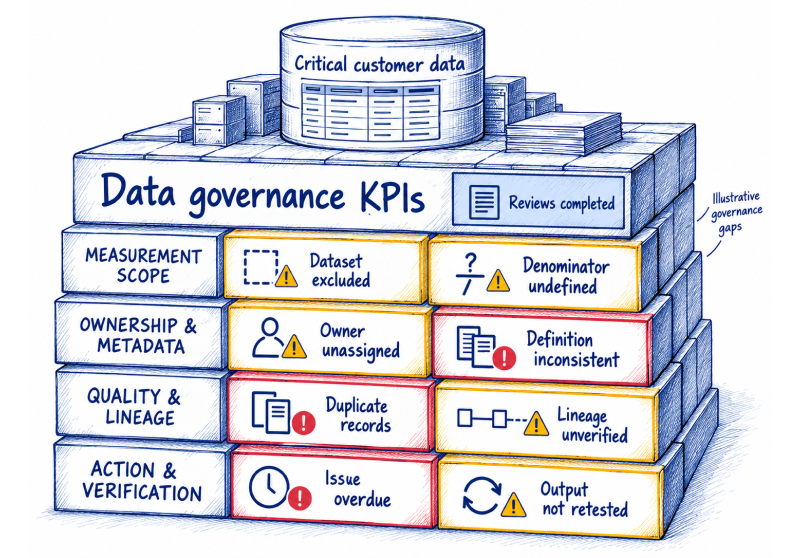
Data governance metrics show whether important data is trustworthy enough for the decisions that depend on it. Policy completion does not tell you whether a critical dataset has an owner, consistent definitions, usable lineage, or unresolved quality defects. A green dashboard may also hide what was left out.
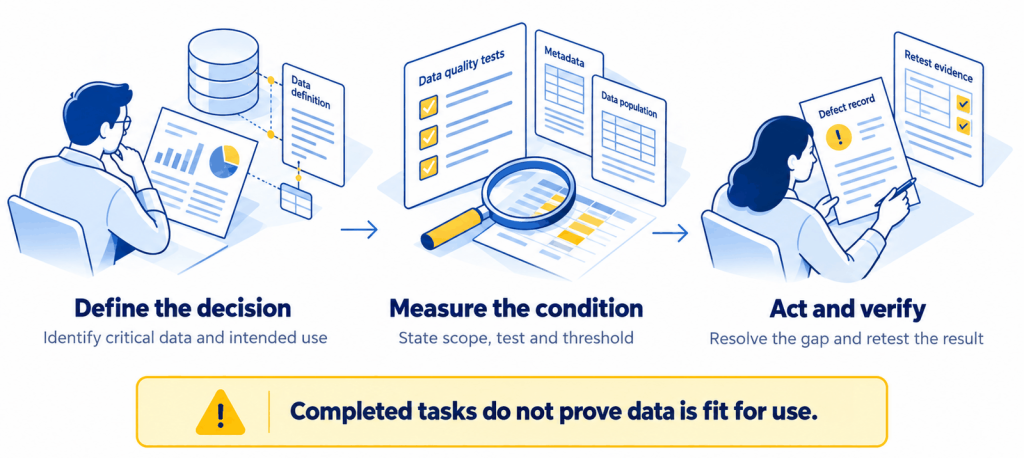
For a CISO, Chief Data Officer, or GRC leader, the useful question is: can we rely on the data behind this decision, and what happens when it fails? Answer with a defined population, a testable condition, an owner, and a response when results fall outside tolerance.
Data governance metrics measure how data assets are managed across their lifecycle, including quality, metadata, ownership, lineage, access, retention, and adherence to rules. A metric records a condition, such as critical datasets without owners. A key performance indicator (KPI) links a measure to an objective and target, such as the share of critical datasets with an accountable owner and current review.
The distinction matters. Fewer unassigned datasets may show activity without proving the inventory is complete or that owners can act. State the desired condition and retain the underlying measure. A blended “maturity score” often conceals meaningful differences.
The UK Government Data Quality Framework, published in January 2025, emphasizes understanding, documenting, and improving data quality across its lifecycle. NIST’s Data Governance and Management Profile was still under development after a May 2026 working session. Neither supports copy-and-paste targets: define measures in your own data and decision context.
A common reporting failure is an undefined denominator. “Ninety percent classified” means little unless the organization states which data stores or critical elements are in scope and how the inventory was reconciled. An omitted analytics workspace can make coverage rise while unknown data grows.
A second failure is measuring completion instead of condition. A stewardship review does not prove definitions are consistent; a finished access review does not prove excess access was removed; a closed deletion request does not prove all copies were addressed. Track activity, but test whether the expected state was reached.
A third failure is averaging unlike data. A few stale reference records should not weigh the same as an incorrect field in a payment or identity dataset. Segment by criticality, sensitivity, use, and impact, and explain any weighting rather than hiding it in a score.
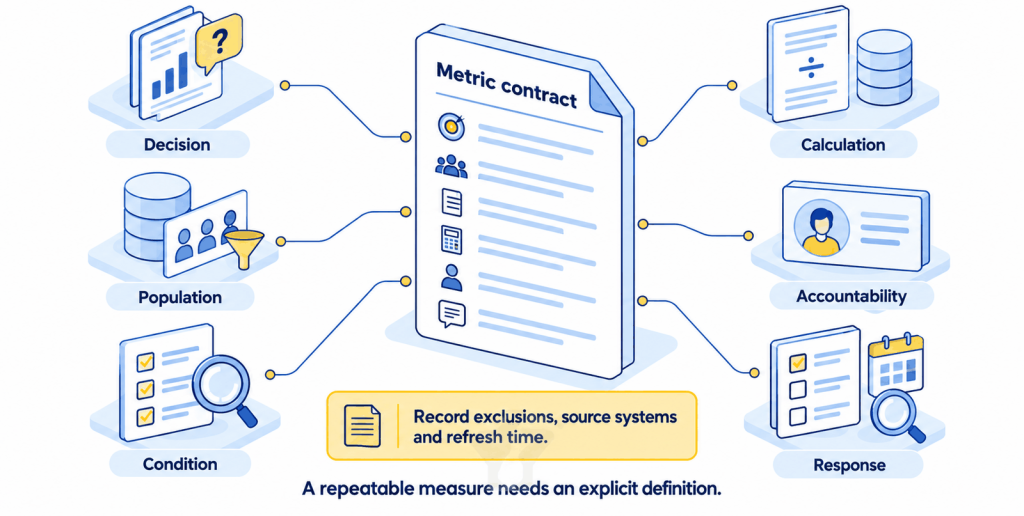
Before adding a metric to a dashboard, write a short contract that makes it repeatable and decision-linked. Record:
For example, “critical data issues closed within target” needs a severity rule, clock, and closure test. If the source is corrected but downstream reports remain wrong, the data is not fit for use. Preserve the original result and retest so later trends do not erase the failure.
Start with critical data domains, not every table. These examples are starting points; set targets from business tolerance, data use, and available evidence.
| Governance area | Example KPI | Population to state | Decision owner |
|---|---|---|---|
| Ownership and metadata | Critical datasets with owner, approved definition, classification, and review date | In-scope critical datasets | Domain owner resolves missing or stale records |
| Quality and fitness | Critical data elements passing rules for a specified use | Tested elements by domain and criticality | Data owner investigates high-impact defects |
| Lineage and lifecycle | Important outputs with verified source-to-output lineage or retention evidence | Selected outputs and in-scope data stores | Data/platform teams validate gaps and failed jobs |
| Access and safeguards | Sensitive datasets with approved access and current safeguard evidence | In-scope sensitive datasets | Security and data owners resolve control gaps |
| Exceptions and remediation | Material issues overdue, expired, or not retested | Open material issues and approved exceptions | Escalate overdue or unverified closure |
Ownership and metadata coverage show whether teams know what data means and who can govern it. Measure critical datasets with an accountable owner, approved definition, classification, and current review date. Report missing fields separately; an assigned owner alone does not make a dataset governance-ready.
Quality and fitness-for-use measures test data against its intended decision. Track critical elements passing validity, completeness, consistency, or timeliness rules, plus high-impact defects by age and use. A one-day delay may suit a report but invalidate a time-sensitive identity or transaction process.
Lineage and lifecycle measures test whether important data can be traced through collection, transformation, use, retention, and deletion. Track critical outputs with verified source lineage, retention rules mapped to stores, and deletion jobs with completion evidence. Counts alone are insufficient; sample records and expose failed paths.
For sensitive data, track datasets with an owner and approved access group, expired high-risk exceptions, or safeguards with current evidence. Keep these separate from data quality metrics: security telemetry can show a safeguard is present, not that the data itself is accurate or fit for purpose.
Exception and remediation measures connect results to action. Show material issues by age, owner, affected process, exception expiry, and retest status. A falling count is useful only if detection continues and the measured population has not narrowed.
Stewards need record-level exceptions. Domain leaders need trends, overdue actions, and resource decisions. Executives need critical data that is unfit for use, affected activities, and the action required. Keep definitions consistent while changing the level of detail.
Pair leading conditions, such as critical datasets with current owners, with outcomes such as decisions delayed by a data defect. Neither proves causation alone; use investigations and change history to test whether the leading measure is useful. Report confidence alongside the result: source coverage, refresh delays, sampling method, and manual overrides. This lets leaders distinguish real improvement from a change in how the data was collected or calculated.
Set review frequency to match how quickly data and its uses change. A quarterly committee can set tolerances, but critical pipeline failures, ownership gaps, or expired exceptions need timely visibility. Track refresh time and source failures; missing telemetry is a coverage gap, not a pass.
SPOG is relevant where data governance intersects with security controls, compliance evidence, and remediation. Its Continuous Control Monitoring solution connects defined controls to operational evidence; its GRC solution brings evidence from security, cloud, identity, IT, and governance systems into a shared assessment context.
This can support measures such as evidence coverage, gap ownership, exception age, and verified remediation. SPOG is not a general data catalog, master-data platform, or data-quality engine. Data owners still define authoritative datasets, quality rules, lineage, and fitness-for-use criteria. Keep the boundary clear when selecting tools.
A useful dashboard shows which critical data is fit for use, where ownership or evidence is missing, and what response is needed. Start with one domain, define its population and test, agree on a threshold, and keep exceptions visible. Add a KPI only when someone can explain what action follows. That is what makes data governance metrics credible.


Security questionnaires help buyers understand how a supplier protects the data, systems and services involved in a proposed...

A vendor cybersecurity inquiry should establish what the supplier will do, which data and systems it can access,...

A vendor management policy sets the rules for approving suppliers, accepting exceptions and responding when relationships change. This...