Continuous Control Monitoring
Security Questionnaires: Respond with Accurate, Verifiable Answers
Security questionnaires help buyers understand how a supplier protects the data, systems and services involved in a proposed...
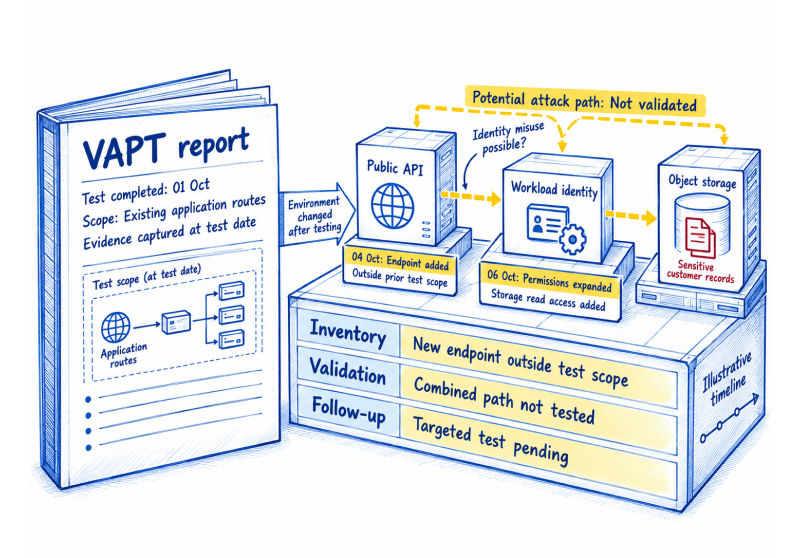
Cloud security VAPT tests what changed and what those changes expose together. A workload can pass a scan while identity permissions, a public endpoint or storage policy combine into an attack path. A finding list can also overstate risk when it omits reachability or existing safeguards. Vulnerability Assessment and Penetration Testing (VAPT) connects discovery to controlled validation.
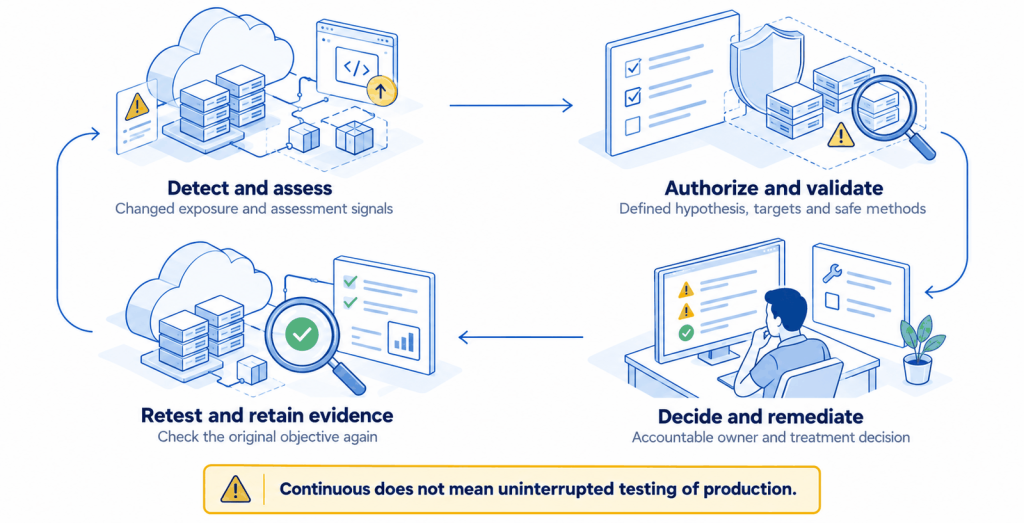
“Continuous” should describe the operating loop, not an uninterrupted attack on production. Automated checks can run after deployments or configuration changes. Human-led penetration testing still requires a defined objective, authorized scope, safe conditions and review. Frequent scanning is not proof of resilience.
A vulnerability assessment identifies weaknesses across assets, applications, configurations and dependencies using scans, cloud checks, software composition analysis and exposure discovery. Its findings are candidates; they do not prove exploitability in the organization’s context.
Penetration testing uses authorized, controlled attempts to validate a defined objective. A tester examines an application, API, identity boundary or workload and checks whether weaknesses combine. Useful results state what was tested, which path was validated, what safeguards held or failed, and what would change the outcome.
A scan supports broad, repeatable discovery. A penetration test explores selected hypotheses and paths. A red-team exercise tests a broader adversary objective and organizational response. Continuous VAPT combines assessment, targeted validation, human testing and verified remediation.
Cloud assets change through pipelines, consoles and APIs. A report covers a defined scope and time, not assets added later. Workload identity, network reachability, secrets, APIs, container images, serverless permissions or storage policies can change what an attacker can reach even when application code stays the same.
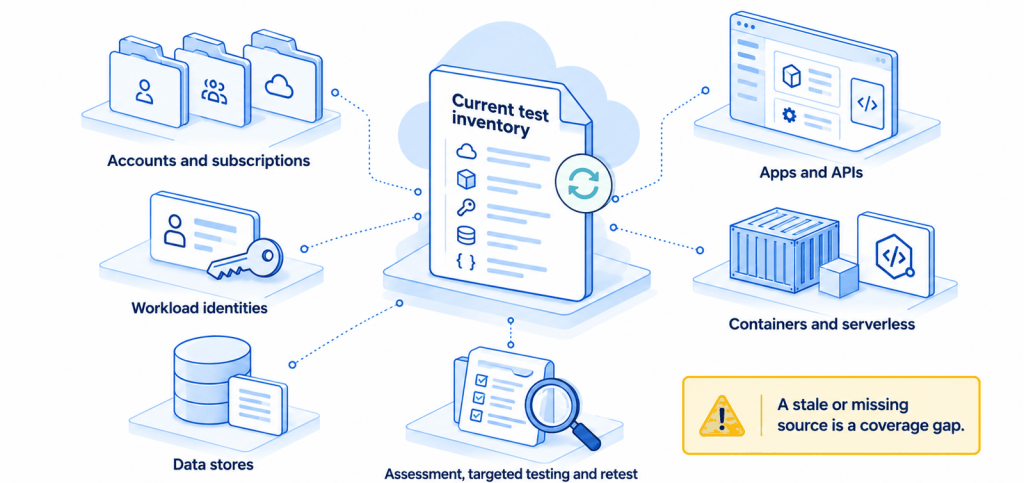
Keep a current test inventory linking accounts and subscriptions to workloads, internet-facing applications, APIs, identities and data stores. Reconcile it against cloud control-plane records, application catalogs, identity providers and external asset discovery. Track last-seen time, owner, environment and source health; a missing or stale feed is a coverage gap, not an assurance pass. Record shared-responsibility boundaries: authorization for your workload does not extend to provider infrastructure or another tenant.
Set cadence by change and risk. Use recurring assessment for broad coverage and trigger checks after material deployments, identity changes, new public endpoints, architecture changes or significant findings. Reserve human testing for high-impact paths, authorization logic, trust boundaries and scenarios that need judgment. A trigger should focus attention, not launch an unsafe test.
Before testing, name the owner, targets, accounts, environments, dates, methods, source addresses, rate limits, emergency contacts and stop conditions. Protect and revoke test credentials. Define whether production testing is allowed and how customers, shared infrastructure and live data are protected. Obtain written authorization for third-party testing.
Cloud provider rules differ and can change. Microsoft’s current penetration-testing guidance, updated July 2026, requires authorized third-party testing to follow its published rules and identifies activities that are prohibited, including denial-of-service testing. Check the rules for each cloud provider and target before the engagement; customer approval alone does not override provider restrictions.
Write an operational question: can an unauthenticated user reach sensitive data; can a workload identity exceed its intended access; can an API flaw cross a tenant boundary; will detection alert when a scoped test reaches a protected asset? A precise objective guides scope, method and interpretation of a negative result.
Combine automated checks with manual testing where judgment matters. Automated scanners can efficiently identify known weaknesses and repeat checks after changes. A skilled tester can evaluate chained conditions, business logic, authorization boundaries and whether compensating safeguards interrupt an attack path. Automation that reports “no finding” only speaks to the tests it ran, its coverage and its configured thresholds.
Rank findings beyond scanner severity. Consider reachability, known exploitation, privilege, affected data or process, and safeguards that may break the path. CISA’s August 2026 vulnerability review provides current context for changing vulnerability activity; use such intelligence to select test hypotheses, not as a standalone risk score. A private database reachable by an overprivileged workload identity may demand a different response from an exposed test endpoint without sensitive access.
Separate confirmed exploitation from theoretical possibility, and distinguish a validated path from a collection of correlated findings. Record the tester’s evidence, limitations and assumptions. If a test did not cover a region, account, identity type or application route, keep that boundary visible rather than generalizing the result to the entire cloud estate.
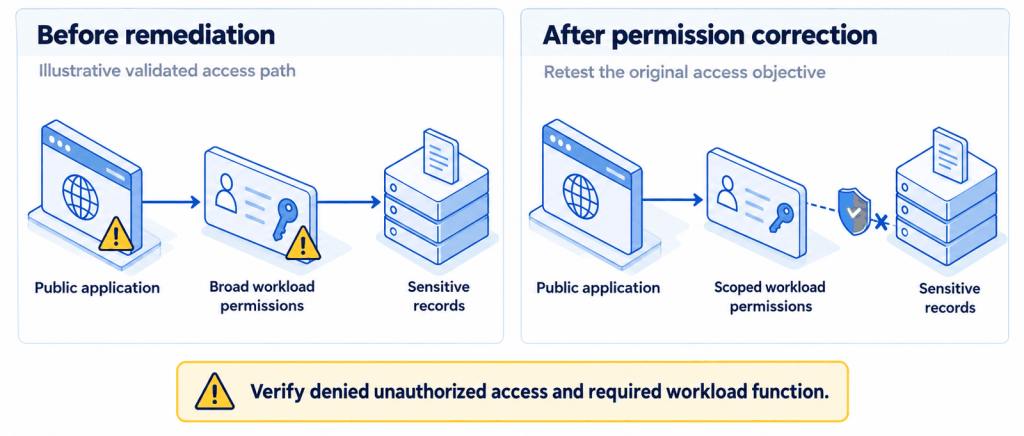
A ticket marked closed is not proof that the exposure has changed. Retest the original objective, confirm the affected asset and permission state, and check for side effects such as broken workloads or replacement paths. Where full retesting is not feasible, document the validation method and what remains uncertain. Keep the initial result and later outcome linked so a reviewer can see the timeline.
Track approved exceptions with scope, rationale, accountable risk owner, expiry and reassessment trigger. An exception records a decision about remaining risk; it does not convert an unremediated weakness into a successful test. Reassess when the environment, threat evidence or business impact changes.
Finding counts can reflect coverage, duplicates, noise or narrow scope. Track the percentage of critical in-scope assets assessed, coverage of selected high-risk paths, time to a validated decision, retest success, recurrence and scope or integration failures.
Report discovery, validation and closure separately: whether relevant assets were assessed; which hypotheses were tested and with what limits; whether remediation changed the expected state. Include exceptions and overdue actions. Scan frequency alone does not prove coverage.
Keep the target and account scope, authorization, date and method, relevant system state, findings, exclusions, remediation and retest outcome. Preserve enough context for a reviewer to see what the conclusion establishes and what it does not.
VAPT produces findings and validation evidence; teams still need to connect those results to asset criticality, exposure, ownership and remediation. SPOG’s Exposure Management solution connects asset, threat, control, business and workflow context to help teams prioritize exposure and carry decisions into accountable action. Its Remediation solution supports ownership, governed workflows, deadlines and outcome validation. The Continuous Control Monitoring solution connects defined controls with operational evidence to assess coverage and effectiveness.
SPOG should not be presented as the tool that performs VAPT unless that capability is separately confirmed. A practical role is to make the program’s findings, decisions, owners and validation status easier to follow across existing systems. Confirm that the integrations, data fields and workflow match your testing process before adopting any platform claim.
Continuous cloud VAPT works when its scope stays current, tests are authorized and safe, automation is matched with human judgment, and results lead to verified changes. Start with a critical workload: map its reachable assets and identities, define one meaningful attack-path objective, agree the test boundaries, and test a remediation through retest. Use what the exercise reveals to improve the next trigger and the next scope. The measure of progress is not how often a scanner runs; it is whether the organization can show what was tested, what remained exposed and what changed.


Security questionnaires help buyers understand how a supplier protects the data, systems and services involved in a proposed...

A vendor cybersecurity inquiry should establish what the supplier will do, which data and systems it can access,...

A vendor management policy sets the rules for approving suppliers, accepting exceptions and responding when relationships change. This...