Continuous Control Monitoring
Security Questionnaires: Respond with Accurate, Verifiable Answers
Security questionnaires help buyers understand how a supplier protects the data, systems and services involved in a proposed...
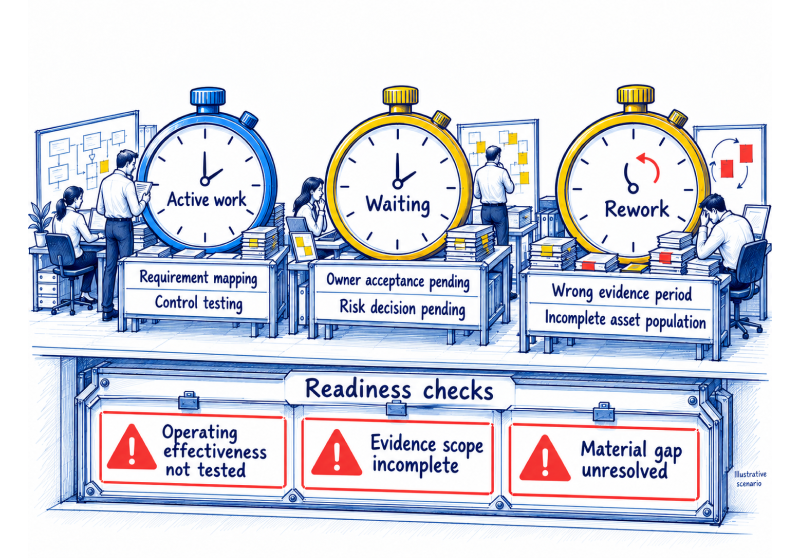
Time to compliance is often reported as one number: the months between a framework decision and an audit. That number can help a CISO explain progress, but it can also hide the reason the work took so long. Was the team implementing controls, waiting for an owner, resolving scope, or repeating evidence work? Until those stages are separated, “faster” is hard to diagnose—and compliance ROI is easy to overstate.
The useful question is not how to make an audit move faster at any cost. It is how to make the path from a defined obligation to defensible readiness more predictable, while keeping control outcomes and review quality intact. That requires a clear clock, a view of work in progress and a financial case that distinguishes cash savings from capacity returned to the business.
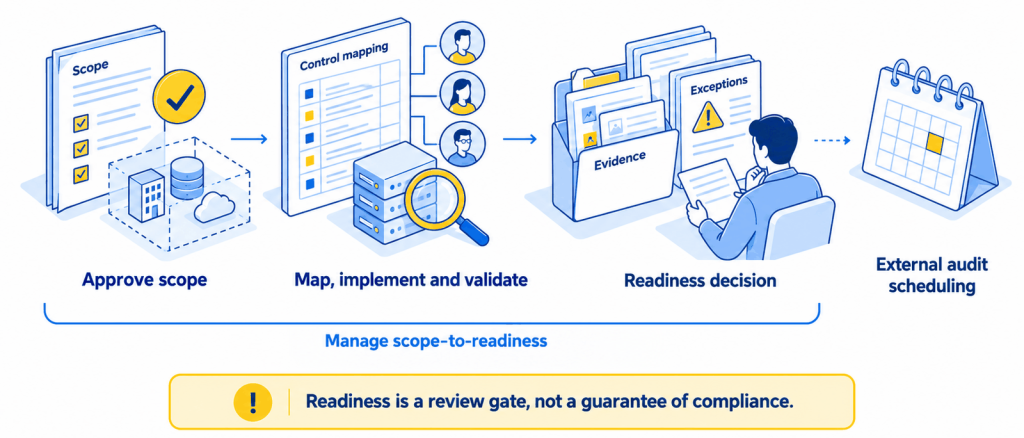
Set the start at the point when leadership approves the target scope and the organization has enough information to begin mapping requirements. Set the finish at a documented readiness gate: in-scope requirements are mapped, accountable owners are assigned, required controls have been implemented or assessed, material exceptions have an authorized disposition, and the evidence package is ready for independent review.
Do not use certificate issuance as the finish line. Scheduling, auditor availability, report drafting and customer acceptance may extend the calendar, but they sit partly outside the CISO’s operating control. Track those external intervals separately. Otherwise, the metric punishes teams for delays they cannot directly change and obscures the work they can improve.
Record the date of each milestone, not just the total. At minimum, capture scope approval, requirement mapping, control-owner acceptance, evidence-ready review, material-gap disposition and readiness approval. Use the same definitions across reporting periods. When scope changes, record the change and its reason rather than quietly restarting the clock.
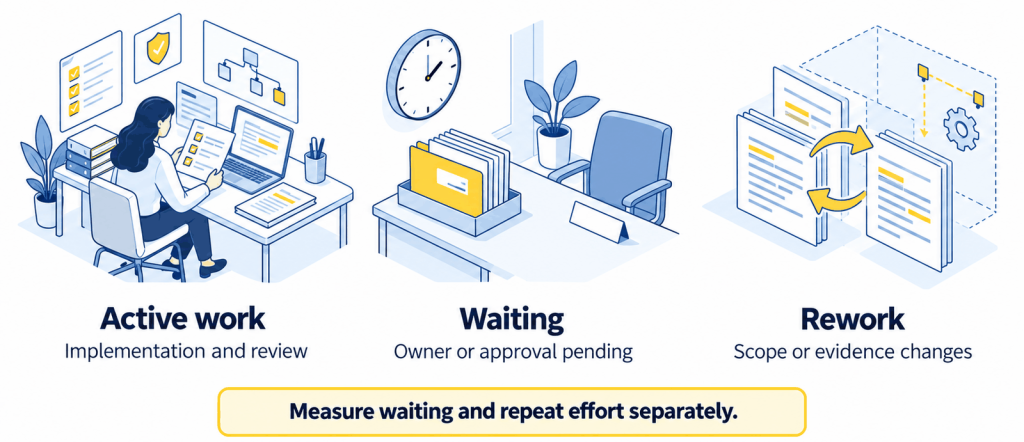
An elapsed-time figure cannot tell a team what to fix. Break the cycle into touch time, queue time and rework. Touch time is active effort; queue time is work waiting for an owner, decision, access or review; rework repeats effort after scope or evidence expectations change. Often, the expensive delay is an unresolved handoff.
For each milestone, track median and long-tail elapsed time, such as the 90th percentile, by function. Add blocked-item count and age of the oldest material blocker. A fast average can hide high-impact gaps that remain open for months.
Classify delays by cause: scope churn, unclear ownership, unavailable source data, inconsistent control operation, pending risk acceptance or review capacity. Avoid treating every late item as an individual performance issue. When functions interpret a requirement differently, clarification may matter more than reminders.
A useful diagnosis asks what must happen next, who can authorize it, and what proof will close the step. If an item has no next decision or named owner, it is not being managed; it is merely being counted.
Once the bottleneck is visible, improve that handoff. Confirm scope and publish assumptions; define “ready” before requesting evidence; give owners authority for their decisions; and set an escalation route for matters requiring risk, legal or executive judgment.
Reuse prior control work where the underlying objective, population, operating period and evidence remain applicable. A control mapping is a hypothesis about equivalence, not permission to copy a prior conclusion. When a new framework or customer requirement arrives, identify what is genuinely new, what can be reused after validation, and what needs a different test. This reduces duplicate effort without turning a familiar label into assumed coverage.
Prioritize using consequence and dependency, not checklist order. A control that protects privileged access to a critical environment may deserve earlier attention than a low-impact documentation task. CISA’s Cross-Sector Cybersecurity Performance Goals 2.0, released in December 2025, frame a limited set of high-impact baseline actions as a way to direct cybersecurity investment. That supports a practical principle for compliance planning: sequence work by risk reduction and business dependency, while still meeting the scope and assurance criteria that apply.
Make exceptions decision-ready. A request for risk acceptance should state the affected scope, business consequence, existing safeguards, proposed duration and reassessment trigger. The authorized business owner can then make a bounded decision instead of letting an unresolved item sit in a queue. Acceptance does not change the control result; it records how the organization will handle the remaining exposure.
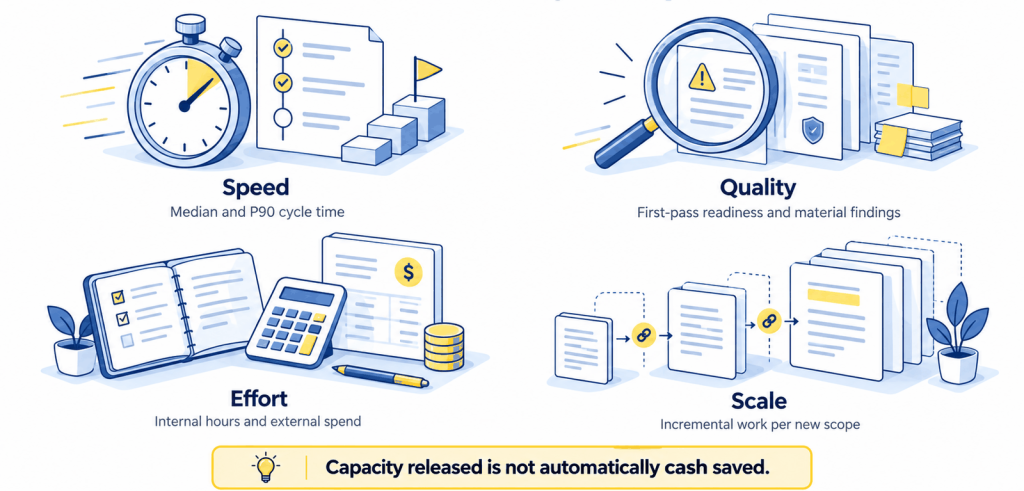
A defensible compliance ROI model starts with costs the organization can verify. Establish a baseline for internal preparation hours, external assessment and advisory spend, repeat evidence work, and the cost of delays where a real business consequence can be shown. Do not assign a speculative dollar value to “confidence” or presume that a shorter audit alone prevented an incident.
After a process or technology change, compare like with like: the same scope, comparable assurance depth and a similar reporting period. Subtract recurring costs such as platform licensing, integrations, administration, control remediation and training. If the team avoids 500 hours of repeated work, report the hours as capacity released. Call it cash savings only if budgets, contractor spend or hiring plans actually changed.
Use a balanced scorecard: cycle time, first-pass readiness, material findings, age of high-risk exceptions, repeat effort per added scope, and validated reuse. A shorter cycle is not a success if the team later spends the saved time correcting omissions.
Consider a fictional technology company preparing for a second customer assurance scope. Its initial estimate assumes every requirement must be remapped and recollected. Review shows some controls already operate across the relevant systems; others need new coverage or a different observation period.
The team records reusable mappings, applicability owners and required evidence periods. It separates engineering work from time spent waiting on scope decisions. The next cycle is shorter because fewer decisions are repeated, without assuming every control is equivalent or every artifact will satisfy an external reviewer.
For ROI, it compares internal hours and external spend with the prior assessment, less recurring workflow costs. Preparation hours released count as capacity unless finance confirms budget savings. This is illustrative, not a benchmark.
The process needs a shared view of requirements, controls, evidence, owners and unresolved actions. SPOG’s Governance, Risk & Compliance solution connects these records with operational context, helping teams see coverage, gaps, accountability and remediation progress. Its Continuous Control Monitoring solution connects defined controls with operational evidence to assess coverage and effectiveness as the environment changes.
Evaluate platforms against the same questions: can they show blockers, preserve decisions, make validated reuse visible, and compare cycle time with control outcomes? Test capabilities against your scope. Software can make work observable; it cannot set risk appetite, approve exceptions or replace independent assurance.
A CISO can use time-to-compliance as a management metric when it has a defined start, a quality-based finish and enough milestone data to locate delay. Measure waiting and rework separately from active effort, and connect improvement to costs the organization can substantiate. The result is not simply a faster audit. It is a more predictable assurance cycle, with fewer repeated decisions and a clearer account of what the investment returned.


Security questionnaires help buyers understand how a supplier protects the data, systems and services involved in a proposed...

A vendor cybersecurity inquiry should establish what the supplier will do, which data and systems it can access,...

A vendor management policy sets the rules for approving suppliers, accepting exceptions and responding when relationships change. This...