Continuous Control Monitoring
Security Questionnaires: Respond with Accurate, Verifiable Answers
Security questionnaires help buyers understand how a supplier protects the data, systems and services involved in a proposed...
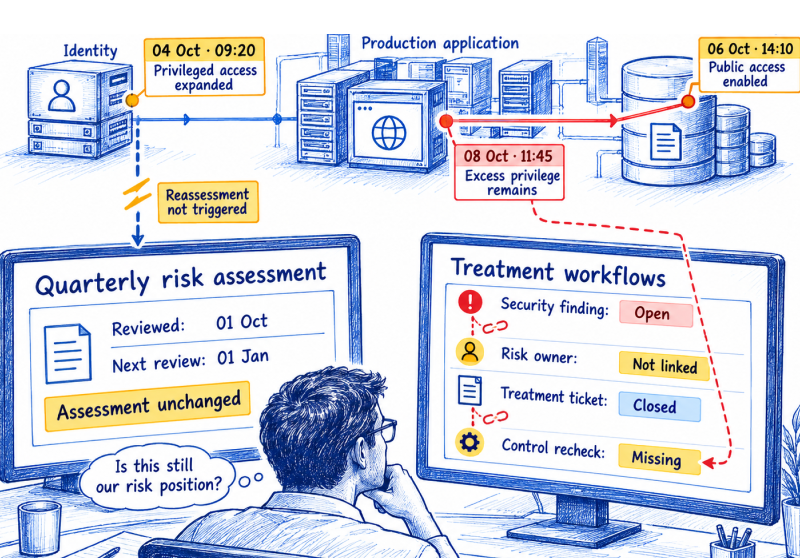
An enterprise completes its quarterly risk assessment, but a critical cloud configuration changes days later, exposing a customer-facing application. The risk register remains unchanged while business operations continue. The concern is not simply outdated reporting, but whether leadership can recognize, assess, and respond to material exposure before the next review cycle.
The goal is not only to automate risk administration, such as questionnaires and approvals, but to improve risk intelligence by connecting current evidence, business context, owners, and decisions.
Risk management automation uses integrated data, defined assessment logic, and governed workflows to support risk identification, evaluation, monitoring, reporting, and treatment. Instead of repeatedly requesting updates by email, teams can collect supported evidence from existing systems and flag material changes for review.
Automation does not make risk decisions independently. Business context, uncertainty, risk appetite, regulatory obligations, and acceptance authority still require accountable people. Nor does every automation run in real time: the currency of insights depends on source refresh intervals, coverage, and test design.
Many risk programs rely on periodic questionnaires, fragmented registers, and control attestations. GRC automation coordinates assessments, approvals, and governance records; cybersecurity automation supplies operational alerts and control evidence. Effective risk oversight connects both without confusing activity with assurance.
Three recurring weaknesses are delayed evidence, disconnected ownership, and inconsistent prioritization. A vulnerability may be known to security but absent from an enterprise risk record; a completed ticket may not demonstrate restored control effectiveness; and a high-severity finding may receive the same attention whether it affects a critical payment service or a low-impact test environment.
| Activity | Suitable automation | Human responsibility |
| Risk identification | Collect findings and detect defined changes | Validate relevance and missing scenarios |
| Risk assessment | Apply consistent scoring rules and enrich context | Judge impact, uncertainty, and exceptions |
| Control monitoring | Test supported configuration, coverage, and evidence | Interpret effectiveness and limitations |
| Risk treatment | Route tasks, deadlines, and escalation notices | Approve actions and allocate resources |
| Reporting | Consolidate status, evidence, and trends | Explain residual risk and decisions |
A finding becomes decision-useful only when operational signals are connected to their scope, business significance, applicable safeguards, and accountable risk decisions.
Establish a common risk taxonomy, assessment criteria, risk appetite and tolerance, ownership, approval authorities, and reassessment triggers. Specify which decisions can follow predefined rules and which require formal review.
Integrate relevant asset inventories, identity platforms, cloud systems, security tools, IT service workflows, and existing GRC records. Document where evidence comes from, when it was last refreshed, and which assets or controls it covers.
Associate evidence with the affected asset, application, control, owner, and business process. Two identical findings can have different consequences depending on internet reachability, sensitive data, compensating controls, or critical-service dependencies. Context prevents prioritization from becoming a simple severity ranking.
Define events that warrant attention: a critical control failing, privileged access expanding, a new internet-facing asset appearing, or an overdue exception exceeding its approval period. Use clear escalation rules, while distinguishing genuine risk changes from noisy technical events.
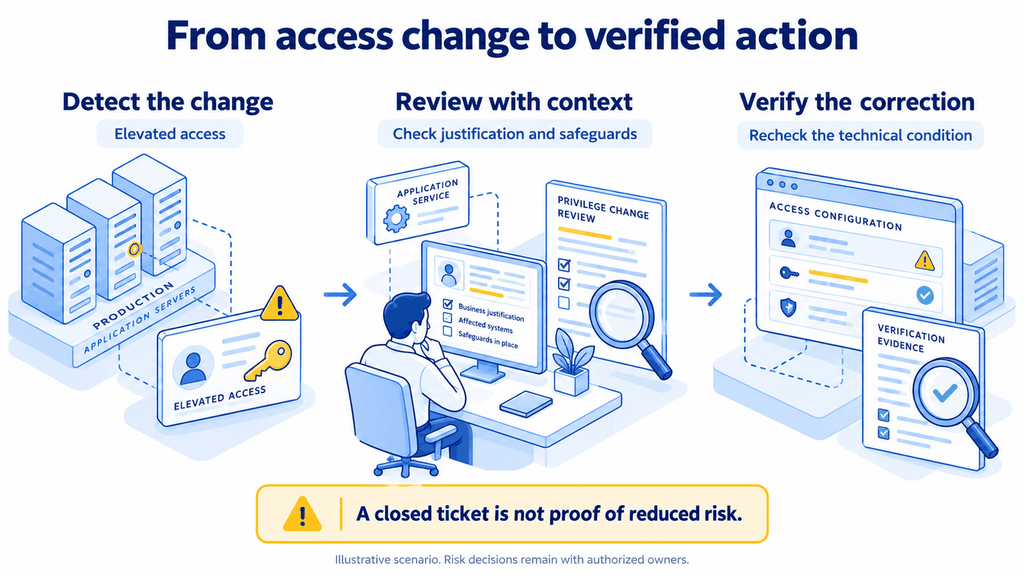
Assign an owner, target date, action plan, and evidence requirement. Track whether work is underway, but do not interpret a closed ticket as verified risk reduction. Recheck the affected control or exposure after corrective action and update the assessment when the evidence supports it.
Measure evidence freshness, time to reassess material changes, overdue high-priority risks, and verified remediation rates. Together, these show leadership whether decisions reflect current conditions, significant exposures receive timely attention, and completed actions deliver measurable risk reduction. Review false positives and scoring drift; risk owners must challenge model assumptions.
Consider a bank where an administrator receives elevated access to a production application. The identity system records the change, while a periodic access review is not scheduled for several weeks.
An integrated process could identify the privilege change, connect the account to the production asset and critical service, check available approval and monitoring evidence, and open a review task for the accountable owner. If a required safeguard is absent, the finding is escalated using the institution’s approved rules.
The business owner then assesses whether the access is justified, whether compensating controls are sufficient, and whether urgent action is necessary. Once corrected, updated evidence confirms whether the technical condition has changed.
Faster identification: Supported monitoring can reveal control deterioration and material exposure changes between scheduled reviews.
More consistent decisions: Shared data and rules reduce avoidable differences across teams, while documented overrides preserve legitimate judgment.
Reduced audit preparation: Reusable, time-stamped evidence linked to controls and obligations can reduce repeated collection, although auditors must still evaluate relevance, completeness, and operating effectiveness.
Clearer accountability: Connected findings, service context, owners, exceptions, and action status help leadership distinguish unresolved material risks from administrative backlog.
Automation can produce persuasive but misleading outputs when source data is incomplete, mappings are wrong, or scoring criteria overlook business realities. A green control score may hide a failure affecting a critical asset if coverage is narrow or exceptions are excluded from reporting.
Organizations should validate data lineage, restrict access to sensitive evidence, maintain change histories, and test alert thresholds. For AI-assisted classification or prioritization, review explainability, data handling, and potential false negatives. Human review is especially important for material residual risks and contested findings.
A further governance risk is confusing workflow completion with risk reduction. Treatment is effective only when the organization can verify that the relevant condition or consequence has changed. Risk acceptance should identify the authorized owner, rationale, safeguards, and expiry or reassessment date; accepting a risk does not eliminate it.
Evaluate the ability to integrate with your existing stack, reconcile assets and owners, preserve evidence provenance, support configurable assessment rules, and connect exceptions with governed workflows. Confirm role-based access, audit trails, export options, and how frequently integrations refresh.
Begin with a bounded use case and baseline these measures before deployment. Expand only when the evidence shows faster decisions, fewer overdue material risks, and verified improvements rather than simply more completed workflows.
SPOG.AI helps organizations connect technical exposure, control effectiveness, and business context to support informed, accountable risk decisions. By relating security and IT signals to affected assets, services, and control evidence, its Unified Risk and Exposure Management approach helps distinguish material exposure from isolated technical findings.
Through its GRC capabilities, organizations can strengthen governance visibility, while Continuous Control Monitoring helps identify supported control weaknesses as conditions change. Together, these capabilities support better prioritization, ownership, and verification of corrective action. SPOG.AI complements existing risk policies, business approvals, and formal risk acceptance processes rather than replacing them.
Make risk decisions using connected evidence, not outdated snapshots. Book a Demo.
Risk management automation is most valuable when it connects trustworthy operational data to consistent assessment, clear ownership, and verified action. It can shorten the distance between a changed condition and an informed decision, but it cannot substitute for governance or guarantee reduced risk. Enterprises should automate repeatable evidence and workflows while keeping material judgment, acceptance, and accountability with the appropriate owners.


Security questionnaires help buyers understand how a supplier protects the data, systems and services involved in a proposed...

A vendor cybersecurity inquiry should establish what the supplier will do, which data and systems it can access,...

A vendor management policy sets the rules for approving suppliers, accepting exceptions and responding when relationships change. This...