Continuous Control Monitoring
Security Questionnaires: Respond with Accurate, Verifiable Answers
Security questionnaires help buyers understand how a supplier protects the data, systems and services involved in a proposed...
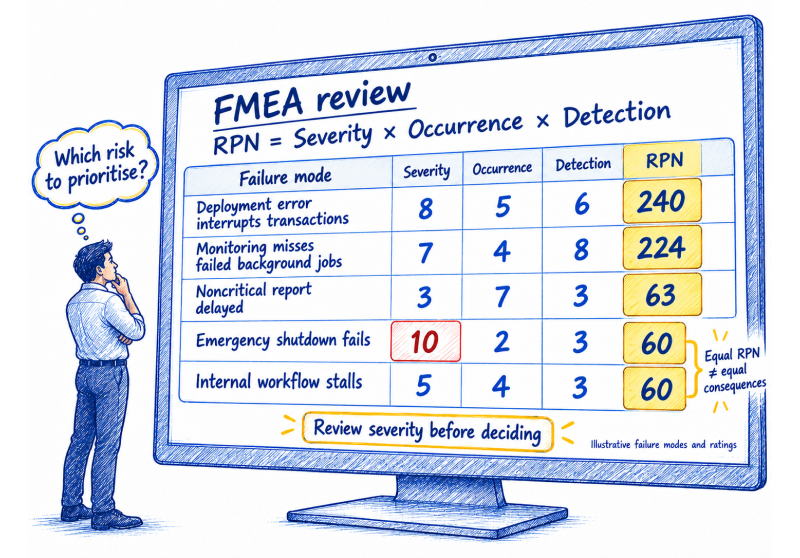
A payment service may depend on a software deployment process that occasionally introduces configuration errors. Some failures are immediately visible; others remain undetected until customers cannot complete transactions. Identifying which failure modes deserve attention requires a structured approach rather than relying on the number of incidents alone.
Failure Mode and Effects Analysis (FMEA) examines how a product, process, or system could fail, what the consequences would be, and how existing controls affect the likelihood and detection of that failure. The Risk Priority Number (RPN) provides one way to compare identified failure modes and organize improvement work.
RPN is a numerical priority indicator calculated from severity, occurrence, and detection ratings assigned to a failure mode. Traditional FMEA commonly uses defined 1-to-10 rating scales. Higher scores represent more severe consequences, greater occurrence, or lower confidence that a failure will be detected before its effects are felt.
RPN is especially useful when teams examine multiple process weaknesses using the same scoring criteria. It supports conversations about which failure modes warrant investigation or additional controls, but does not by itself establish an absolute probability, expected loss, or acceptable risk threshold.
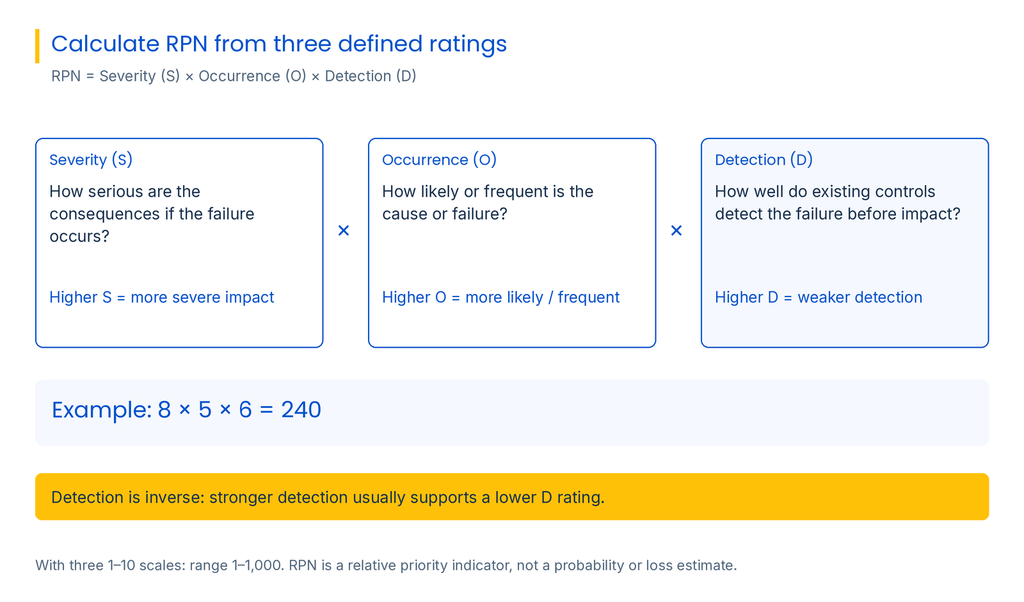
RPN = Severity (S) × Occurrence (O) × Detection (D)
When each rating uses a 1-to-10 scale, the theoretical RPN range is 1 to 1,000. The scale must be documented because rating definitions vary between FMEA methods and industries.
| Factor | What it measures | Meaning of a higher rating |
| Severity (S) | Consequence if a failure occurs | More serious impact |
| Occurrence (O) | Relative likelihood or frequency of the cause/failure | More frequent or likely |
| Detection (D) | Ability of existing controls to detect or prevent escape of the failure | Less likely to be detected before impact |
Detection is an inverse effectiveness score: strong detection usually means a lower D rating, not a higher one. The distinction matters because misreading detection can reverse the intended priority.
Identify the process boundaries, intended operation, possible failure modes, causes, and effects. Include relevant system owners and operational specialists. A failure mode should describe what can go wrong, not merely state that a process is risky.
Evaluate the consequences if the failure occurs, considering safety, customer impact, critical-service disruption, or relevant obligations. Use predefined rating descriptions, and do not reduce severity simply because safeguards make occurrence less likely.
Use incident history, testing, defect trends, process reliability, and expert judgment to estimate how frequently the failure might occur. Document uncertainty when historical evidence is limited.
Assess whether monitoring, testing, automated checks, and procedural controls would reveal the failure before its consequences materialize. Ratings should reflect evidence of actual control effectiveness rather than the existence of a documented policy.
Calculate S × O × D for each failure mode. Review rankings alongside criticality and severe outcomes. Escalate high-severity failures to the accountable risk owner, document treatment or approved acceptance, and track corrective actions, deadlines, and reassessment.
Consider a hypothetical financial-services organization reviewing failures in a customer transaction workflow. Its FMEA team uses illustrative 1-to-10 scales consistently across scenarios.
| Failure mode | S | O | D | RPN |
| Deployment error interrupts transactions | 8 | 5 | 6 | 240 |
| Monitoring misses failed background jobs | 7 | 4 | 8 | 224 |
| Noncritical report is delayed | 3 | 7 | 3 | 63 |
For the deployment error, 8 × 5 × 6 = 240. The calculation suggests a priority relative to the other listed failure modes, not a 24% probability or a monetary loss estimate. The monitoring failure also deserves attention because its high detection rating indicates weak chances of identifying the problem early.
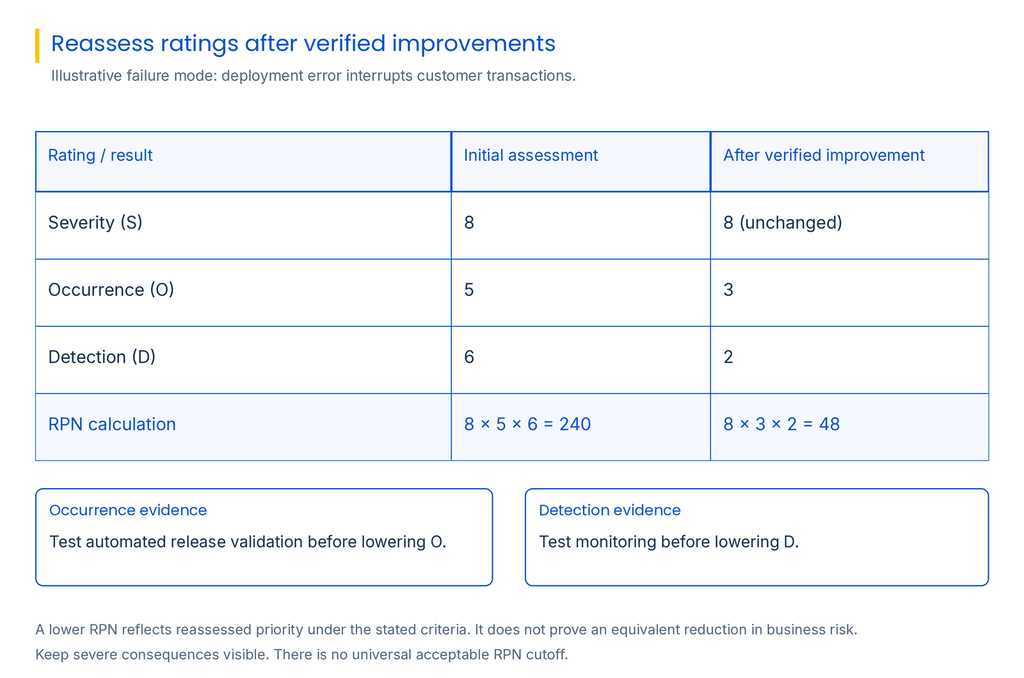
Suppose automated release validation reduces the deployment error’s occurrence rating from 5 to 3, while improved monitoring reduces detection from 6 to 2. With severity unchanged, the revised RPN is 8 × 3 × 2 = 48. This represents a reassessed priority under the stated scoring model; teams should verify that the new controls actually work before adopting the revised ratings.
Sorting values from highest to lowest can provide a useful starting point, but equal RPNs need not indicate equal consequences. A failure rated 10 × 2 × 3 and another rated 5 × 4 × 3 both yield 60, even though the first carries greater severity.
There is also no universal RPN cutoff that automatically means a failure is acceptable or unacceptable. Some sector-specific FMEA approaches use additional action-priority rules rather than relying on the product of three ratings alone. Organizations should set decision rules appropriate to their methodology and never allow a modest RPN to conceal potentially catastrophic consequences.
FMEA originated in engineering and reliability work, but its failure-mode approach can also inform cybersecurity and IT operations. For example, a privileged-access review may fail to identify an inappropriate administrator account. Teams can assess the resulting impact, likelihood of the review failure, and whether independent monitoring would detect it before misuse.
For a cybersecurity team, FMEA can help examine how a control or process might fail. It should not replace threat-informed exposure assessment, exploitability analysis, business-impact assessment, or the organization’s established enterprise risk methodology. RPN evaluates specified failure modes using ordinal ratings; it is not equivalent to a conventional likelihood × impact risk score.
Problems often arise when teams apply inconsistent scoring scales, overestimate detection capability, or treat mathematical rankings as definitive risk decisions. Other errors include ignoring high-severity failure modes because occurrence appears low, scoring vague failure descriptions, and failing to revisit assumptions after process changes.
What improves reliability: standardized rating guides, cross-functional reviews, documented evidence, clear escalation rules, and separate attention to severe outcomes. An RPN should prompt informed action, not provide a false sense of precision.
Revisit RPN when controls change, incidents occur, or dependencies alter a failure path. Record the original ratings, risk owner, treatment, test evidence, and revised scores. A falling RPN alone does not establish lower business risk: control improvements must be independently evidenced, effective in operation, and relevant to the original failure mode.
Automation can help consolidate monitoring signals and identify changes worth reviewing, but scoring still requires knowledgeable interpretation. AI-assisted analysis may highlight patterns or suggest candidate failure modes; outputs need validation against real system conditions and the organization’s rating criteria.
SPOG.AI brings together security and IT signals with asset, control, and business context to support evidence-based risk oversight. Its supported control monitoring and contextual visibility can help teams identify operational changes or control weaknesses that warrant reassessment.
Where FMEA is used to examine cybersecurity or IT process failures, this evidence may inform discussions about detection, controls, and business exposure. SPOG.AI does not need to be treated as an automatic RPN calculator: defined FMEA scoring criteria, analysis of failure modes, and final risk decisions remain the responsibility of the organization’s teams. For related guidance on risk evaluation, explore SPOG.AI’s holistic risk audit article.
Strengthen visibility into operational control conditions. Book a Demo.
RPN offers a straightforward way to compare identified failure modes through severity, occurrence, and detection. Its value comes from consistent definitions, reliable control evidence, and decisions that account for high-severity consequences rather than treating the numerical product as a complete risk model. Reassessing scores after verified improvements makes FMEA a more useful part of continuous risk management.


Security questionnaires help buyers understand how a supplier protects the data, systems and services involved in a proposed...

A vendor cybersecurity inquiry should establish what the supplier will do, which data and systems it can access,...

A vendor management policy sets the rules for approving suppliers, accepting exceptions and responding when relationships change. This...