CERT-In’s May 2026 guidance recommends immediate containment and remediation within 12 hours, where feasible, for known exploited vulnerabilities affecting internet-facing crown-jewel systems. Other indicative timelines range from one to five days, depending on exploitation status, exposure, severity, and asset criticality.
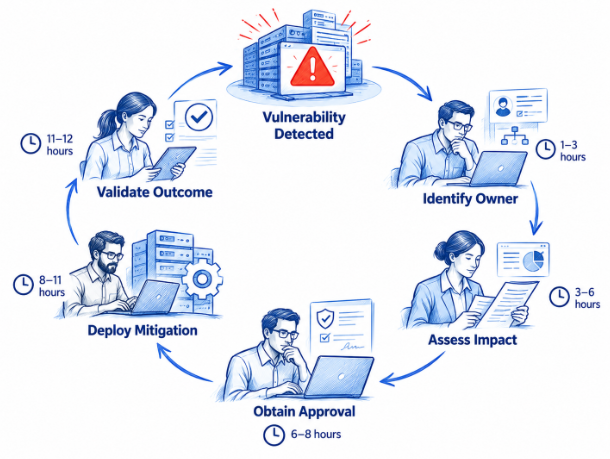
Consider an actively exploited vulnerability discovered on an internet-facing application supporting a bank’s payment services. The scanner identifies the affected server. Security must establish its exposure and business criticality. Infrastructure evaluates patch compatibility. Application owners assess potential disruption, while change management coordinates approval. Every team follows its established process. Yet by the time these activities are completed, the remediation window may have closed. The real constraint is often not patch deployment but decision latency: the time spent establishing exposure, business impact, ownership, and an acceptable course of action before remediation can begin.
Remediation Readiness Must Precede Vulnerability Discovery
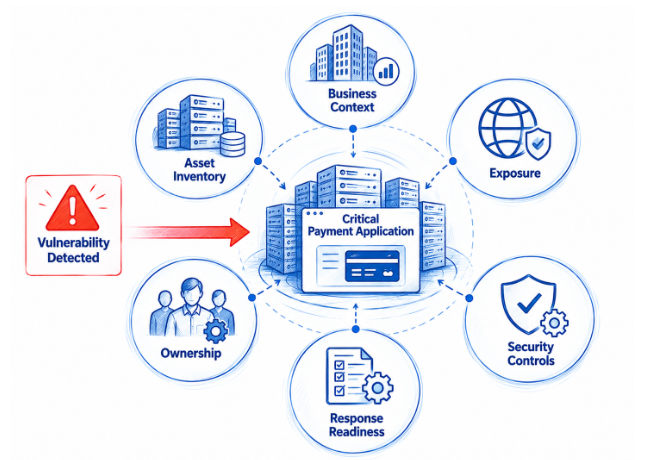
Traditional vulnerability management follows a sequential process: discover, assess, prioritise, assign, remediate, and validate. This becomes difficult when remediation windows shrink from weeks to hours. A scanner may identify a vulnerable server without knowing which business service it supports. A CMDB may contain application dependencies but lack current exposure information. Security controls may provide protection, but their effectiveness may not be visible to the vulnerability management team.
The resulting investigation consumes valuable remediation time. Enterprises need continuously maintained relationships between business services, applications, infrastructure assets, vulnerabilities, and security controls. For the payment application, this means knowing its business criticality, infrastructure dependencies, internet exposure, accountable owners, and available containment options before a vulnerability is discovered.
Remediation readiness depends on having this context available before the vulnerability is discovered, rather than assembling it during an incident.
Remediation Priority Must Reflect Current Exposure, Not Just Severity
A critical vulnerability on an isolated development server does not necessarily create the same exposure as one affecting an internet-facing payment application. Remediation urgency depends on technical severity, known exploitation, accessibility, business criticality, and existing safeguards. These conditions can change independently of the vulnerability. A firewall change may expose a previously internal application. A vulnerability may appear in a known exploited vulnerability catalogue. A compensating control may stop functioning. The CVSS score remains unchanged, but remediation urgency may increase.
Enterprises therefore need continuous reassessment using current threat intelligence, asset exposure, business context, and control effectiveness. Not every change warrants emergency remediation. The organisation must identify changes that materially affect exposure and adjust priorities accordingly.
Remediation priorities should reflect current exposure, not just static vulnerability classifications.
Critical applications may have production dependencies, restricted maintenance windows, or availability requirements that make immediate patching unsafe. Security must reduce exposure while infrastructure and application teams protect service continuity. Change management must ensure urgent interventions do not introduce additional failures.
The opportunity lies in replacing sequential handoffs with parallel decisions, supported by predefined ownership, business context, and emergency procedures. In a sequential process, ownership identification, impact assessment, approvals, and remediation may each consume several hours.
In a coordinated process, the affected business service and owner are already known. Patch feasibility and containment options are evaluated simultaneously, while predefined emergency procedures enable timely execution. The improvement comes not from making every activity faster, but from eliminating waiting time between them.
This requires predefined ownership, escalation paths, emergency change authority, and accountability. Automation can initiate workflows, notify owners, and track deadlines. Leadership must establish which actions can proceed under predefined conditions and which require explicit approval.
Decision latency should itself be measured across detection, classification, ownership assignment, approval, and action initiation to identify where critical hours are lost.
Containment Must Be Verified, Not Just Implemented
A critical vulnerability may not be patchable within 12 hours, but that does not necessarily mean the organisation must remain exposed. For the payment application, restricting access, disabling vulnerable functionality, or implementing targeted protective controls may reduce immediate exposure while permanent remediation is prepared.
However, implementing a compensating control does not establish its effectiveness. A WAF rule may block a known exploit while leaving alternative attack paths available. Network restrictions may protect one interface while another remains exposed. The organisation must validate whether the intervention has reduced the relevant exposure.
A patched vulnerability is different from one protected by temporary controls. Similarly, an approved exception does not eliminate residual risk or automatically waive regulatory obligations. Temporary safeguards and exceptions require accountable ownership, supporting evidence, and periodic reassessment.
Closing a remediation ticket records an activity. Validating the intervention establishes whether exposure has actually been reduced.
Measure Time to Verified Exposure Reduction, Not Just Closure
Shorter remediation windows will increase attention on SLA compliance. Yet closing vulnerabilities within SLA does not necessarily mean the organisation has reduced its most consequential exposures. An enterprise could close 95% of findings on time while leaving known exploited vulnerabilities unresolved on critical internet-facing applications. Conversely, immediate patching may be impossible, while verified containment substantially reduces exposure. Traditional Mean Time to Remediate (MTTR) measures remediation duration but does not necessarily distinguish ticket closure from verified exposure reduction.
Time to Verified Exposure Reduction (TVER) is a proposed operational metric that measures how long it takes to demonstrably reduce exploitable exposure after a vulnerability becomes actionable. Unlike ticket closure, TVER requires evidence that the relevant exposure has been eliminated or effectively mitigated. TVER is not an established ISO or NIST metric. It complements traditional remediation measures by distinguishing verified containment from permanent remediation, without implying that reduced exposure necessarily eliminates residual business risk. For the payment application, TVER would measure the time until containment is verified, while permanent remediation remains separately tracked.
Security leaders should distinguish three outcomes:
Verified exposure reduction: How quickly exploitable weaknesses or attack paths are eliminated or effectively mitigated.
Residual business risk: What exposure remains after considering implemented safeguards.
This shifts vulnerability management reporting from activities completed to security outcomes achieved.
The Real Test Is Decision Readiness
CERT-In’s recommended timelines provide an opportunity to test whether enterprise security and IT operations can respond at the required speed. A practical starting point is to simulate a known exploited vulnerability affecting a critical application. Measure the time spent establishing exposure, identifying ownership, evaluating containment, obtaining approvals, and validating the outcome.
The results will reveal whether the primary constraint is technical remediation or the decisions surrounding it. For CIOs and CISOs, the priority should extend beyond patching capacity to reducing decision latency and measuring verified exposure reduction.
An enterprise cannot build a 12-hour remediation capability after discovering a critical vulnerability. The ability to respond within hours depends on the intelligence, controls, ownership, and decisions established long before the alert arrives.
Connected Risk Intelligence with SPOG.AI
Meeting CERT-In’s recommended remediation timelines requires more than faster patching. It requires continuously connected intelligence across vulnerabilities, business services, assets, security controls, and remediation workflows.
SPOG.AI’s Connected Risk Intelligence brings this context together to help enterprises reduce decision latency, prioritise critical exposures, coordinate remediation, and verify exposure reduction.
Frequently asked questions
CERT-In recommends immediate containment and patching, mitigation or removal of exposure within 12 hours, where feasible, for known exploited vulnerabilities affecting internet-facing and crown-jewel systems. The timeline is indicative and risk based.
No. The blueprint sets different indicative timelines according to exploitation status, external exposure, severity and system criticality. Organizations should assess the relevant category rather than apply a blanket 12-hour deadline.
Teams can lose critical hours identifying affected services, confirming exposure, finding owners and obtaining approvals. Faster deployment helps, but timely response also requires current context, predefined responsibilities and coordinated decisions.
Decision latency is the time spent establishing what is affected, why it matters, who is responsible and which action can proceed. Measuring these delays helps identify bottlenecks before technical remediation begins.
Teams should know the asset’s business service, criticality, dependencies, internet exposure, accountable owners and available safeguards. Emergency approval routes and containment options should also be established before an urgent finding arrives.
Combine technical severity with known exploitation, accessibility, business impact and functioning safeguards. Reassess priority when these conditions change, such as an internal service becoming publicly accessible or a protective control failing.
Evaluate containment options such as restricting access, disabling vulnerable functionality or applying targeted protective controls. Verify their effectiveness, document remaining exposure and keep permanent remediation separately assigned and tracked.
Test whether the relevant attack path is blocked across affected interfaces and assets. Use appropriate rescanning, configuration checks, logs or controlled security testing. Record the scope, time, results and any remaining gaps.
TVER is the article’s proposed operational metric for elapsed time between a vulnerability becoming actionable and evidence confirming reduced exploitable exposure. It is not presented as an established ISO or NIST metric. Track permanent remediation separately.
Within connected systems and configured assessments, SPOG.AI can bring vulnerability findings together with asset, business-service, control and remediation context. This helps teams prioritize exposure, coordinate action and review evidence of the outcome.
Founder & CEO at SPOG.AI | Cyber Risk Intelligence | Continuous Security Assurance | AI & Cybersecurity Leadership
Sumit Malhotra is the founder of SPOG.AI, a cybersecurity mesh platform purpose-built to unify risk visibility, automate compliance, and drive continuous security maturity across complex enterprise environments. With over 24 years of experience across cybersecurity, GRC, IT operations, and infrastructure strategy, Sumit has partnered with organizations to solve some of the most persistent challenges in security operations: fragmented tooling, audit fatigue, delayed risk decisions, and lack of ownership alignment.